Navigating the American road system starts long before you get behind the wheel. This comprehensive handbook is designed to demystify the legal requirements and administrative hurdles that F1 students face when applying for their first US driver's license.
Introduction: Why International Students Should Get a US Driver License Early
For international students arriving in the United States, obtaining a driver’s license is often one of the most critical "Level 1" tasks. While you may live in a city with public transit, a US driver’s license is far more than just a permit to operate a vehicle:
-
Legal Identification: It serves as a primary form of government-issued photo ID, allowing you to leave your bulky passport securely at home when traveling domestically or entering age-restricted venues.
-
Transportation Freedom: Outside of major hubs like NYC or Chicago, the US is a "car-dependent" society. Having a license is the first step toward grocery runs, weekend trips, and commuting.
-
Economic Benefits: It simplifies car rentals and is a prerequisite for competitive auto insurance rates.
-
Common Concerns: Many students worry about the complexity of the DMV (Department of Model Vehicles), the lack of a Social Security Number (SSN), and the strict "REAL ID" requirements.
The big question: “Can I apply for a license if I don't have a job or an SSN?” The answer is a resounding YES. This guide breaks down exactly how.
Can F1 Students Apply for a US Driver License Without an SSN?
A Social Security Number (SSN) is a tax-processing number generally reserved for those authorized to work in the US. Since most new F1 students do not have immediate on-campus employment, they do not have an SSN.
Core DMV Document Requirements for All Applicants
Regardless of your SSN status, the DMV requires every applicant to provide physical proof of four specific categories. As an F1 student, your documents must be originals (no photocopies) and must be consistent across all records:
-
Proof of Identity and Legal Presence: This is typically your valid foreign passport with your F1 visa stamp and your current I-20.
-
Proof of Social Security Status: You must either provide a Social Security Card OR an official SSA Ineligibility Letter.
-
Proof of Residency: You must show at least two documents proving you live in the state where you are applying (e.g., a lease agreement and a bank statement).
-
Proof of Date of Birth: Your passport or birth certificate (with a certified translation if not in English).
Two Application Paths Based on Eligibility:
-
The Employment Path (With SSN): If you are currently working on campus (e.g., as an RA, TA, or at the dining hall) or are authorized for CPT/OPT, you are eligible for an SSN. In this case, you must provide your physical SSN card at the DMV. This card acts as a permanent part of your identity record in their system.
-
The Student Path (Without SSN - Using the Ineligibility Letter): If you are a full-time student without a job or you just landed in the US, you must follow the "waiver" process. This involves visiting a Social Security Administration (SSA) office to obtain an Official SSA Ineligibility Letter (Form SSA-L676).
-
The Legal Context: This document serves as official verification from the federal government that you have applied for an SSN but were denied due to your current visa status and lack of employment authorization.
-
DMV Acceptance: All DMVs are trained to accept this letter in lieu of an SSN card. It confirms that you are not "hiding" a number or avoiding taxes, but simply do not have a work-authorized status yet.
-
Document Requirements for Non-SSN Applicants
When applying without an SSN, the DMV requires a specific set of alternative documents to establish your "SSN Denial" status and your overall legal presence. You must bring the following to bridge the gap:
-
The SSA-L676 Form: This is the physical "Ineligibility Letter" mentioned above. It must be an original copy, usually issued within the last 30 to 60 days.
-
Passport & Visa: Your valid foreign passport with a valid F1 visa stamp (even if the stamp is expired, your status remains valid as long as your I-20 is active).
-
Form I-20: The most recent version of your "Certificate of Eligibility for Nonimmigrant Student Status," signed by your school official and yourself.
-
Electronic I-94 Record: A printout of your most recent arrival/departure record, showing "F1" class of admission and "D/S" (Duration of Status).
-
Secondary Identity Documents: Some states may ask for a secondary ID, such as your school ID card or a foreign driver's license with an English translation.
REAL ID Compliance and the SAVE System
The REAL ID Act established minimum security standards for license issuance. For international students, this means:
-
SAVE Verification: The DMV must run your data through the Systematic Alien Verification for Entitlements (SAVE) database. This system cross-references your I-94 and I-20 with Department of Homeland Security records.
-
Standard vs. REAL ID: While most states allow you to get a "Standard" license without an SSN, many also now allow you to get a "REAL ID" using the SSA Ineligibility Letter.
-
Pro Tip: Check Your SAVE Case Status Early If the DMV tells you your application is "pending" or "sent for secondary verification," don't just wait at home. You can track your status online to see if the Department of Homeland Security has approved your case:
-
Official Link: Check your SAVE Case Status
-
Information Needed: You will need your Date of Birth and one of the following: your Passport Number, I-94 Number, or Alien Number (found on your EAD card if you are on OPT).
-
Status Meanings: * Returned to Agency: The DMV can now proceed with your license.
-
Case Under Review: Federal agents are still manually verifying your I-20/I-94.
-
-
-
Expiration Alignment: Regardless of whether you have an SSN, your license will typically be a "Limited Term" license, meaning its expiration date will match the "End Date" on your I-20 (plus any applicable grace periods).
Step-by-Step Guide: How International Students Can Apply
Step 1: Wait for SEVIS Activation After Arrival
Do not rush to the DMV the day after you land. Your school’s International Student Office (ISO) must first "activate" your record in the SEVIS system.
-
Why it matters: The DMV uses the SAVE (Systematic Alien Verification for Entitlements) system to verify your legal status. If your SEVIS record isn't "Active," the SAVE check will return a "No Match" or "Pending" status, forcing you to wait weeks for manual verification.
-
Pro Tip: Check with your Designated School Official (DSO) during orientation. Ask specifically: "Has my SEVIS record been updated to 'Active' status?"
Step 2: Obtain SSN or SSA Ineligibility Letter
Your SSN status determines your documentation path. You cannot simply tell the DMV you don't have one; you must prove it.
-
If Eligible for SSN (Working on campus/CPT):
-
Obtain a job offer letter and a support letter from your ISO.
-
Visit the SSA office to apply. You will receive your card by mail in about 2 weeks.
-
-
If Ineligible for SSN (Most new students):
-
Visit a local Social Security Administration (SSA) office. No appointment is usually needed, but go early.
-
Step 3: Prepare DMV Application Documents
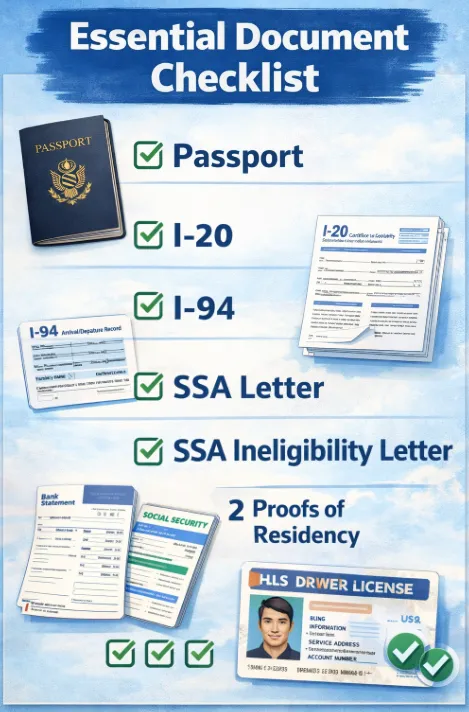
The DMV is notorious for strict document requirements. Even a minor typo can lead to rejection. Collect the "Big Five" original documents:
-
Identity: Valid Passport with your F1 Visa stamp.
-
Status: Your most recent Form I-20. Ensure it is signed by both you and your DSO (the travel signature should be current).
-
Arrival Record: A printed copy of your I-94 (fetch it from
cbp.gov/i94). -
SSN Evidence: Your SSN card OR the SSA Ineligibility Letter.
-
Proof of Residency (The "Residency Requirement"): Most states require two different documents showing your name and local address.
Step 4: Knowledge Test (Written Exam)
This is your first official hurdle at the DMV. You must prove you know the rules of the road.
-
The Experience: Usually taken on a touch-screen computer at the DMV office. It covers traffic signs, signals, and state-specific laws (e.g., blood alcohol limits).
-
Preparation: Do not wing it. Download the Official DMV Driver’s Manual PDF from your state's website. Use free apps like "DMV Genie" to take practice quizzes until you consistently score above 90%.
Step 5: Road Test (Behind-the-Wheel)
Once you pass the written test, you get a "Learner's Permit" which allows you to practice driving if a licensed driver (21+) is in the passenger seat.
-
The Exam: The examiner will sit in the passenger seat. They will check your ability to:
-
Perform a 3-point turn.
-
Parallel park.
-
Merge into traffic.
-
Observe speed limits (School Zones are a common "auto-fail" trap).
-
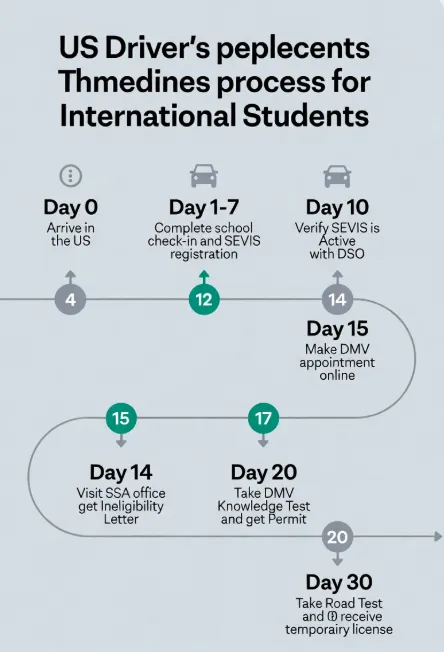
Recommended Timeline for New Arrivals
-
Day 0: Arrive in the US.
-
Day 1-7: Complete school check-in and SEVIS registration.
-
Day 10: Verify SEVIS is "Active" with your DSO.
-
Day 14: Visit SSA office to get the Ineligibility Letter.
-
Day 15: Make a DMV appointment online.
-
Day 20: Take the DMV Knowledge Test & get a Permit.
-
Day 30: Take the Road Test & receive your temporary license.
Required Documents for International Students at the DMV
To avoid multiple trips to the DMV, you must ensure every document is valid, original, and meets state-specific criteria. Use the guide below to prepare your folder.
1. Proof of Identity & Legal Status (Federal Requirements)
-
Passport & F-1 Visa: * Validity: Must be unexpired. If your Visa stamp has expired but you have an active I-20 and I-94, you are still "in status," but the Passport itself must be valid for at least 6 months beyond your application date.
-
Form I-20: * Validity: Must be the original "Continued Attendance" or "Initial" I-20.
-
The Trap: Ensure the Travel Signature on page 2 is less than 12 months old (some DMVs are strict about this even if you aren't traveling). The "Program End Date" determines your license expiration.
-
-
I-94 (Arrival/Departure Record): * Validity: Must be the most recent record printed from the CBP website.
-
The Trap: Check that it says "Class of Admission: F1" and "Admit Until Date: D/S". If it shows a specific date instead of D/S, visit an International Student Advisor immediately.
-
2. Proof of Social Security Status
-
Option A: SSN Card: Must be the original card (no copies).
-
Option B: SSA Ineligibility Letter (Form SSA-L676):
-
Validity: Highly time-sensitive. Most DMVs require this letter to be issued within the last 30 to 60 days.
-
The Trap: If you obtained this letter months ago and waited to go to the DMV, it will likely be rejected. You will need to visit the SSA office again for a fresh one.
-
3. Proof of State Residency (The "Residency Requirement")
Most states require two different documents. They must show your full name and your current physical address (no P.O. Boxes).
-
What counts as valid residency proof?
-
Lease/Rental Agreement: Signed by both the landlord and you.
-
Utility Bills: Electricity, Water, or Gas bills (usually issued within the last 60 days). Cell phone bills are often NOT accepted.
-
Bank Statements: Mailed to your address (digital printouts are usually fine if they include the bank's logo and your address).
-
Insurance Policy: Auto or Renter's insurance documents.
-
The "Student Shortcut" - Registrar's Verification Letter: If you live on campus and don't have a lease or utility bills, you can request an Official Verification of Enrollment/Residency from your school's Registrar's Office.
-
Pro Tip: This letter must be on official university letterhead, signed, and include your current dormitory address. It is the most reliable "Plan B" for new students.
-
-
-
The Trap: If your name is not on the lease (e.g., you are subletting), you may need a notarized "Affidavit of Residency" from your roommate or landlord.
4. Pro-Tips for "Document De-Risking"
-
Name Consistency: Your name must be identical on all documents. If your Passport says "John Doe Smith" but your bank statement says "John Smith," the DMV may reject you.
-
The "SAVE" Check: Before your appointment, ensure your school has registered you in SEVIS. If the DMV clerk says they need to "send your documents for secondary verification," it usually means your SAVE record isn't updated yet—this can delay your license by 20–40 days.
-
No Photocopies: The DMV will not accept scanned or photographed versions of your I-20 or Passport. Everything must be the "Wet Signature" original.
State-by-State DMV Requirements (No SSN)
While federal law allows international students to apply without an SSN, specific DMV procedures and wait times vary significantly across the country. Below is a breakdown of how the most popular student destinations handle non-SSN applications.
|
State |
Can Apply Without SSN |
Accepts SSA Letter |
License Validity |
Difficulty / Notes |
|---|---|---|---|---|
|
California (CA) |
✅ |
✅ |
Tied to I-20 |
Medium. Appointments are hard to get; book 1 month ahead. |
|
New York (NY) |
✅ |
✅ |
Tied to I-20 |
High. Must attend a 5-hour Pre-licensing Course; strict road test. |
|
Texas (TX) |
✅ |
✅ |
Tied to I-20 |
Low. Clear process; many third-party test locations available. |
|
Florida (FL) |
✅ |
✅ |
Tied to I-20 |
Low. DMV is friendly; some areas offer the written test in Chinese. |
|
Illinois (IL) |
✅ |
✅ |
Tied to I-20 |
Medium. Can use TVDL or standard path; Chicago wait times are long. |
|
Washington (WA) |
✅ |
✅ |
Tied to I-20 |
Medium. Lower written pass rate; road test is very detail-oriented. |
|
Massachusetts (MA) |
✅ |
✅ |
Tied to I-20 |
Very High. Strict document review; car needs a center handbrake. |
|
Pennsylvania (PA) |
✅ |
✅ |
Tied to I-20 |
Medium. Includes mandatory parallel parking in the road test. |
|
Arizona (AZ) |
✅ |
✅ |
Tied to I-20 |
Low. Fast process and beginner-friendly roads. |
|
Georgia (GA) |
✅ |
✅ |
Tied to I-20 |
Medium. Strict proof-of-address; Atlanta test slots are tight. |
Note: Most states allow no SSN if SSA Ineligibility Letter is submitted. REAL ID may have stricter SSN verification than standard license.
Can You Convert a Foreign Driver License to a US License?
While many students hope to skip the testing process, "License Conversion" (Reciprocity) depends entirely on which country issued your license and which US state you are in.
1. Full vs. Partial Conversion
-
Full Conversion (No Tests): Very few countries have full reciprocity with the US. This usually applies to Canada, Germany, France, South Korea, and Taiwan (depending on the state). In these cases, you simply surrender your old license and pay a fee.
-
Partial Conversion (Written Test only): Some states allow you to skip the Road Test if you have a valid foreign license but still require you to pass the Knowledge/Written exam.
-
Full Test Required: The vast majority of international students will be required to take both the Written and Road tests.
2. How to Convert: The Step-by-Step Process
If you are from a reciprocating country or region (e.g., Taiwan, South Korea, or Germany), follow these steps to bypass the road test:
-
Verification of Foreign License: Visit your home country's consulate in the US to obtain a "Certificate of Authentication" for your license.
-
Translation: If your license is not in English, get a certified translation from an approved agency.
-
The DMV Interview: Bring your original license, the consulate certificate, and all F1-related documents (I-20, I-94).
-
Surrender & Swap: In states like Massachusetts or Washington, you must physically surrender your foreign license to receive the US version. You will not get your old license back.
3. Examples: Chinese, Indian, and International Licenses
-
Chinese Licenses: There is no reciprocity between mainland China and US states. You must take the full test. However, a valid Chinese license may allow you to skip the "Learner's Permit" waiting period in states like California.
-
Indian Licenses: Most states do not allow a direct swap for Indian licenses. You must undergo the full testing process.
-
Other Licenses: If your license is from a non-English speaking country, you must provide a certified English translation or a "Translation of Foreign Driver License" form.
4. Limitations and Eligibility Conditions
-
You must have at least 6 months of legal stay remaining on your I-20/Visa to be eligible for a conversion application in most states.
-
Surrendering your original license is often required for a direct swap; ensure you are comfortable losing your physical home-country card before proceeding.
Is an International Driving Permit (IDP) Valid in the US?
An International Driving Permit (IDP) is often misunderstood. It is not a license, but a translation document that must be accompanied by your original valid foreign license.
1. IDP Basics and Limitations
-
Short-term Use Only: Most states allow you to drive with a foreign license + IDP for a limited time (ranging from 30 days to 1 year). However, once you become a "Resident" (e.g., staying for a semester of school), state laws usually require you to get a local US license within 10–30 days.
-
Not a Standalone ID: An IDP is worthless without your actual physical driver license from your home country.
2. Countries with Restricted IDP Access (e.g., China)
-
The Legal Hurdle: Some countries are not signatories to the 1949 Geneva Convention on Road Traffic.
-
Case Study: Mainland China: China does not issue a "true" IDP. Any website offering a "Chinese IDP" is selling a non-official translation. While some US car rental companies may accept these for vacationers, the police or DMV may not recognize them as legal driving authorization for residents.
-
Case Study: India: While India does issue official IDPs, they are only valid for 1 year and must be issued in India. You cannot renew an Indian IDP from within the US.
3. Short-term vs. Long-term Use
-
Short-term (Vacation/First 30 Days): Driving on your home license + an official translation (like an IDP) is generally okay for immediate needs.
-
Long-term (Student Life): As an F1 student, you are considered a "Resident" for DMV purposes. You should prioritize getting a US State License as soon as possible to avoid "Driving without a valid license" citations.
Renewing Your US Driver License During OPT/CPT or After Graduation
Your license expiration is strictly tied to your legal status in the SAVE database. Managing renewals requires careful timing.
1. License Validity Tied to I-20 / EAD
-
Your initial license will typically expire on the "Program End Date" listed on your I-20.
-
If you graduate and move to OPT, your license must be renewed using your Employment Authorization Document (EAD).
2. Renewal Rules During OPT and STEM Extensions
-
Initial OPT: You can renew your license once you receive your physical EAD card. The license will usually be valid for 1 year (matching the EAD).
-
STEM Extension: This is the most difficult period for renewals. Because there is often a gap between your initial OPT expiring and your STEM EAD arriving, you should bring your "I-797 Receipt Notice" (proving you applied for the extension) and your new STEM-endorsed I-20 to the DMV.
-
The 180-Day Rule: Most states recognize the automatic 180-day work authorization extension for STEM OPT, but DMV clerks may need to consult a supervisor to verify this via the SAVE system.
3. Impact of Not Having an SSN on Renewals
-
If you originally obtained your license without an SSN (using an Ineligibility Letter) and you now have a job, you must update the DMV with your new SSN.
-
If you still do not have an SSN, you must provide a new SSA Ineligibility Letter. Most DMVs will not accept the old letter from 4 years ago; it must be a "fresh" one issued within the last 30–60 days.
10 Common Reasons for Rejection at the DMV
-
SEVIS Record Not Active: Applying before your school DSO has officially "registered" you in the federal system.
-
I-94 Mismatch: Your arrival record contains typos or incorrectly listed "Admit Until" dates (should be D/S).
-
Expired SSA Letter: Bringing an Ineligibility Letter that is older than 30 or 60 days (state rules vary).
-
Insufficient Proof of Residency: Providing cell phone bills or generic mail instead of accepted utility bills, lease agreements, or bank statements.
-
Name Discrepancy: Your name is spelled differently across your Passport, I-20, and bank statements.
-
Program End Date Too Close: Attempting to apply when your I-20 has less than 3–6 months of validity remaining.
-
SAVE System Delay: Your data hasn't synced between DHS and the DMV, leading to a "Pending" status that requires manual review.
-
Invalid Vehicle for Road Test: Bringing a car with expired registration, no insurance, or safety issues (e.g., broken brake lights).
-
Lack of Original Documents: Bringing high-quality photocopies instead of the physical "wet signature" originals.
-
Early Application: Applying within the first 10 days of entering the US, before the border records have fully processed through the SAVE database.
Frequently Asked Questions (FAQ)
Q: Can I apply for a REAL ID without a Social Security Number?
A: Yes, in most states. You must provide the official SSA Ineligibility Letter (Form SSA-L676) along with all other required identity and residency documents to prove your legal presence and home address.
Q: Can F2 or J1 students apply for a driver's license?
A: Yes. F2 (dependents) and J1 (scholars) follow a similar process to F1 students. Dependents must also bring the primary holder's (F1/J1) documents, such as their I-20 or DS-2019, to establish their legal basis for being in the U.S.
Q: How soon after arriving in the U.S. can I visit the DMV?
A: It is recommended to wait at least 10–14 days. This allows time for your border entry records (I-94) to sync with the federal verification system (SAVE) and for your school to activate your SEVIS record.
Q: Can I take the DMV written or road test in my native language?
A: Many states (like California, New York, and Florida) offer the written knowledge test in various languages, including Chinese, Spanish, and Korean. However, the road test is typically conducted in English to ensure you can understand police instructions and road signs.
Q: How long can I drive with my foreign license before I MUST get a U.S. license?
A: This varies by state. While some states allow up to a year for tourists, most states require "residents" (including students staying for a full semester) to obtain a local license within 10 to 30 days of establishing residency.
Q: Do I need to provide my own car for the road test?
A: Yes. The DMV does not provide vehicles. You must bring a car that is properly registered and insured. Many students borrow a friend's car or use a vehicle from a local driving school.
Q: What happens to my license if I transfer to a new school?
A: Your license remains valid as long as your SEVIS record remains active and you are within your legal stay. However, if you move to a different state, you are legally required to transfer your license to that new state within 30 days.
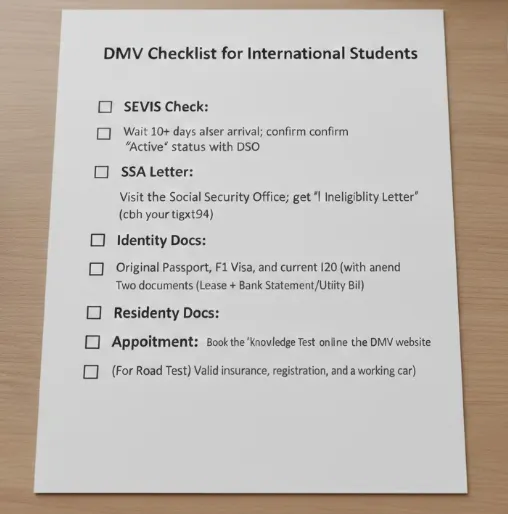
One-Page Checklist for International Students
Before you go to the DMV, check these off:
Disclaimer: DMV rules change frequently. Always check your local state DMV website for the most current requirements.
US Driver’s License Test Guide 2026: Written Test, Road Test & DMV Tips