Getting your US driver's license in 2026? Read our ultimate guide to passing the DMV written exam and road test, including document checklists and top tips.
📌 5 Steps to Get Your US Driver's License in 2026
-
Gather Your Documents: Prepare your Proof of Identity, SSN, and two proofs of state residency (check REAL ID requirements).
-
Pass the Written Knowledge Test: Study your state's DMV handbook and pass the multiple-choice exam to get your Learner's Permit.
-
Complete Practice Hours: Practice driving with a licensed adult. (Minors usually require logging 50+ hours of supervised driving).
-
Schedule the Road Test: Book your behind-the-wheel exam at your local DMV.
-
Pass the Road Test: Demonstrate safe vehicle control, yielding, and parking maneuvers to the examiner to earn your license.
What Is the DMV — and Why Does the Process Feel So Complicated?
The DMV, or Department of Motor Vehicles, is the government agency responsible for driver’s licenses, learner’s permits, driving tests, and vehicle registration in the United States. In simple terms, if it involves driving legally, the DMV is in charge. Driver’s license tests are not managed at the federal level. Instead, they are handled by each state’s DMV (or an equivalent agency). This means every state sets its own rules, testing procedures, and requirements for getting a driver’s license.
That said, the overall structure of the process is very similar across states. Almost everywhere, you’ll need to apply through the DMV, pass a written test to get a learner’s permit, practice driving, and then pass a road test. The core traffic rules and road signs are also largely the same nationwide.
So while this guide can’t replace your specific state’s DMV handbook, understanding the process explained here will give you a strong foundation—no matter which state you’re in. Once you know the logic behind the system, adjusting to state-specific details becomes much easier.
The driver's license test process is basically as follows. We'll break it down step by step, so relax, let's go!


First Things First — What License Do You Actually Need?
1. Understanding License Classes
Before you apply, you need to know which category you fall into. U.S. licenses are categorized by "Classes" based on the type of vehicle and its weight.
|
License Class |
Vehicle Type & Description |
Who Needs It? |
|---|---|---|
|
Class A (CDL) |
Commercial Heavy Combination: Tractor-trailers (big rigs) over 26,001 lbs. |
Professional long-haul truckers. |
|
Class B (CDL) |
Commercial Large Single: City buses, school buses, or dump trucks. |
Bus drivers and heavy equipment operators. |
|
Class M |
Motorcycles and motor-driven cycles. |
Anyone riding a 2 or 3-wheel motorized vehicle. |
|
Class C |
Standard Operator: Passenger cars, SUVs, minivans, and small trucks. |
Most drivers (The focus of this guide). |
Note: In some states (like New York or New Jersey), the standard driver's license is referred to as Class D. However, the testing requirements and vehicle types are virtually identical to Class C. If you are looking to drive a personal car for daily life, Class C/D is what you need.
2. What Are Endorsements?
While the "Class" defines the vehicle size, an Endorsement is a specific authorization added to your license that allows you to operate certain types of vehicles or carry specific items. Think of them as "add-ons" to your basic license.
Common Endorsements:
-
-
P (Passenger): To drive vehicles carrying a specific number of passengers.
-
S (School Bus): Required for school bus drivers.
-
T (Double/Triple Trailers): For hauling multiple trailers.
-
N (Tank Vehicle): For transporting liquids in bulk.
-
H (Hazardous Materials): For carrying "HazMat" (dangerous goods).
-
Do You Need One? For 99% of readers, the answer is No. If you are just driving yourself, your family, or commuting to work, your standard Class C license is all you need. Endorsements are typically for professional or commercial drivers.
3. REAL ID: The 2026 "Hard Deadline"
REAL ID is essentially an upgraded version of a state-issued driver’s license or ID, designed to meet higher federal security standards. You can recognize it by the gold star in the top corner of the card. Starting May 7, 2025—and fully enforced in 2026—the U.S. federal government will require a REAL ID–compliant license (or a passport) for domestic air travel and access to certain federal facilities.
What does this mean in real life? If your driver’s license doesn’t have that gold star, you’ll need to carry your passport just to take a domestic flight—from Los Angeles to Las Vegas, for example. If you’re already applying for a driver’s license, getting a REAL ID at the same time can save you an extra DMV visit later. It’s not mandatory for driving, but it’s becoming increasingly practical to have.
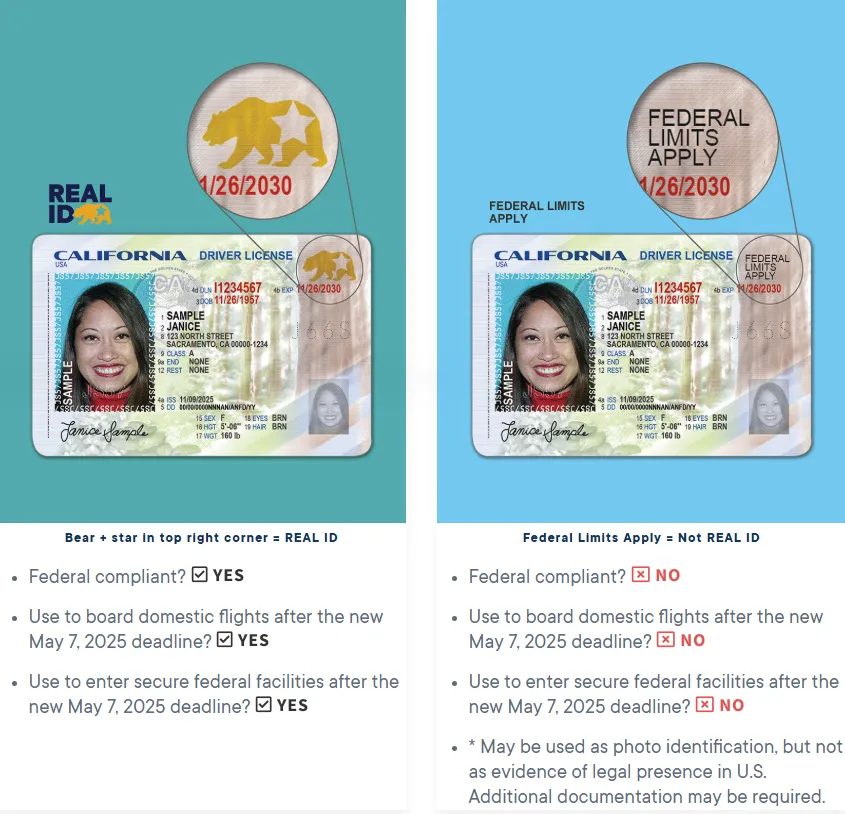
Application Strategy: If you are a non-citizen (H1B, F1, J1), the REAL ID process is stricter. You must bring original, unexpired immigration documents (I-20, EAD card, or I-94). No photocopies allowed!
Getting Ready — Before You Step Into the DMV
4. Basic Eligibility & Initial Steps
Before gathering documents, ensure you meet the foundational requirements:
-
Age: Minimum age for a permit varies (usually 15-16, depends on state DMV), but you must be 18+ for a standard adult license without parental consent.
-
Vision: You must pass a basic vision screening (typically 20/40 vision in at least one eye, with or without corrective lenses).
-
Legal Presence: You must be a U.S. Citizen, Permanent Resident, or hold a valid non-immigrant status (F1, H1B, etc.).
-
Physical/Mental Health: You must disclose any conditions (like epilepsy or vision impairment) that might affect driving safety.
5. The "Identity Stack" (The Document Trap)
DMV clerks are trained to reject you if your paperwork is 99% perfect. It needs to be 100%. The requirements differ significantly depending on your citizenship status:
A. For U.S. Citizens
|
Document Category |
Required Items |
|---|---|
|
Proof of Identity |
A valid U.S. Passport or an original Birth Certificate. |
|
Proof of SSN |
Physical Social Security Card or a W-2 form showing your full SSN. |
|
Proof of Residency |
Two documents (e.g., mortgage statement, lease, or utility bill < 90 days old). |
B. For Non-U.S. Citizens (Expats, Students, H1B)
For non-citizens, your documents must be original and unexpired. You generally need to fulfill these three pillars:
1. Identity & Proof of Legal Presence (Must bring ALL that apply):
-
International Students (F-1/J-1): Valid Passport + Visa + Signed I-20 (F-1) or DS-2019 (J-1) + I-94 Form (printed from the CBP website).
-
OPT/EAD Holders: Valid Passport + Visa + EAD Card (Employment Authorization Document) + I-20 with OPT endorsement + I-94 Form.
-
Work Visa Holders (H-1B/L-1/O-1): Valid Passport + Visa + I-797 (Notice of Action/Approval Notice) + I-94 Form.
-
Permanent Residents (Green Card): Valid Passport + I-551 Card (Permanent Resident Card).
-
Other Legal Status: Any I-797 or official USCIS document proving current legal stay.
2. Social Security Number (SSN) or Denial Letter:
-
If you have an SSN: Bring the physical SSN Card (or a W-2/Paystub showing the full number in some states).
-
If you are ineligible for an SSN: You must visit an SSA (Social Security Administration) office first to request an SSA-L676 "Social Security Ineligibility Letter" (also known as a Denial Letter). The DMV requires this as a substitute.
3. Proof of Residency (x2 Documents):
-
Requirement: Most states require two documents showing your name and current residential address in that state.
-
Accepted Documents: Lease/Rental agreement, Bank statements, Utility bills (Electric, Gas, Water), Internet/Cell phone bills, or official letters from your University/Employer.
6. DMV Application & Appointments
When it comes to the DMV application process, one important thing to know is that each state runs its own DMV system, so forms, appointment rules, and fees may vary slightly. In 2026, most DMVs require an Online Appointment.
The easiest way to find the right page is simply to search:“[Your State] DMV written driver test appointment.”
As for fees, expect to pay anywhere from $30 to $100, depending on the state and the type of license you’re applying for. Payment is typically made online during the application process or at the DMV on test day.
State DMV Quick Links
|
State |
Official DMV Website / Appointment Portal |
|---|---|
|
California |
|
|
New York |
|
|
Texas |
|
|
Florida |
|
|
Washington |
Tips to avoid delays:
Before you even think about going to the DMV, make sure your Social Security situation is resolved. Either having an SSN or an official SSN denial letter is often a required first step—without it, the DMV will not process your application. Also, prepare copies of all your documents, just in case the DMV wants to keep one on file.
If you’re on an F-1 or J-1 visa, double-check that your I-20 or DS-2019 is valid, and give the system some time to update after you enter the U.S. In many cases, it’s best to wait 10–14 days after arrival so the DMV can successfully verify your immigration status.
The Written Test — Mastery Over Memorization
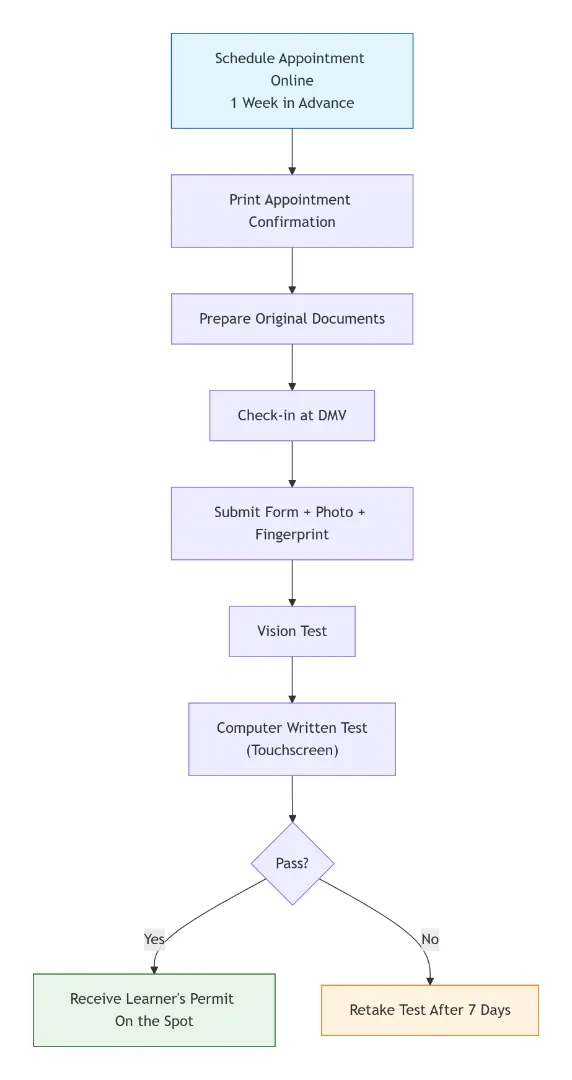
7. The Pre-Exam Checklist
Before you head out to the DMV for your written test, make sure you can check off every item on this list. Forgetting just one could mean a wasted day:
[ ] Appointment Confirmation: A printed or digital copy of your appointment (some DMVs don't allow walk-ins in 2026).
[ ] The "Identity Stack": Every single original document listed in Part II of this guide.
[ ] Vision Readiness: If you wear glasses or contact lenses, bring them. You will be given a vision test on the spot.
[ ] Application Fee: Check if your DMV accepts credit cards or if they are "Cash/Check Only" (this varies by county).
[ ] Testing App: Have your practice app open for a final 10-minute "cram session" while you wait in line.
8. The Written Test Content & Study Strategies
To get your permit, you must pass the Knowledge Test.
The written test is taken on a computer at the DMV and uses a multiple-choice format. Most states require a passing score of around 80%. You’ll also need to pass a basic vision test, with or without glasses or contacts.
Exam preparation materials:
- States Driver's Handbook (download at state dmv official website of your location) . Example:
 [[copyright:dmv.ca.gov] DMV usually provides handbook in various languages.
 - Recommended practice materials: We recommend using official practice questions from each state or third-party mock exam apps/websites (such as DMV Genie, Driving-Tests.org, etc.) for repeated practice.
Key Content Areas
-
Traffic Laws: Right-of-way, speed limits, and DUI laws.
-
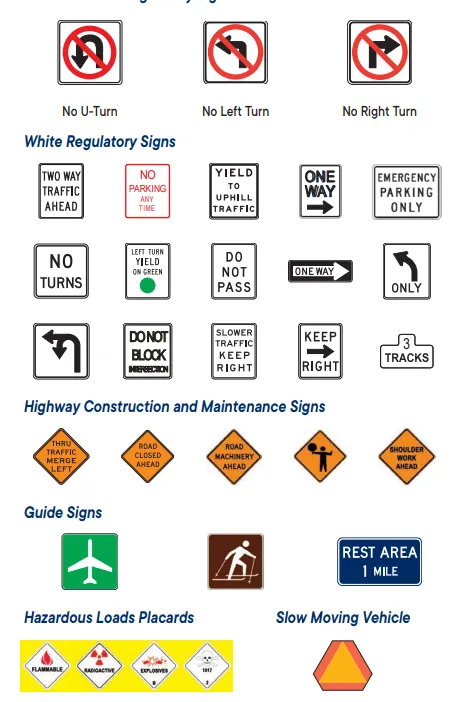
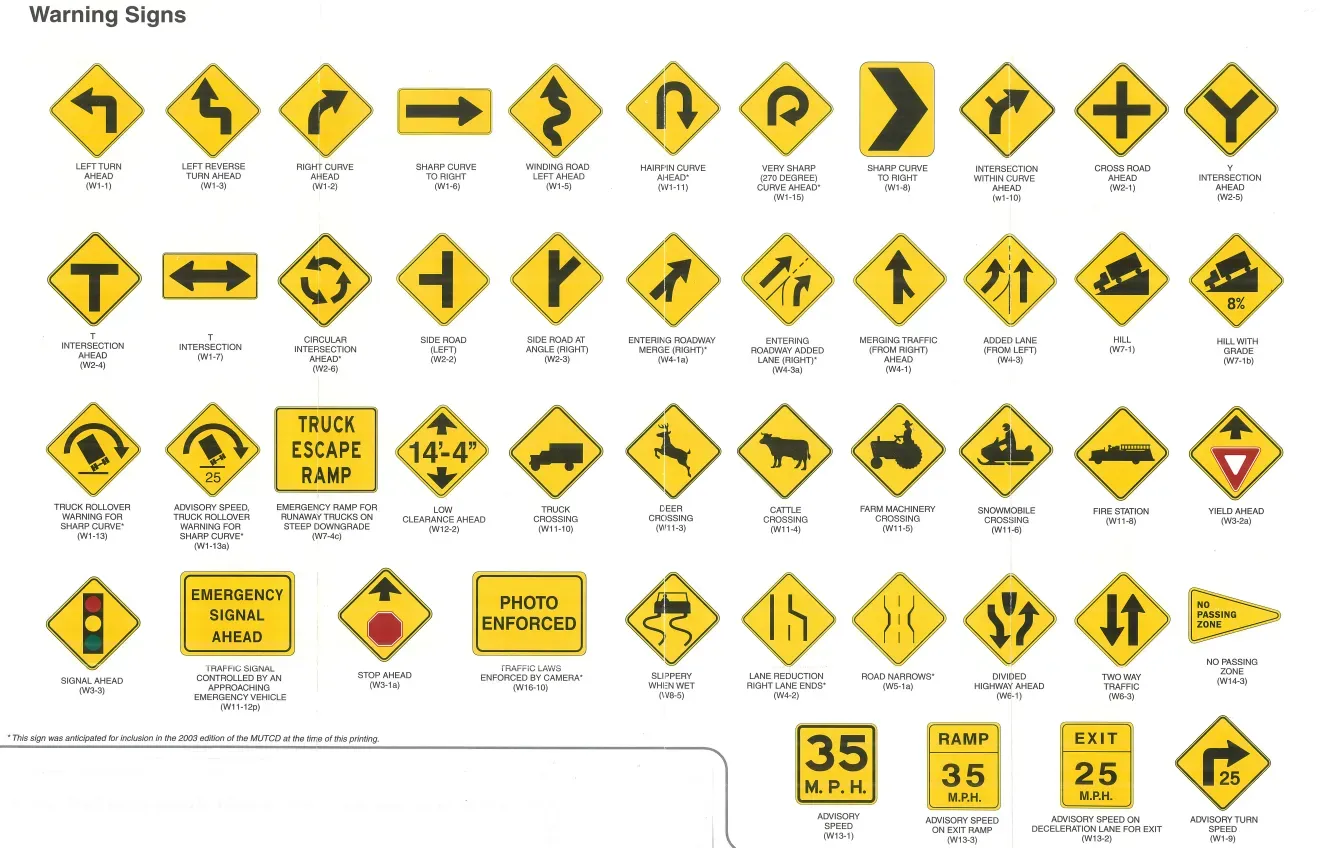
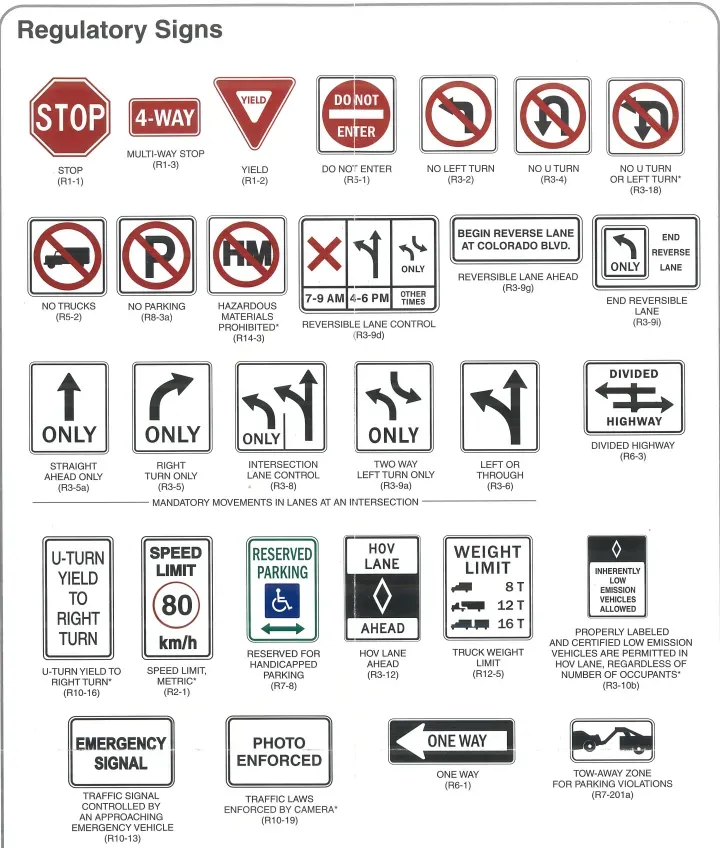
Road Signs: Identifying shapes and colors (e.g., Octagon = Stop, Yellow Diamond = Warning).
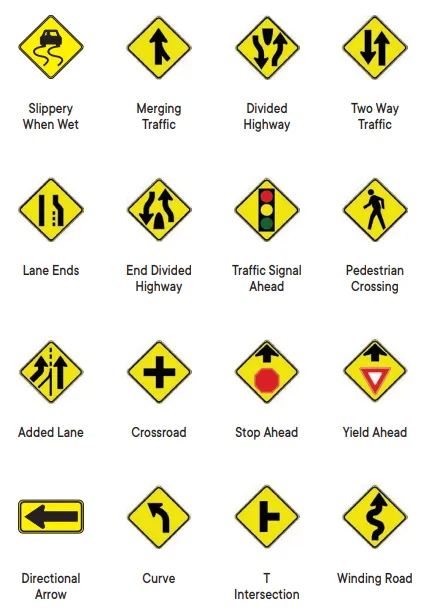
 [[copyright:dmv.ca.gov]
 -
Safe Driving Practices: Handling weather conditions, sharing the road with bicyclists, and emergency maneuvers.
The "Numbers Game" (High-Frequency)
The English test loves specific metrics. Memorize these:
-
DUI/BAC: 0.08% for adults, 0.01% for minors.
-
Signaling: 100 feet before the turn.
-
Parking: Within 18 inches of the curb; 15 feet from a fire hydrant; 20 feet from a crosswalk.
-
Speed Limits: 25 mph in residential/school zones; 55-65 mph on highways (unless posted).
Critical Vocabulary & Sign Logic
-
Yield vs. Stop: Yield means "slow down and be ready to stop," while Stop means a "Complete Cessation of Movement."
-
The Right-of-Way Logic:
-
Pedestrians always win.
-
The vehicle that arrives first at a 4-way stop goes first.
-
If two arrive at the same time, the one on the RIGHT goes first.
-
Diamond-Shaped Signs: Always mean Warning/Hazard.
-
9. Success! Obtaining Your Learner’s Permit
The moment you pass your Written (Knowledge) Test, the DMV officer will issue you a Learner’s Permit (Instruction Permit).
-
Format: You will usually receive a temporary paper copy on the spot, with the official plastic card arriving by mail in 2–4 weeks.
-
Purpose: This is your "Legal Pass" to start practicing on public roads. However, you cannot drive alone. You must be accompanied by a licensed driver sitting in the front passenger seat.
10. Next Steps: Practicing with Your Permit
The rules for practicing driving vary significantly based on your age. Identify your category below to understand your path to the Road Test:
A. Applicants 18 Years and Older (Adults)
For adults, the process is much more flexible:
-
No Waiting Period: Technically, you can schedule your road test as soon as you feel ready (or as soon as an appointment is available).
-
Practice Requirements: You are not legally required to log a specific number of hours or take professional lessons (though it is highly recommended to avoid failing).
-
Supervisor Rule: You must practice with a licensed driver who is at least 21 years old (age requirements vary by state, e.g., 25+ in CA).
B. Applicants Under 18 Years Old (Minors)
Minors follow a Graduated Licensing Program (GDL) designed for safety:
-
6-Month Waiting Period: You must hold your Learner’s Permit for at least 6 months before you can even take the road test.
-
Driver’s Ed: You must complete a state-approved Driver Education course (classroom) and often behind-the-wheel training with a professional instructor. (May various for states)
-
The Logbook: You must log 40–60 hours of supervised driving, including at least 10 hours at night. Depending on the state, this person must be at least 18 or 21 years old and hold a valid, full driver’s license. The supervising driver can be a parent, a friend, or a professional instructor. If your budget allows, working with a driving school instructor is highly recommended. Instructors are familiar with local test routes and common exam patterns, which can significantly improve your chances of passing the road test.
-
The Driving Log Requirement: Most states require you to track your practice sessions in a Driving Log/Log Sheet. You may need to present this completed and signed document to the DMV examiner on the day of your Road Test. Without this proof of practice, you may be disqualified from testing. Down Supervised Driving Log (PDF) or Behind-the-Wheel Practice Log at State DMV Website.
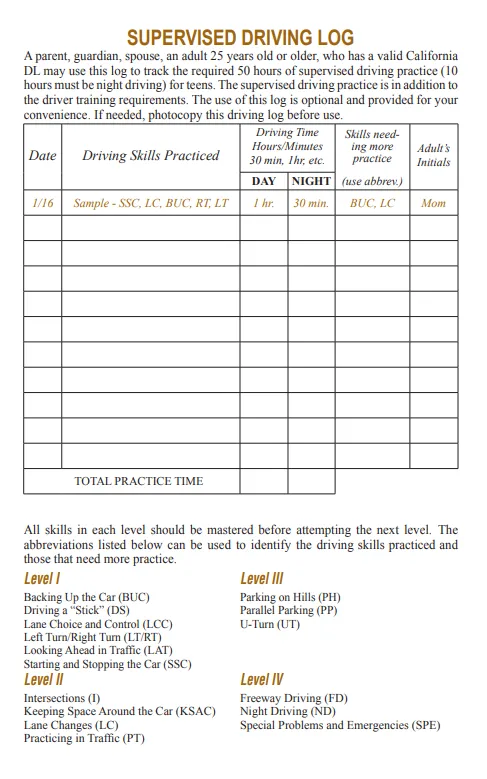 Image from dmv.ca.gov, Copyright by original author
C. Universal Practice Restrictions (For Everyone)
Regardless of age, while driving with a permit:
-
Supervisor Seating: Your supervisor must sit in the front passenger seat next to you.
-
Zero Tolerance: You must have a 0.00% Blood Alcohol Content.
-
Device Ban: Hands-on cell phone use is strictly prohibited.
-
Passenger Rules: Some states limit the number of non-family passengers you can carry.
Requirements may vary slightly by state. Always check your state DMV website for the most up-to-date rules.
Pre-Test Final Audit (The Document & Vehicle Checklist)
Before you even start the engine, the DMV clerk will conduct a "Dead-End Audit." If you fail this, your test is cancelled immediately.
11. The Road Test Preparation Timeline
Success on the road test is about planning. Use this countdown to ensure you are ready:
|
Timeframe |
Action Items |
|---|---|
|
1–2 Months Before |
• Book Your Appointment: Popular DMV locations book up fast; secure your slot online early.
• Vehicle Check: Ensure no cracked windshields, and that all lights and registration are valid. |
|
2–4 Weeks Before |
• Mock Practice: Practice maneuvers like parallel parking near the actual DMV area.
• Confirm Supervisor: Finalize the licensed driver who will accompany you on test day. |
|
1 Week Before |
• Documentation Audit: Print your confirmation and ensure your Permit is in your wallet.
• Finalize Logs (Minors): Complete supervised driving logs and get parent/guardian signatures. |
|
The Day Before |
• Car Preparation: Clean the interior and exterior; a clean car impresses examiners.
• Route Rehearsal: Drive around the DMV one last time to spot hidden signs or construction. |
|
Test Day |
• Arrival: Show up 15–30 minutes early to handle any unexpected DMV delays. |
12. The Vehicle, Paperwork & Hardware Audit
To ensure your test vehicle and documents are compliant, verify every item below:
A. Paperwork & Accompanying Driver
-
[ ] Valid Learner's Permit: Original copy only (no photocopies).
-
[ ] Vehicle Registration: Original and current.
-
[ ] Proof of Insurance: Physical card or official app. Crucial: The VIN on the card must match the vehicle exactly.
-
[ ] Accompanying Driver: Must have their valid physical driver's license ready.
-
[ ] Appointment Confirmation: Digital or printed.
-
[ ] Rental Car Warning: Most DMVs DO NOT allow rental cars unless you have specific, high-level insurance documentation (very rare at standard counters).
B. Vehicle Hardware Check
-
[ ] Brake Lights: All three (Left, Right, and Center/Top) must function.
-
[ ] Turn Signals: Front and rear signals must work on both sides.
-
[ ] Horn: Must be clearly audible.
-
[ ] Tires: Must have adequate tread (no "bald" or excessively worn tires).
-
[ ] Windshield: No cracks in the driver's direct line of sight.
-
[ ] Windows: Front driver and passenger windows must be able to roll down.
-
[ ] Tinting: Must comply with state laws (no heavy tint on front side windows).
-
[ ] Dashboard Lights: No "Check Engine," "Airbag," or "Brake" warning lights should be on.
C. Critical State-Specific Traps
-
Emergency Brake Access: In many states (like NJ), the examiner must have access to a center-console handbrake. If your car only has a foot-operated brake on the left side, the vehicle may be rejected.
-
Rear-View Camera: You are permitted to use it, but you cannot rely on it solely. If you do not physically turn your head to check your surroundings, you will fail.
The Road Test — The 15-Minute Performance
13. The Critical Testing Pillars
To pass the actual driving portion, you must master the scoring system and the performance flow.
A. Exam Procedure
Knowing what to expect reduces anxiety. The 2026 standardized flow usually follows this sequence:
-
The Greeting: The examiner meets you and checks your paperwork.
-
Pre-Drive Hardware Check: You demonstrate vehicle controls (Signals, Horn, Defrosters).
-
The Driving Loop: A 15–20 minute drive through residential and business districts.
-
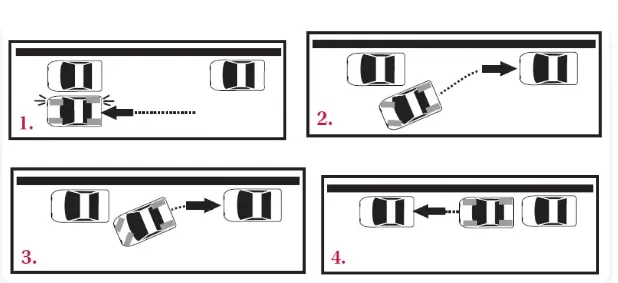
Maneuver Evaluation: Performance of specific tasks like parallel parking or reversing in a straight line.
-
The De-brief: The examiner scores your sheet and informs you of the result.
B. The Scoring System & Common Point Deductions
Most states use a point-deduction system. You usually start with a "perfect" score and lose points for minor errors. Typically, you fail if you lose more than 15 to 30 points (varies by state).
-
-2 to -5 Points: Minor technical errors (e.g., stopping slightly over the limit line, one-handed steering, or slow acceleration).
-
-5 to -10 Points: Observation errors (e.g., mirror check only, no head swivel).
-
Common Trap: Failing to look over your RIGHT shoulder while reversing in a straight line is the #1 point-drainer for new drivers.
C. The "Exaggerated Check" (Observation Skills)
This is where most experienced drivers fail. You must prove you are observing your surroundings:
-
The Head Swivel: Do not just move your eyes; physically move your head when checking mirrors so the examiner sees the effort.
-
The Shoulder Check: When changing lanes or pulling out, you must turn your head to check the Blind Spot. A quick glance at the mirror is an automatic point deduction.
D. Automatic Critical Failures
Avoid these "Instant Fails" at all costs (One mistake here equals an immediate fail):
-
Mounting the Curb: Even a slight touch of the tire to the curb during parallel parking.
-
Intervention: If the examiner has to touch the steering wheel or the passenger-side brake.
-
Pedestrian Safety: Failing to yield to a pedestrian who is near a crosswalk.
-
Speeding: Going even 1 mph over the limit, especially in School or Construction zones.
-
Disobeying Signs: Running a red light or performing a "Rolling Stop" (not coming to a 0 mph dead halt).
⚠️ Instant Fail: Avoid These Automatic Driving Test Fails Even if you drive perfectly for the rest of the exam, making one of these critical errors will result in an automatic failure:
-
Running a Red Light or Stop Sign: You must come to a complete stop behind the white limit line. "Rolling stops" are an instant fail.
-
Dangerous Action Causing Intervention: If the examiner has to grab the steering wheel or use the dual-brake to prevent an accident.
-
Speeding: Going significantly over the posted speed limit (or driving too fast for active school zones).
-
Striking the Curb: Hitting the curb forcefully while parallel parking or pulling over.
14. The Soft Skills — Master the Examiner Interface
A. Professional Communication
The examiner is looking for confidence and safety.
-
The "Check-Back" Technique: When given a command, repeat it briefly.
-
Examiner: "Make a right at the next signal."
-
You: "Right turn at the signal, copy that."
-
-
Dealing with Ambiguity: If a command is unclear, always ask: "The first or second left, sir/ma'am?"
-
The "Self-Correction" Rule: If you make a minor mistake, state it calmly: "I realized I signaled a bit late there; I will ensure the next one is 100 feet ahead."
B. Projecting "Safe Driver" Vibes
Beyond steering, your body language sends signals:
-
The "Mirror Scan" Ritual: Every 5-10 seconds, visibly glance at your mirrors.
-
Two-Hand Control: Keep your hands at 9-and-3 or 10-and-2. No one-handed driving.
-
Predictable Braking: Avoid "jerky" stops. Begin braking early.
After the Test — Results & Licensing
15. Passing the Test: From Paper to Plastic
Congratulations! Once the examiner tells you that you’ve passed, the process isn't over yet. Here is what happens next:
-
The Temporary License: You will receive a Temporary Paper License on the spot. This is a legal document that allows you to drive legally while you wait for your official card.
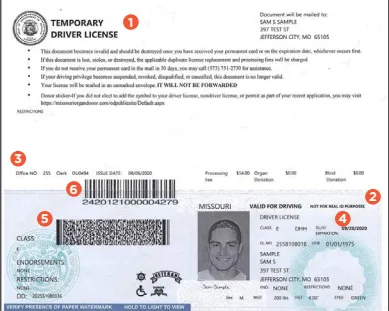 Image from dor.mo.gov, Copyright by original author
 -
Mailing Period: The DMV will mail your permanent plastic license to your registered address. This usually takes 2–4 weeks. Ensure your address on file is 100% accurate.
-
Full License Validity: A standard Full License is typically valid for 4–8 years, depending on state regulations and, for non-citizens, your visa expiration date.
-
Insurance Update: Immediate Action Required! Contact your insurance company to update your status from a "Permit" to a "Licensed Driver." This often helps you qualify for significantly lower insurance premiums.
16. Provisional License Restrictions (Under 18)
If you are under 18, you will receive a Provisional License. It will automatically upgrade to a Full License once you turn 18. Until then, you must follow these strict rules (usually for the first 12 months):
-
Nighttime Driving Restriction: You cannot drive between 11:00 PM and 5:00 AM unless accompanied by a licensed parent/guardian or for specific school/work reasons with documentation.
-
Passenger Restrictions: You cannot transport passengers under 20 years old (specifically those aged 16-17) unless they are immediate family members, or you have a licensed driver aged 25+ in the car.
-
Zero Tolerance: Any traffic violation or detectable alcohol while on a provisional license can lead to immediate suspension.
17. Critical Notes for Non-Citizens (International Students & Work Visas)
For F-1, J-1, H-1B, and other non-immigrant status holders, your license validity is often tied directly to your legal stay (the "Admit Until" date on your I-94 or I-20/DS-2019).
-
License Synchronization: Your driver’s license will typically expire on the same day as your current visa/status. If you extend your stay (e.g., through OPT or a visa renewal), you MUST visit the DMV to update your license immediately. Driving with an expired license—even if your visa is technically extended—is illegal and can lead to severe legal and immigration consequences.
-
Documents for Renewal/Update:
-
New I-20 or DS-2019: Showing the new program end date.
-
Updated I-94: Printed from the CBP website after your latest entry or status change.
-
EAD Card: If you are on OPT or STEM OPT.
-
I-797 Notice of Action: If you have a pending or approved H-1B/L-1 extension.
-
Proof of Residence: Some DMVs require you to bring two fresh utility bills or bank statements to confirm you still live in the state.
-
18. License Renewal & Replacement (What Happens Later)
Your license is a living document. You will need to interact with the DMV again for the following reasons:
-
Standard Renewal: Most states allow you to renew your license online every 4–8 years unless you have a major vision change or a non-immigrant status that requires in-person document verification.
-
How to Renew (Step-by-Step):
-
Online: This is the easiest method. Check your state's DMV website. You'll need your current license number, SSN, and a credit card. Note: Non-citizens or those with vision changes usually cannot renew online.
-
By Mail: If you receive a renewal notice in the mail, follow the instructions to send back the form and fee. This is common for those who don't need a new photo.
-
In-Person: Required if you need a new photo, if your legal status has changed, or if you are upgrading to a REAL ID. Pro-Tip: Make an appointment to avoid 4-hour wait times.
-
-
Address Change: If you move, you are legally required to notify the DMV within 10–30 days (varies by state). Failure to update your address can lead to fines and missing your renewal notice.
-
Replacement: If your license is lost, stolen, or damaged, you can usually order a "Duplicate License" online for a small fee (~$15–$30).
-
Vision Re-testing: Some states require a vision test at every renewal, while others only require it after a certain age (e.g., 65+ or 70+).
FAQ & Pro-Hacks for 2026
19. State-Specific "Quirks"
-
California (CA): Very strict on "Rolling Stops." You must count "One-Mississippi, Two-Mississippi, Three-Mississippi" at every stop sign.
-
New York (NY): The 5-hour Pre-Licensing Course is mandatory before you can even book a road test.
-
Texas (TX): Parallel parking is almost always on the test, often with poles.
20. FAQ
-
Q: Can I drive with an international driver's permit (IDP) indefinitely?
-
A: No. An IDP is a translation of your home license, not a U.S. license. Most states require you to get a local license within 30–90 days of establishing residency.
-
-
Q: How do I handle a DMV appointment cancellation?
-
A: Use the online portal immediately to reschedule. Pro-tip: Check the portal at 7:00 AM local time for "cancellation slots" that open up for the same day.
-
-
Q: What is the process for an out-of-state license transfer?
-
A: If you move states, you usually only need a vision test and the "Identity Stack" to swap your old license for a new one. No written or road test is required if your current license is valid.
-
-
Q: Can I use my own car for the road test?
-
A: Yes, but it must pass the safety audit in Part IV. If you don't have a car, you can use a driving school vehicle rental for the exam.
-
-
Q: What is the minimum age to get a learner’s permit in the U.S.?
-
A: The minimum age varies by state, but most states allow teens to apply for a learner’s permit between 15 and 16 years old. Check your state DMV website for exact requirements.
-
-
Q: How many supervised driving hours are required for teens?
-
A: Most states require 30–50 hours of supervised driving before taking the road test, including a minimum number of night driving hours. Always log your practice hours in a learner’s permit driving log.
-
-
Q: How do I schedule a road test appointment?
-
A: Visit your state DMV website, create an account, and book your behind-the-wheel road test. Early booking is recommended as slots can fill up quickly, especially in busy urban areas.
-
21. Helpful Resources for Passing Your Driving Test
A. US Road Symbol Signs
【DOT us_road_symbol_signs.pdf】
B. Official Resources: DMV Handbooks for Major States (2026 Edition)
When preparing for the Knowledge Test, reading the official handbook for your specific state is the most reliable way to ensure success. Here are the latest official download links for 2026:
Final Thought: The DMV road test is a performance. For 15 minutes, you are an actor playing the role of the "World's Safest Driver." Follow the script, move your head like an owl, and you'll walk out with your license.
Good luck—the road is yours! 🚗💨