Entering the United States is more than just a flight; it is a formal legal process managed by multiple government agencies. For international travelers, understanding the nuances of this process is the key to a stress-free arrival. This guide provides an exhaustive, step-by-step analysis of every stage of the journey, ensuring you are prepared for every possible scenario.
Part I. Who This Guide Is For (First-Time Travelers to the U.S.)
This handbook is meticulously crafted for first-time visitors who may be unfamiliar with the complex "hub-and-spoke" airport layouts and the rigorous nature of U.S. Customs, as well as non-immigrant visa holders such as those carrying B1/B2, f-1/M-1, or J-1 visas. It also serves as a vital resource for travelers facing language barriers by providing structured scripts and visual cues to navigate the entry process effectively. The primary objective of this guide is to move beyond basic travel tips to provide critical legal context regarding officer inquiries, ensure procedural precision from the moment you deplane, and ultimately reduce traveler anxiety through a clear understanding of the "why" and "how" behind each protocol. Please note that U.S. immigration laws and Department of Homeland Security (DHS) protocols are subject to frequent updates; therefore, this guide is for informational purposes and does not replace official government advice.
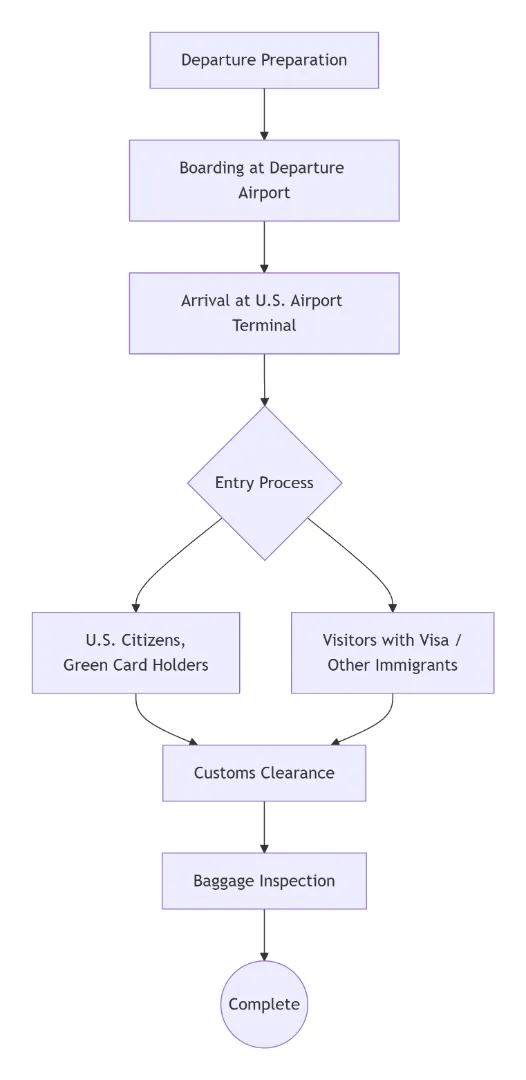
IMPORTANT DISCLAIMER: U.S. immigration laws and Department of Homeland Security (DHS) protocols are subject to frequent updates. This guide is for informational purposes only and does not replace official government advice from CBP or the U.S. Department of State.
Part II. Pre-Departure Preparation for Entering the U.S.
The journey to the United States begins long before you step onto the aircraft. Success at the Port of Entry is built on meticulous preparation, where the goal is to present yourself as a low-risk, well-documented traveler with a clear and legal intent. A single oversight—whether a missing document or a prohibited item in your suitcase—can lead to hours of administrative delays or, in extreme cases, the cancellation of your visa.
2.1 Pre-Flight Checklist for U.S. Entry
-
Passport Validity and Integrity: While many countries are part of the "6-Month Club," it is a universal gold standard to have at least six months of validity remaining from your date of entry. Furthermore, ensure the passport is in pristine physical condition; significant wear, water damage, or loose pages can be grounds for denying entry as the document may be deemed "tampered with."
-
U.S. Visa Verification: Carefully inspect your visa for any printing errors in your name or passport number. Pay close attention to the "annotations" section (e.g., F-1 visas often list the school name). If you have a new passport but your valid visa is in an expired one, you must carry both passports.
-
EVUS Enrollment (Mandatory): For PRC passport holders with 10-year B1/B2 visas, an active Electronic Visa Update System (EVUS) enrollment is a strict requirement. Check your status at least 72 hours before departure. If your status is not "Enrolled," you will be denied boarding at the airport. (How to Enroll? See 2.4 EVUS Enrollment Guide for First-Time Travelers)
-
Flight, and Itinerary Documentation: Always have a printed copy of your confirmed return or onward ticket. For B1/B2 travelers, the lack of a return flight is a major "red flag" for intending immigrants.
-
Digital Footprint Awareness: U.S. Customs and Border Protection (CBP) has the legal authority to search electronic devices. Ensure that your social media profiles, chat histories (e.g., WeChat, WhatsApp), and emails do not contain content that contradicts your visa status—such as mentions of working illegally, birth tourism plans (if not declared), or jokes about staying in the U.S. permanently.
CBP is the U.S. government agency responsible for immigration inspections and customs enforcement at airports, seaports, and land borders.
-
U.S. Residency and Contact Details: You must be able to provide the specific street address of your destination. For students, this is often the campus dormitory or an off-campus apartment. For tourists, have the hotel name and address ready. Memorize or write down a U.S. contact's name and phone number.
-
Medical and Financial Preparedness: Carry a mix of international credit cards and a reasonable amount of U.S. cash. If carrying prescription medication, keep them in their original pharmacy packaging with a translated doctor's note. Be aware that federal law governs the border; therefore, even if medical marijuana is legal in your destination state, bringing it across the border is a federal crime.
- Tip: If your parents don't speak English, you can write a customs memo and print out a medication declaration form, placing them together in a folder to use when going through customs upon arrival in the United States.
2.2 Baggage Rules and Prohibited Items When Entering the U.S.
The U.S. Department of Agriculture (USDA) and the Transportation Security Administration (TSA) maintain some of the strictest standards in the world. Ignorance of these rules is not considered a valid excuse by CBP officers.
USDA is the federal agency responsible for regulating agricultural products entering the United States, including food, meat, plants, seeds, and animal products.
TSA is responsible for airport security screening, including passenger and carry-on baggage checks.
2.2.1 Airline Baggage Allowances & Costs
Most trans-pacific/trans-atlantic flights allow one or two checked bags (usually 23kg/50lbs each) and one carry-on bag plus one personal item for economy class. Check your specific airline's policy as "Basic Economy" may not include checked bags.
Pre-purchase Savings Tip: If you plan to carry extra luggage, pre-purchase the allowance on the airline's official website. Buying extra bags online is significantly cheaper (often 30%–50% less) than paying "Excess Baggage Fees" at the airport check-in counter.
2.2.2 Carry-On Baggage Rules
-
Weight & Size: Most airlines limit carry-on weight to 7kg–10kg (15lbs–22lbs). Ensure it fits in the overhead bin.
-
Mandatory Carry-on Items:
-
Power Banks & Lithium Batteries: These are strictly prohibited in checked bags due to fire risks. They must be in your carry-on.
-
Valuables & Documents: Never pack your passport, I-20, or jewelry in checked luggage.
-
-
Prohibited Carry-on Items: Sharp objects (knives, scissors over 4 inches), tools, and weapons.
2.2.3 Checked Baggage Rules
-
Weight Limit: Standard limit is 23kg (50lbs). Overweight bags can trigger fees ranging from $100 to $200.
-
Prohibited Items: Flammable liquids, gas canisters, strike-anywhere matches, and loose lithium batteries. Lithium batteries are prohibited from being checked in as baggage (including power banks, laptops, camera batteries, iPads, and other electronic devices containing lithium batteries).
2.2.4 TSA Liquid Restrictions (The 3-1-1 Rule)
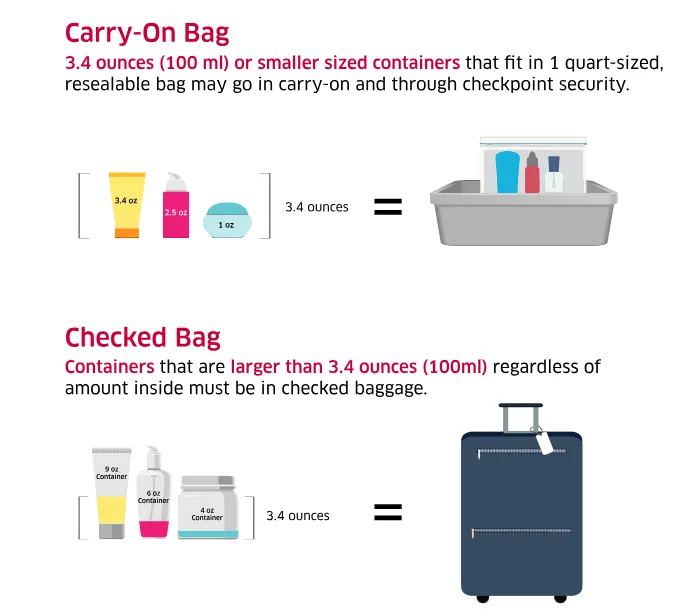
For carry-on bags only, all liquids, aerosols, and gels must follow these rules:
-
3: Containers must be 3.4 ounces (100ml) or less. (Even if the bottle is half-empty, the container itself cannot exceed 100ml).
-
1: All containers must fit in one (1) clear, quart-sized, zip-top bag.
-
1: Only one (1) bag per passenger.
-
Note: Duty-free liquids in secure, tamper-evident bags (STEBs) are usually allowed if purchased within 48 hours.
2.2.5 Quick Reference: Allowed vs. Prohibited Items
|
Category |
Allowed (Permitted) |
Prohibited (Forbidden) |
|---|---|---|
|
Food & Agriculture |
Factory-sealed candies, chocolate, roasted coffee, dried fruit, bread, canned fish. |
Fresh fruits/vegetables, Meats (fresh/dried/canned/jerky), Seeds, Plants, Soil. |
|
Medicine |
Pills in original packaging, Vitamins, Traditional medicine (processed/sealed). |
Raw herbs, unprocessed animal parts (antlers, bird's nests), illegal drugs. |
|
Electronics |
Laptops, Cameras, Power banks (Carry-on only). |
Power banks/Lithium batteries in Checked Bags. |
|
Cash |
Any amount (but must declare if > $10,000). |
Failing to declare currency over $10,000. |
|
Other |
Duty-free alcohol (1 liter), Tobacco (200 cigarettes). |
Counterfeit goods, switchblades, hazardous chemicals. |
IMPORTANT: Illegal drugs, as well as traditional Chinese medicines and proprietary Chinese medicines containing the following ingredients, are prohibited: Ephedrine-containing drugs: Compound Fritillary Cough Syrup, Cold Capsules, Acute Bronchitis Syrup, etc.; Strychnine-containing drugs: Bruise and Sprain Liniment, Rheumatism and Arthritis Tablets, Arthritis Ointment, etc.; Morphine-containing drugs: Cough Relief Syrup, Cough Suppressant, Children's Diarrhea Relief, etc.; Traditional Chinese medicines or proprietary Chinese medicines containing animal or animal organ ingredients such as scorpion, centipede, deer antler, musk, bird's nest, and donkey-hide gelatin are prohibited from being carried.
2.3 Required and Recommended Documents for U.S. Immigration
While the previous section focused on "status," this section outlines the physical documents you must have in your hands when you meet the CBP officer. Organize these in a dedicated folder.
|
Document Type |
Status |
Who Needs It? |
Officer Question it Answers |
|---|---|---|---|
|
Passport & Valid Visa |
Mandatory |
All travelers. |
Identity & Legal Entry Permission. |
|
Signed I-20 / DS-2019 |
Mandatory |
F, M, J visa holders. |
What school/program are you attending? |
|
SEVIS Fee Receipt |
Mandatory |
F, M, J visa holders. |
Have you paid your student fees? |
|
Hotel/AirBnB Booking |
Recommended |
B1/B2 (Tourists). |
Where exactly will you be staying? |
|
Return Flight Ticket |
Recommended |
B1/B2 (Tourists). |
When do you plan to leave the U.S.? |
|
Financial Support Proof |
Recommended |
All (especially F-1). |
Can you afford your stay without working? |
|
Invitation Letter |
Recommended |
B1 (Business/Family). |
Why are you visiting this specific person? |
Professional Tip: Never pack these in your checked luggage. If your bag is lost, you will not be able to clear immigration. Always keep paper copies as a backup to your phone, as officers may not accept digital screens as primary evidence.
2.4 EVUS Enrollment Guide for First-Time Travelers
While most travelers only need a valid visa, certain nationalities are subject to additional electronic reporting requirements. The most prominent of these is Electronic Visa Update System (EVUS)
Who Needs It?
Currently, EVUS enrollment is a mandatory requirement for travelers holding a People's Republic of China (PRC) passport equipped with a 10-year B1, B2, or B1/B2 visa. Failure to have a valid EVUS enrollment will result in being denied boarding by the airline.
Official Website Only: Ensure you use the official government portal: www.evus.gov. Be wary of third-party websites that look official but charge excessive fees. The official process is currently free or carries a nominal administrative fee.

-
Renewal Frequency: Travelers must update their EVUS enrollment every two years, or immediately upon obtaining a new passport or a new U.S. visa.
-
"Enrolled" Status: Always check your status at least 72 hours before your flight. Print the confirmation page as a backup, though the record is linked to your passport electronically. If your status shows "Unsuccessful Enrollment," do not travel; contact the EVUS Call Center.
-
Consistency Check: EVUS is an update of your information. Providing data that significantly contradicts your original visa application may trigger additional screening or a visa review by CBP officers.
Part III. What Happens When You Arrive at a U.S. Airport
Navigating a U.S. airport requires precision. Unlike many other countries, the U.S. does not have "sterile transit," meaning nearly every passenger must clear immigration at their first stop.
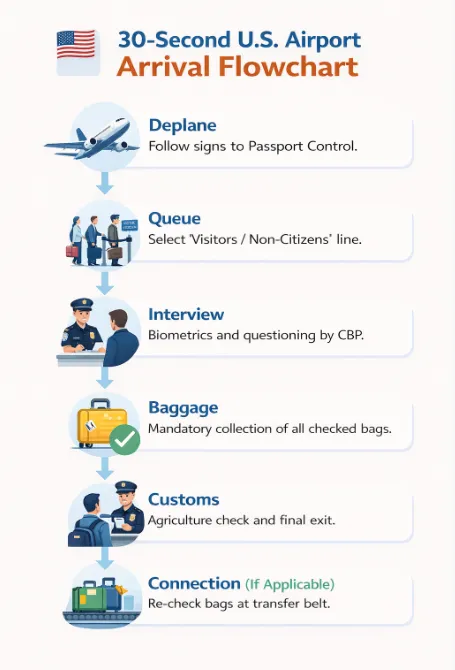
The 30-Second Quick Flowchart
-
Deplane -> Follow signs to Passport Control.
-
Queue -> Select "Visitors/Non-Citizens" line.
-
Interview -> Biometrics and questioning by CBP.
-
Baggage -> Mandatory collection of all checked bags.
-
Customs -> Agriculture check and final exit.
-
Connection -> Re-check bags at transfer belt (if applicable).
Deplane → Passport Control → CBP Interview → Baggage Claim → Customs → Re-check Bags (if connecting)
3.1 Direct Flights vs. Connecting Flights to the U.S.
-
First U.S. Airport as Entry Point: Your legal entry into the U.S. occurs at the first city where the plane touches U.S. soil. Even if your final destination is New York, if your flight stops in Los Angeles first, LAX is where you clear immigration and customs.
-
Immigration at First Landing City: Allow at least 3 to 4 hours for layovers at your first U.S. stop. You must deplane, pass through immigration, collect your luggage, clear customs and re-checked baggage before boarding your next domestic flight.
-
Transit Tip: Even if you are transiting through the U.S. to a third country (e.g., Canada or Mexico), you generally must clear U.S. immigration and customs.
3.2 The Step-by-Step U.S. Arrival & Inspection Process
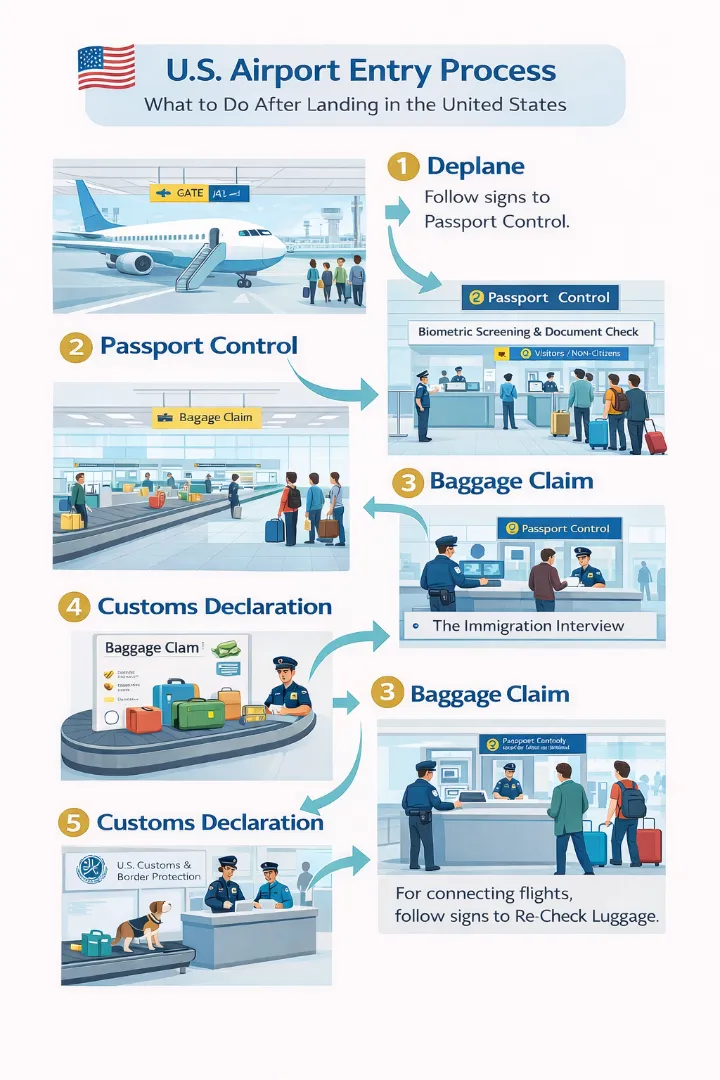
Follow these steps in chronological order once your aircraft reaches the gate:
Step 1: Deplaning and Navigating to Passport Control Immediately upon exiting the aircraft, follow the signs for "Arrivals," "Passport Control," or "Immigration."
-
The "Sterile Area": Mobile phone use and photography are strictly prohibited. Keep your phone in your pocket until you have fully exited the Customs hall.
-
Choosing the Correct Lane:
-
Visitors / Non-Citizens: The default lane for most international travelers (B1/B2, F-1, J-1).
-
APC (Automated Passport Control) Kiosks: Available in many airports for U.S. Citizens, Lawful Permanent Residents (Green Card holders), Canadian Citizens, and travelers from Visa Waiver Program (VWP/ESTA) countries who have visited the U.S. at least once since 2008. Note: Most first-time B1/B2 or F-1 visa holders are NOT eligible for APC.
-
Global Entry: A dedicated fast-track lane for pre-approved, low-risk travelers (membership required). If you are a member, head directly to the Global Entry kiosks
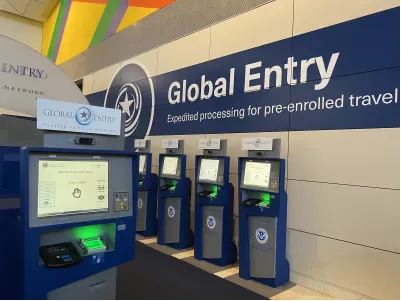 Image from CPB, Copyright by original author
-
Step 2: Biometric Screening and Document Check When you reach the CBP officer's booth:
-
Fingerprints & Photo: You will scan your fingers and look into a digital camera for facial recognition.
-
Hand Over Documents: Present your Passport and your signed I-20/DS-2019 (if applicable). Do not offer extra papers unless requested.
-
Digital Device Cooperation: If a CBP officer requests to inspect your mobile phone or laptop, you are legally required to cooperate. Refusal can lead to your devices being seized or even your entry being denied.
Step 3: The Immigration Interview The officer will ask questions to verify your intent.
-
Purpose & Duration: "Why are you here?" and "How long will you stay?" are the most common questions.
-
Limited English Proficiency: * If you do not speak English well, do not panic. You can politely say, "Sorry, my English is not good. Can I have a translator?" or "Do you have a Chinese/Japanese/French/Korean/Spanish-speaking officer?" * Translation Apps: In many cases, officers may allow you to use a translation app on your phone, but always ask for permission before taking your phone out.
-
The Invitation Letter: For parents or non-English speakers, carry a printed "Letter to the CBP Officer" in English that explains the purpose of the trip, the address of stay, and a contact phone number of a U.S.-based relative.
-
-
Conclusion of Interview: Traditionally, an officer would stamp your passport and generate an I-94 record upon approval. Note the following current trends:
-
Maybe There Is No Passport Stamps: Many U.S. ports of entry are phasing out physical ink stamps in passports.
-
Direct Release: In many cases, the officer will simply hand back your passport and say "Welcome to the U.S." without taking new fingerprints or stamping anything.
-
I-94 Verification: If you do not receive a stamp, your legal record is still generated electronically. You must visit i94.cbp.dhs.gov after you exit the airport to download your I-94 and verify the "Admit Until Date" (the date you must leave the U.S.). Always verify the date on your I-94 matches your intended program or visitor duration.
-
-
Secondary Inspection: If you are asked to go to a separate waiting room (Secondary), stay calm. It is often for routine verification that requires a supervisor's access to a different computer system. It does not mean you are in trouble.
Step 4: Mandatory Baggage Collection Even if your bags are tagged to a final domestic destination, you must physically pick them up at the first point of entry.
-
Look for the baggage carousels immediately following the immigration booths.
-
If your bag is missing, find the airline baggage desk before leaving the Customs hall.
Step 5: Customs Declaration and Agriculture Check Walk toward the "Exit" with your luggage.
-
The Declaration Status: Historically, travelers filled out a blue paper form (Form 6059B). Today, most airports have replaced this with verbal declarations.
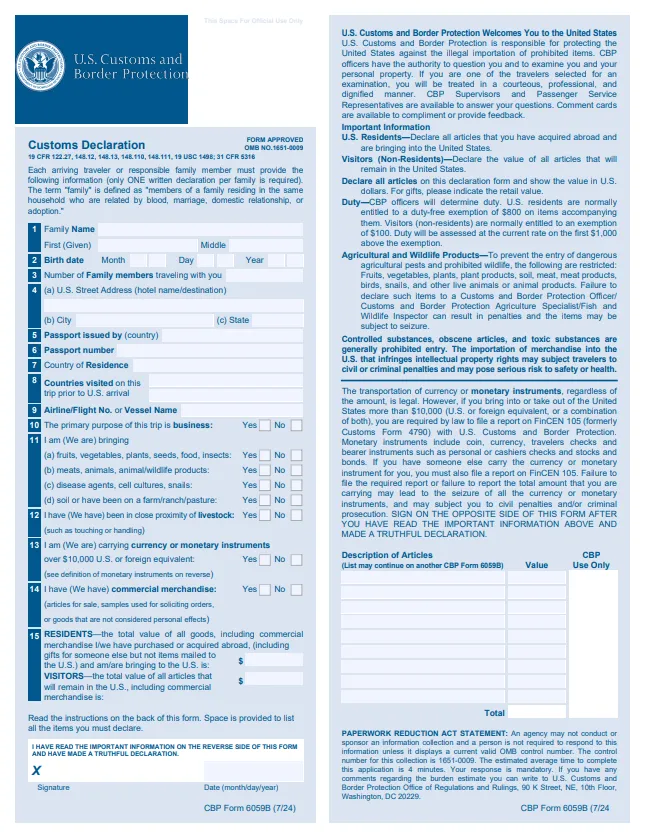 Image from cbp.gov, Copyright by original author
 -
How to Declare: If asked about food, avoid a simple "No" if you have snacks. Say: "I have some commercially packaged snacks and sealed tea." This shows transparency and prevents fines.
-
Filling the Form (If Required): If you are handed a paper form (usually on airplane or before the immigration Interview), list all items accurately. For currency over $10,000, you must mark "Yes"—it is not a crime to carry it, but it is a crime not to report it.
-
Agriculture Dogs: You may see "Beagle Brigade" dogs sniffing bags for fruit or meat. If they sit next to your bag, cooperate with the officer.
Step 6: Re-Checking Luggage for Connecting Flights If you have a domestic connection: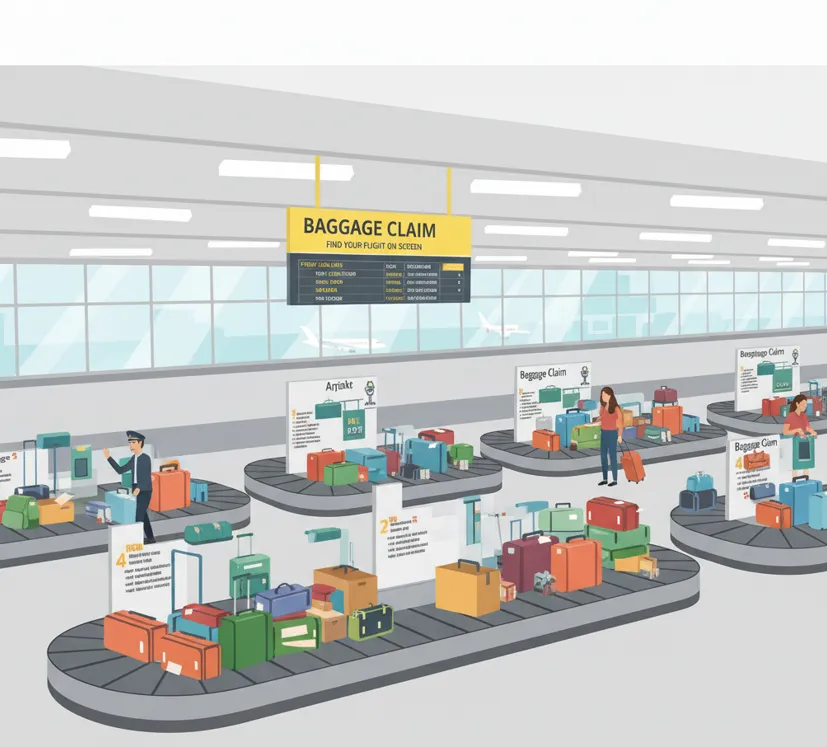
-
Immediately after exiting the Customs door, look for the "Baggage Drop" or "Transfer" belt.
-
Place your bags on the belt (they should already have the correct destination tags from your origin).
-
Final TSA Check: You must then go through a TSA security screening (liquids out, shoes off) before entering the domestic terminal gates.
Step 7: Final Exit (For Local Arrivals) If this is your final city, follow signs for "Ground Transportation" to find Taxis, Uber/Lyft, or trains.
Part IV. Common Immigration Questions and Sample Answers
The interview with a CBP officer is not a casual conversation; it is a formal assessment of your eligibility to enter the United States. While most interviews last less than two minutes, being unprepared can trigger a transition to more intensive questioning.
4.1 Purpose of Visit – Sample Answers by Visa Category
Officers customize their questions based on your visa type. You should be prepared for the following:
For B1/B2 (Tourism & Business) Holders:
-
"What is your itinerary?" -> Do not just say "California." Be ready to name specific cities or landmarks.
-
"How much money are you carrying?" -> This includes cash and available credit limits.
-
"Do you have family in the U.S.?" -> If yes, be honest.
-
"Who is your employer back home?" -> They are looking for "strong ties" to your home country.
For F-1/M-1 (Student) Holders:
-
"What is your major and why did you choose this university?" -> You must show genuine academic intent.
-
"How will you pay for your tuition and living expenses?" -> Refer to the financial details on your I-20.
-
"Where do you plan to live?" -> Have the dormitory or apartment address memorized.
-
"What are your plans after graduation?" -> The safest answer is returning home to apply your degree.
For J-1 (Exchange Visitor) Holders:
-
"Who is your program sponsor?" -> Know the name of the organization on your DS-2019.
-
"What are the dates of your exchange program?" -> Ensure they match your documents exactly.
4.2 Length of Stay and Accommodation Questions
Officers focus heavily on your housing and departure plans to ensure you do not intend to stay in the U.S. permanently or work illegally.
-
"Where are you staying?" -> You must provide a specific address. If staying at a hotel, have the reservation ready. If staying with a friend/relative, know their full name and their relationship to you. Avoid saying "I haven't decided yet," as this looks suspicious.
-
"How long do you plan to stay?" -> Your answer must match your return ticket and your visa category. For tourists, "two weeks" or "one month" is standard. If you say "six months" (the maximum allowed) without a very strong financial reason, it may trigger a secondary inspection.
-
"When is your return flight?" -> Be prepared to show your return itinerary. Even though a return ticket is not technically mandatory for all visas, not having one as a B1/B2 holder is a major red flag.
-
"What is your relationship to the person you are visiting?" -> Be honest. If they are an "internet friend" or someone you barely know, the officer will worry about your safety or your true intent.
4.3 What If You Don’t Speak English at U.S. Immigration?
Language barriers are common, and CBP officers are equipped to handle them. You are not required to be fluent in English to visit the U.S., but you must be able to communicate your purpose.
-
Ask for Assistance Early: If you don't understand a question, do not guess. Say: "Sorry, I don't speak English. I need an interpreter, please." or "Can I speak to someone who speaks Mandarin/Spanish/etc.?"
-
The Power of the Invitation Letter: For travelers with limited English (especially elderly parents), a printed letter is the best tool. It should include:
-
Your full name and passport number.
-
The purpose of your visit.
-
The exact address and phone number where you will stay.
-
The name and contact info of your U.S. sponsor/relative.
-
Your planned departure date.
-
-
Using Technology: Most officers are comfortable with you using a translation app (like Google Translate), but always ask first: "May I use my phone for translation?"
-
Stay Calm and Patient: The process will take longer if a translator is needed. Use simple "Yes" or "No" answers when possible and rely on your printed documents to do the "talking."
4.4 Your Rights and Limitations at the Border
It is important to understand that as a non-citizen at a Port of Entry, your legal rights are significantly limited compared to being on U.S. soil.
-
Search Authority: CBP does not need a warrant to search your luggage or your electronic devices.
-
Right to Counsel: You do not have the right to an attorney during an immigration inspection.
-
Withdrawal of Application: If the interview is going very poorly and you fear a formal deportation (which carries a 5-year ban), you can ask for a "Withdrawal of Application for Admission."
Part V. Emergency Situations and Tips to Avoid Problems
5.1 Common Mistakes First-Time Travelers Make
Avoid these common pitfalls to ensure a smooth entry:
-
Inconsistent Answers: Ensure your verbal answers match your visa application and the supporting documents you carry.
-
Example: If your visa application stated you are visiting for a business conference, but you tell the officer you are only there for a family vacation, this creates a major red flag.
-
-
Joking with Officers: U.S. immigration is a serious legal process. Never make jokes about "staying forever," "illegal work," or "smuggling" items.
-
Example: Answering "Maybe I'll never leave!" when asked about your departure date will likely result in immediate detention or denial of entry.
-
-
Over-sharing Information: Answer the questions asked directly and concisely. Providing excessive unsolicited information can lead to unnecessary follow-up questions.
-
Example: If asked "What is the purpose of your visit?", simply say "Tourism." Don't start explaining your life story or mentioning that you might look for a job while you are there.
-
-
Inappropriate Digital Content: As mentioned in Part II, controversial content in chat histories (like "birth tourism" plans or working under the table) is a leading cause of visa cancellations.
-
Example: Messages discussing how to get a job in the U.S. without a work permit, even if sent in jest, are sufficient grounds for an officer to cancel your visa.
-
5.2 How to Reduce the Risk of Secondary Inspection
While some selections are random, you can lower your "risk profile" by following these tips:
-
Be Fully Prepared: Have all your mandatory documents (I-20, Hotel booking, Return ticket) organized and ready to present.
-
Dress Appropriately: Dress in clean, professional or casual travel attire. Looking respectable helps convey that you are a legitimate traveler.
-
Stay Calm and Confident: Nervousness (excessive sweating, avoiding eye contact, trembling) is often flagged by officers as a sign of deception.
-
Have a Clear Itinerary: Know exactly where you are going, what you will do, and when you will leave. Uncertainty often leads to deeper questioning.
5.3 Emergency Response Manual (What if things go wrong?)
-
Denied Entry: If the officer denies your admission, you will likely be placed on the next flight back to your origin. Avoid signing Form I-867 (sworn statement) if you do not understand it.
-
Lost Passport/I-20: If you lose your documents mid-flight, inform the CBP officer immediately upon landing.
-
Missed Connection Due to CBP Lines: If long lines cause you to miss your domestic flight, go to your airline's customer service desk after exiting Customs.
-
The "Back Room" (Secondary): If sent here, do not panic. It is often just to wait for a phone call to be placed to your school or employer.
Part VI. Frequently Asked Questions (FAQ)
Q: What is "Secondary Inspection" and should I worry?
A: It is a more detailed check. It happens to about 1-3% of travelers. Most are cleared once the officer verifies a phone number or a school record. Just tell the truth.
Q: Can they check my WeChat/X/Social Media?
A: Yes. CBP has broad authority to search digital devices. Ensure your chat history does not contain jokes about "working illegally" or "staying forever," as these are taken literally by officers.
Q: How do I find my I-94?
A: The U.S. no longer gives paper I-94s. Visit i94.cbp.dhs.gov 24 hours after entry to download your record. You will need this for your driver's license or Social Security applications.
Q: What if I make a mistake on my Customs declaration?
A: Correct it verbally as soon as you meet the officer. Honesty prevents fines. Intentional concealment leads to penalties.
Q: My U.S. visa is expiring soon. Can I still enter the country?
A: Yes. As long as your visa is valid on the day you arrive at the Port of Entry, you may enter. Your legal length of stay is determined by the CBP officer and recorded on your I-94, not by the visa's expiration date.
Q: Do I need to pick up my luggage for a U.S. domestic connection?
A: Yes. For almost all international-to-domestic connections, you must clear immigration, retrieve your checked bags, pass through customs, and then drop your bags at the "Baggage Transfer" belt before heading to your next gate.
Q: Is "Layover Immigration" required for international transit?
A: Generally, yes. The U.S. does not have "sterile transit" zones. Even if you are flying from London to Mexico City with a stop in Dallas (DFW), you must clear U.S. immigration and customs. Ensure you have the proper visa or ESTA for transit.
Q: How much cash can I bring into the USA without tax?
A: There is no limit on the amount of cash you can bring, and it is not taxed at the border. However, if you are carrying more than $10,000 (including currency and monetary instruments), you must declare it on your customs form to avoid seizure and legal penalties.
Safe travels and enjoy your stay in the United States!