Wondering if 1 hour is enough for a connecting flight? Read our 2026 guide to US airport minimum connection times, baggage rules, and transfer tips at LAX, SFO & JFK.
📌 Is 1 Hour Enough for a Connecting Flight in the US?
-
Domestic to Domestic: Yes, 1 hour is usually enough at most US airports if your flights are on the same airline/terminal (e.g., 45-60 mins).
-
Domestic to International: 1 hour is extremely tight but possible if you do not need to change terminals. 1.5 to 2 hours is strongly recommended.
-
International to Domestic (Entering the US): No. Because you must clear US Customs and Immigration and recheck your bags, you need an absolute minimum of 2.5 to 3 hours.
-
International to International: No. The US does not have transit zones. You still must clear customs, meaning you need 2 to 3 hours.
Overview of Minimum Connection Time (MCT)
In aviation, the Minimum Connection Time (MCT) is a legal and operational benchmark. It determines if airlines can sell you a ticket for two flights and who bears responsibility if you miss the connection.
What is MCT?
MCT is the shortest allowable time between flights, set by airports and airlines.
- Booking Standard: All booking systems (like Kayak, Expedia, or airline websites) check the airport's MCT when combining flights. If the gap is too short, you can't book it.
- Liability Line: If your connection time exceeds the MCT and a delay causes you to miss the next flight, the airline must assist (rebook, provide meals/hotels). For separate tickets (non codeshare), MCT offers no protection.
US Major Airports: MCT vs. Recommended Connection Times
| Airport | Type | Minimum Connection Time (MCT) | Recommended Time (Realistic) | Notes |
|---|---|---|---|---|
| LAX (Los Angeles) | Domestic-Domestic | 40-50 minutes | 1-1.5 hours | Multiple terminals, requires AirTrain or walking |
| Domestic-International | 45-60 minutes | 1.5-2 hours | ||
| International-Domestic | 90-120 minutes | 2.5-3+ hours | Long customs queues; IRBS pilot may reduce to 1.5 hours (select flights) | |
| SFO (San Francisco) | Domestic-Domestic | 45-50 minutes | 1-1.5 hours | Efficient AirTrain connections |
| Domestic-International | 60 minutes | 1.5-2 hours | ||
| International-Domestic | 80-105 minutes | 2-3 hours | Fog delays common; IRBS for Sydney flights | |
| JFK (New York Kennedy) | Domestic-Domestic | 30-45 minutes | 1-1.5 hours | AirTrain links terminals |
| Domestic-International | 45-60 minutes | 1.5-2 hours | ||
| International-Domestic | 120-135 minutes | 3-4+ hours | Busiest customs; inter-terminal travel time | |
| ORD (Chicago O'Hare) | Domestic-Domestic | 35-45 minutes | 1-1.5 hours | United hub; weather delays frequent |
| International-Domestic | 90-120 minutes | 2.5-3.5 hours | Terminal 5 international isolation | |
| ATL (Atlanta) | Domestic-Domestic | 35-40 minutes | 1-1.5 hours | Delta hub; efficient Plane Train |
| International-Domestic | 90-120 minutes | 2-3 hours | World's busiest airport | |
| DFW (Dallas-Fort Worth) | Domestic-Domestic | 40-50 minutes | 1-1.5 hours | American hub; fast Skylink |
| International-Domestic | 90-120 minutes | 2-3 hours | ||
| IAH (Houston) | Domestic-Domestic | 40-50 minutes | 1-1.5 hours | United hub |
| International-Domestic | 90-120 minutes | 2.5-3 hours | ||
| MIA (Miami) | Domestic-Domestic | 45-60 minutes | 1.5 hours | Heavy South American routes |
| International-Domestic | 120+ minutes | 3-4 hours | Long customs queues (South America peaks) |
Note: The US lacks dedicated "international transit lanes." Even for international-to-international (e.g., Beijing via SFO to Mexico), you must enter US borders, claim baggage, clear customs, and recheck.
Why 2026 MCTs Are Often Unrealistic
Though systems allow 90-minute international-to-domestic (I-D) connections, they're risky in 2026:
-
Traffic Surge: Global air traffic exceeds pre-pandemic levels, leading to 1-2 hour customs waits at entry points like LAX and JFK.
-
Terminal Shifts: Many airports (e.g., LAX, ORD) have international arrivals in isolated terminals, requiring 30 minutes for walking or shuttles.
-
Security Pressures: TSA's AI scanners speed things up theoretically, but peak-hour lines remain a bottleneck.
International-to-Domestic Transfer Flow
Understand MCT components to gauge your odds:
-
Landing (0 min): Touchdown doesn't mean deplaning; taxiing can take 15 minutes.
-
Immigration (+30-60 min): Use MPC (Mobile Passport Control) or Global Entry to save time.
-
Baggage Claim (+20 min): Must retrieve and pass customs.
-
Recheck (+5 min): Quick at dedicated counters post-customs.
-
Re-Security (+20-40 min): The biggest variable.
Pro Tip: Avoid MCT minimums. If a 90-minute I-D shows up, opt for a later flight unless you have no checked bags and US citizenship/green card. Check for same-terminal ops (e.g., United at SFO, Delta at ATL) for higher reliability.
related guide: JFK Airport Guide
LAX Los Angeles International Airport Breakdown: Is 1 Hour Enough?
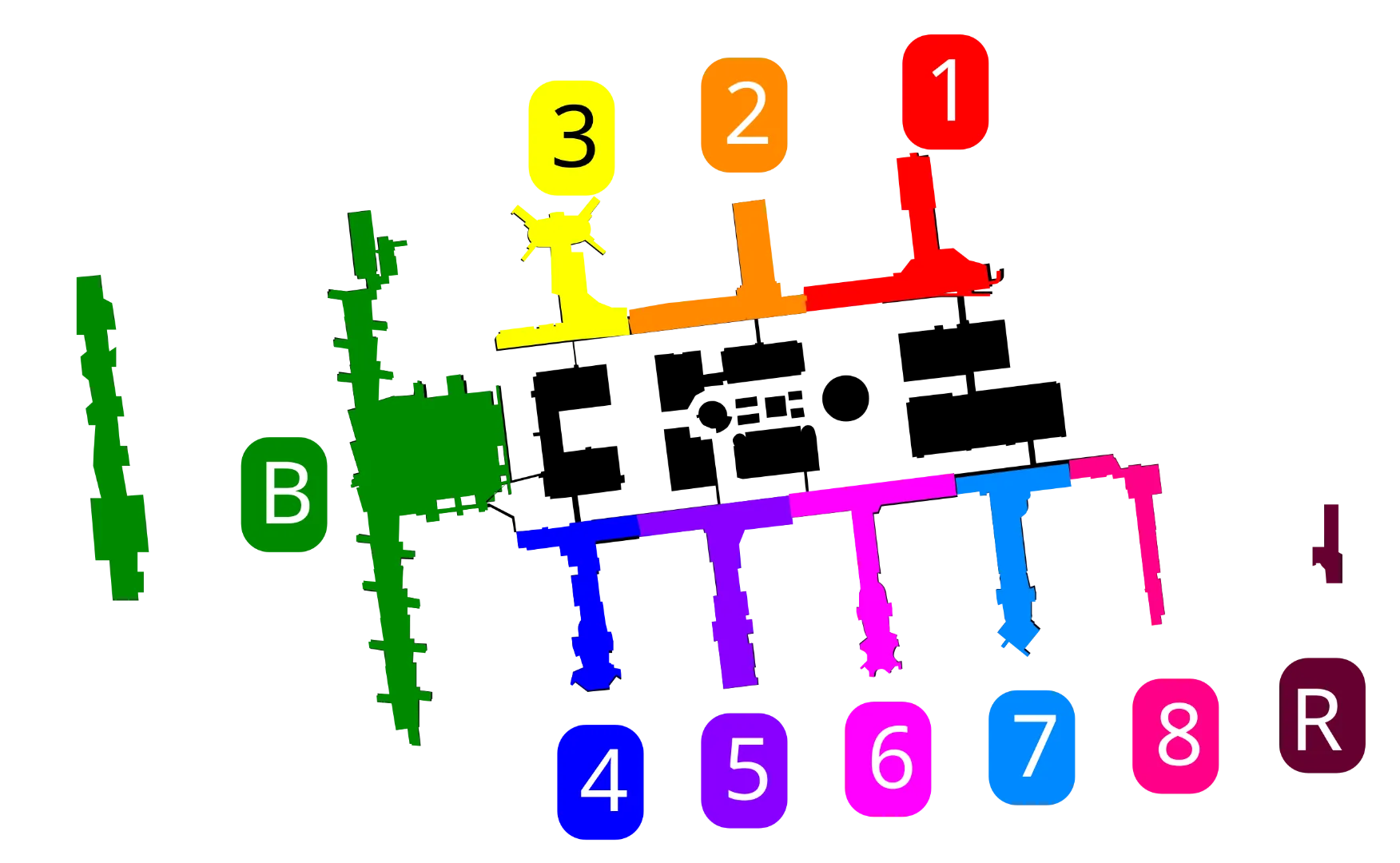
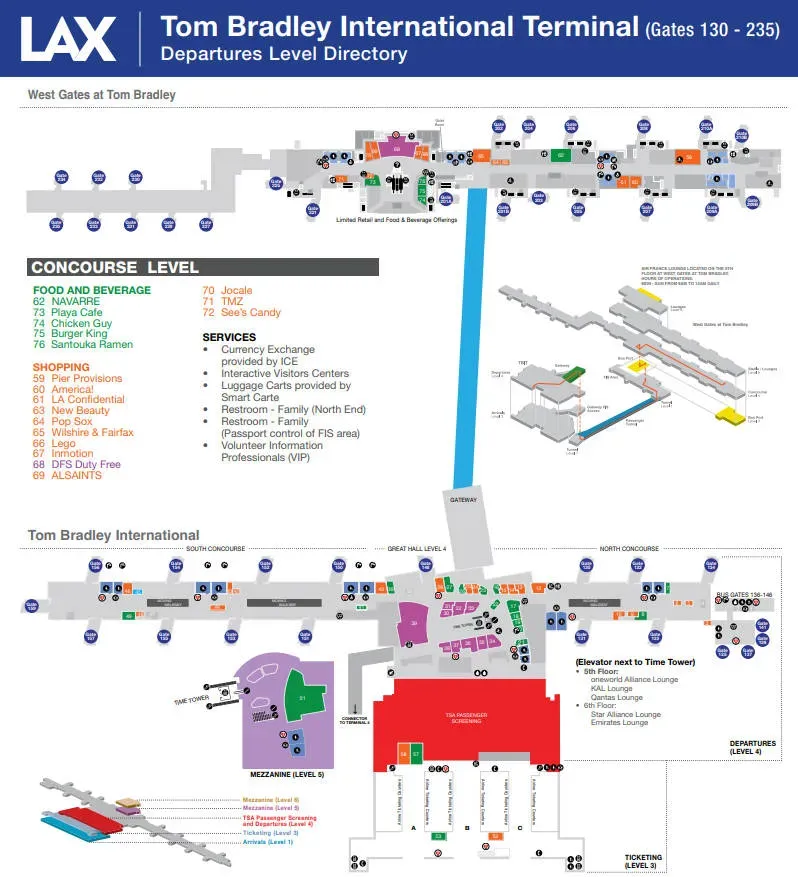
Los Angeles International Airport (LAX) features a distinctive U-shaped (horseshoe) layout with 9 terminals: Terminals 1 through 8 and the Tom Bradley International Terminal (TBIT, often called Terminal B). Major ongoing modernizations have significantly improved connectivity, making transfers easier than in previous years.
As of January 2026, the Automated People Mover (APM) train is now operational, providing fast, free landside connections across the airport.
At LAX, whether 1 hour is "enough" is a high-stakes gamble. While it is technically possible for some domestic-to-domestic routes, for most travelers, it is not recommended.
Airport Layout
-
Airside connections (post-security walkways, no re-screening needed for most): Nearly all terminals are linked. You can walk from Terminal 1 to Terminal 8 airside (about 2 miles total, with moving walkways).
-
Strong connections: TBIT ↔ T3 ↔ T4 ↔ T5 ↔ T6 ↔ T7 ↔ T8.
-
Terminal 1 connects to T2/T3.
-
Walking times: 5–20 minutes between adjacent terminals.
-
-
Landside: The new APM train (every 2 minutes peak) connects terminals quickly, plus free shuttles remain available.
Standard Minimum Connection Times (MCT) at LAX
These are the "legal" minimums airlines use for single-ticket itineraries (as of 2026; varies slightly by airline/alliance):
| Connection Type | Typical MCT | Notes |
|---|---|---|
| Domestic to Domestic | 40–60 minutes | Often 40 min (e.g., American); easy with airside walks. |
| Domestic to International | 45–75 minutes | Common ~60 min; straightforward if airside. |
| International to Domestic | 90–120 minutes (1.5–2 hours) | Includes immigration, customs, baggage recheck, re-security. |
| International to International | 90–120 minutes | Similar; longer lines possible. Precleared flights (e.g., Canada) treated as domestic. |
Key Transfer Tips
-
Domestic connections: Often smooth and low-stress thanks to airside walkways and same-airline hubs (e.g., American in T4/5, United in T7/8, Delta in T2/3).
-
Involving international: Allow extra buffer—immigration/customs lines can add 30–90+ minutes. Global Entry/Mobile Passport speeds this up.
-
APM impact: Great for landside transfers (e.g., separate tickets or baggage issues), but airside walks are still fastest for secure connections.
-
Recommendations: For comfort, add 30–60 min buffer to MCT. 2–3+ hours ideal for international or separate tickets. On one ticket meeting MCT? Airline rebooks if missed due to delays.
- LAX Transportation Guide
SFO San Francisco International Airport Breakdown: Top Choice for Efficient Transfers
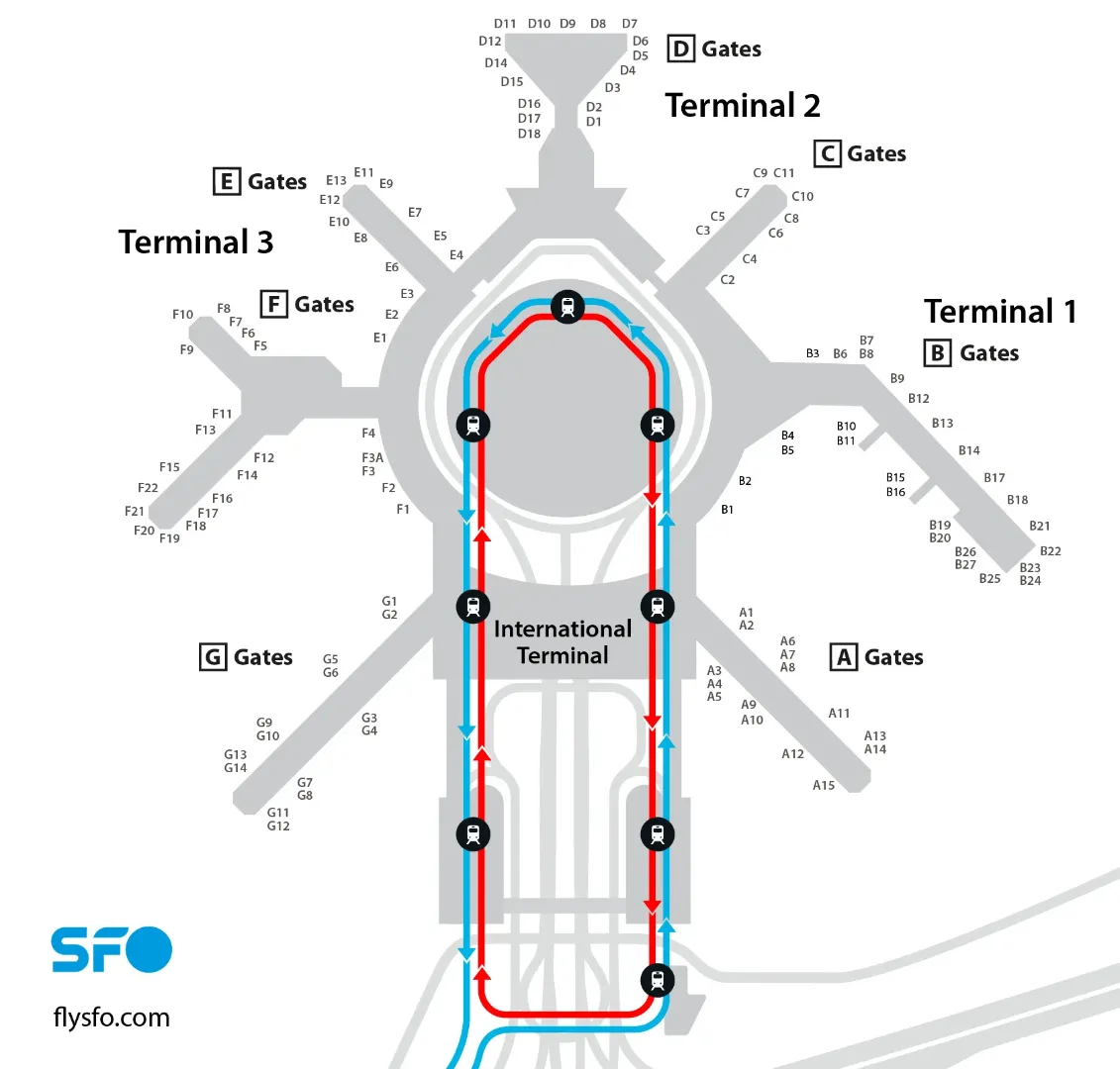
San Francisco International Airport (SFO) features a distinctive looped layout with four terminals: Harvey Milk Terminal 1, Terminal 2, Terminal 3, and the International Terminal (with Boarding Areas A and G). As of early 2026, all terminals are fully connected airside via post-security walkways (completed in 2024 with the final phase of Harvey Milk Terminal 1), allowing seamless transfers without re-clearing security for most connections.
Key Terminal Assignments
-
Harvey Milk Terminal 1: Southwest, JetBlue, Frontier (B and C gates).
-
Terminal 2: Alaska, Delta (C and D gates).
-
Terminal 3: United domestic (E and F gates).
-
International Terminal: United international (G gates); other carriers (A gates).
Walking times airside: 5–20 minutes between most areas (longest ~20–25 min end-to-end with moving walkways). Note: No direct airside link between A and G gates—you can loop around via other terminals.
The free AirTrain (24/7, every 4 minutes) provides landside connections if needed.
Standard Minimum Connection Times (MCT) at SFO (as of 2026)
These are airline-agreed "legal" minimums for single-ticket itineraries (varies by carrier; United, the largest at SFO, often has efficient rules):
| Connection Type | Typical MCT | Notes |
|---|---|---|
| Domestic to Domestic | 45–60 minutes | Often 50 min; very easy with airside walks. |
| Domestic to International | 60–90 minutes | ~1 hour common; no customs needed. |
| International to Domestic/International | 90–120 minutes (1.5–2 hours) | Includes immigration/customs/bag recheck/re-security; United ~90 min possible. |
Why SFO is Efficient for Transfers
-
Full airside connectivity: Walk between any gate without re-screening (a major upgrade since 2024).
-
Quick processes: Immigration often faster than larger hubs; Global Entry/Mobile Passport helps.
-
United hub advantages: Many same-terminal connections.
-
Traveler reports: Smooth for 60–90 min domestic; international arrivals average ~1.5 hours.
Practical Tips
-
Buffer recommendation: Add 30–60 min to MCT for comfort (fog delays common). 2–3+ hours ideal for international or separate tickets.
-
On one ticket meeting MCT: Airline protects you if missed due to delays.
-
Check gates via flysfo.com app.
- San Francisco Airport (SFO) to Downtown Transportation Ultimate Guide
JFK New York Kennedy International Airport Breakdown: East Coast Hub Challenges
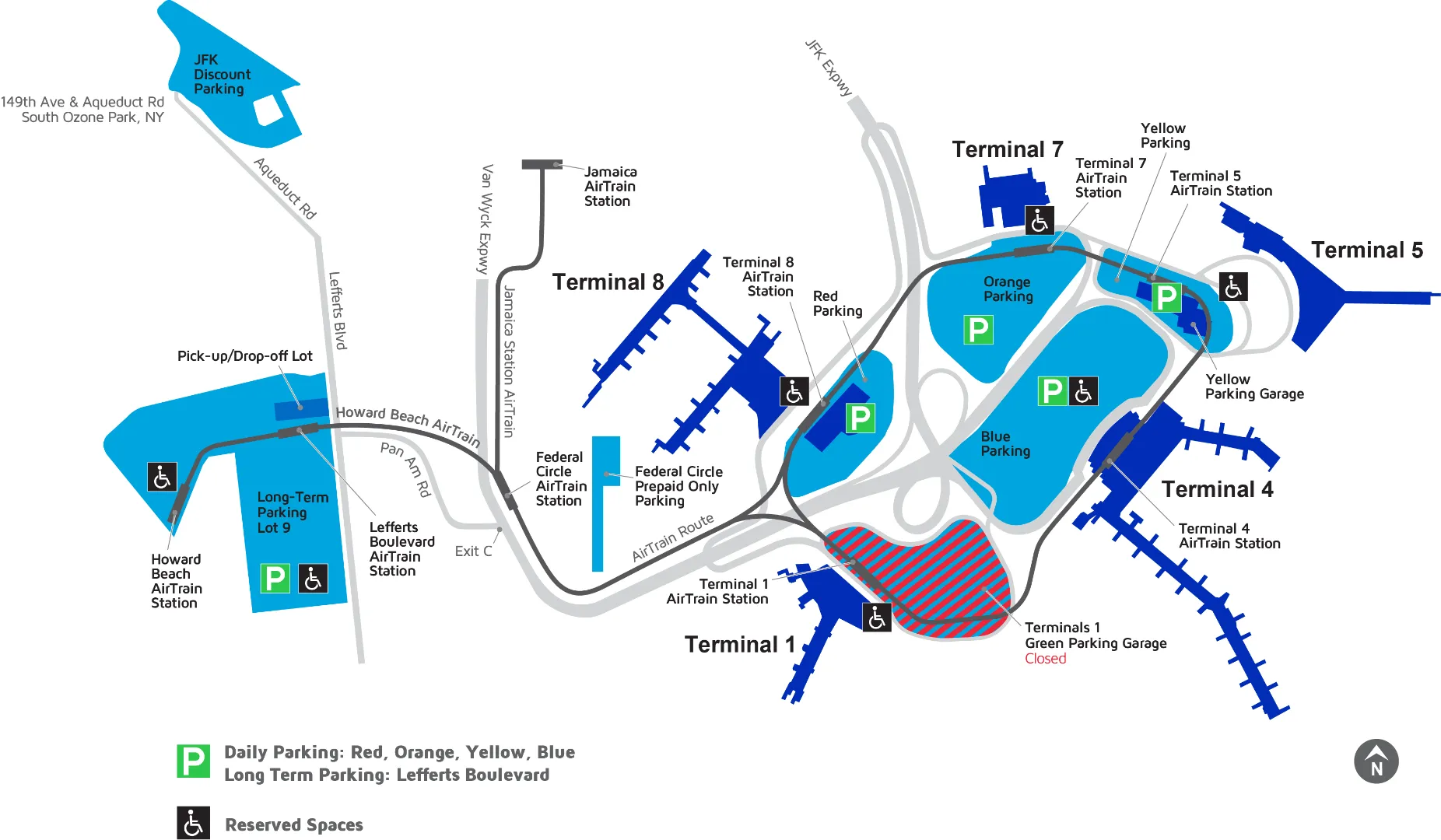
John F. Kennedy International Airport (JFK) is New York City's primary international gateway, handling over 60 million passengers annually. It features a distinctive circular layout with five active terminals (1, 4, 5, 7, and 8) arranged around central parking and facilities. There are no airside connections between terminals—passengers must exit security and use the free AirTrain people mover (24/7, every 4–10 minutes) for all terminal changes.
Key Terminal Assignments
-
Terminal 1: Many international carriers (e.g., Air France, Korean Air, Lufthansa).
-
Terminal 4: Delta hub + major international (e.g., Virgin Atlantic, KLM); largest and busiest.
-
Terminal 5: JetBlue.
-
Terminal 7: British Airways + others.
-
Terminal 8: American Airlines hub + Oneworld partners.
Ongoing Redevelopment (as of January 2026)
JFK is midway through a $19 billion transformation. First phases of the new Terminal 1 (all-international, replacing old T1/T2 sites) and Terminal 6 (on former T6/T7 sites) are scheduled to open later in 2026 with initial gates. Current terminals remain operational with some expansions complete (e.g., T4, T8).
Standard Minimum Connection Times (MCT) at JFK (as of 2026)
MCTs vary by airline (e.g., Delta often 35–45 min domestic; international longer). No airside links make terminal changes riskier.
| Connection Type | Typical MCT | Notes |
|---|---|---|
| Domestic to Domestic | 35–60 minutes | Possible if same terminal (e.g., Delta in T4); add time for AirTrain if change. |
| Domestic to International | 45–90 minutes | Often ~60 min; straightforward in same terminal. |
| International to Domestic/International | 90–150 minutes (1.5–2.5 hours) | Immigration/customs + baggage recheck + AirTrain/re-security; lines can add 60+ min. |
Why Transfers Can Be Challenging
-
No airside connectivity: Always re-clear security for terminal changes.
-
AirTrain reliability: Free and frequent, but adds 10–20 minutes + walking.
-
Immigration/customs: Often crowded; Global Entry/Mobile Passport essential for speed.
-
Traveler reports: Domestic same-terminal smooth; international or changes often stressful—recommend 2–3+ hours buffer.
Practical Tips
-
Buffer recommendation: 90–120 min minimum for comfort; 3+ hours for international or separate tickets.
-
On one ticket meeting MCT: Airline protects you.
-
Check terminals/gates early via jfkairport.com.
Baggage Through-Check Rules: When You Don't Need to Claim & Recheck Bags
Through-checking (or "checking baggage through") means your checked luggage is tagged to your final destination at the origin airport, transferred automatically by handlers between flights, and only collected at the end. This avoids claiming/rechecking during connections.
Key Scenarios Where Bags Are Through-Checked (No Claim Needed)
| Scenario | Through-Check Possible? | Details & Exceptions |
|---|---|---|
| Single ticket/itinerary (one booking, even multiple airlines) | Yes, almost always | Requires interline agreement between carriers (most major airlines have these). Bags transferred automatically. Protected if delayed/misconnected. |
| Same airline, separate tickets | Sometimes (agent discretion) | Possible if same PNR or agent agrees, but many airlines (e.g., American, British Airways) refuse due to policy. Risky—often must claim/recheck. |
| Different airlines, separate tickets | Rarely | No guarantee; needs interline agreement + agent willingness. Most refuse (e.g., no through-check to non-partners). High risk of mishandling/fees. |
| Domestic connections (anywhere) | Yes | No customs involved; bags always transferred if on one ticket. |
| Domestic → International | Yes | Straightforward; no entry procedures at connection. |
| International → International (no US/Canada entry) | Yes | If on one ticket + interline; stay airside if possible. |
| International → Domestic (entering US) | No (standard) | Must claim bags after immigration, clear customs, recheck (even on one ticket). Exception: US Preclearance airports (below). |
| US Preclearance departure (e.g., Dublin, Toronto) | Yes (arrive as domestic) | Full US customs/immigration abroad; bags through-checked. Arrive in US like domestic—no recheck. |
Special Case: US Entry & Recheck Requirement
-
Standard rule: On international arrival to US (first US airport), claim bags after immigration, pass customs, then recheck at drop-off belt (quick, usually airside). Applies even on single ticket.
-
No recheck if: Depart from US Preclearance airport—clear US procedures abroad.
-
Locations (as of 2026): Canada (8 airports: Toronto, Vancouver, Calgary, Edmonton, Halifax, Montreal, Ottawa, Winnipeg); Ireland (Dublin, Shannon); Abu Dhabi; Aruba; Bermuda; Bahamas (Nassau).
-
Bags tagged through; arrive US as domestic (direct to gate/exit).
-
-
Emerging pilots (2025–2026): Remote screening (IRBS) on select routes (e.g., Sydney → SFO/LAX) may skip recheck, but limited.
Risks & Tips for Separate Tickets
-
High risk: No airline protection if missed connection; potential extra fees; baggage mishandling more likely (no coordinated transfer).
-
Advice: Avoid checking bags if separate tickets. Allow 3–4+ hours buffer. Print/show onward ticket at check-in. Politely ask agent, but don't rely on it.
-
Baggage allowance: Usually follows first carrier or Most Significant Carrier (MSC) rule on single ticket.
LAX/SFO/JFK Baggage Through-Check Comparison
| Scenario | LAX | SFO | JFK |
|---|---|---|---|
| Domestic Transfer | Through-Check | Through-Check | Through-Check |
| Standard International-to-Domestic | Claim + Recheck | Claim + Recheck | Claim + Recheck |
| IRBS Eligible | Yes (AA SYD) | Yes (UA SYD) | None Yet |
| Preclearance Origin | Through-Check | Through-Check | Through-Check |
Codeshare Flights vs. Separate Tickets (Single vs. Separate Bookings)
These two concepts are related but distinct in air travel. Codeshare refers to how a specific flight is marketed and operated, while single vs. separate bookings is about how your entire itinerary is ticketed. Often, codeshares appear in single bookings, but not always.
What is a Codeshare Flight?
A codeshare is an agreement where one airline operates the flight (provides the plane, crew, etc.—the "operating carrier"), but one or more partner airlines market and sell seats on it under their own flight numbers (the "marketing carriers").
-
Example: You book United flight UA123 from NYC to London, but it's actually operated by Lufthansa (LH456 is the real flight number).
-
Benefits: Expands route options, seamless booking on one site, often coordinated schedules.
-
Common in alliances (e.g., Star Alliance, Oneworld) but also bilateral partnerships.
Single Booking/Itinerary vs. Separate Tickets
| Aspect | Single Booking (One Ticket/Itinerary) | Separate Tickets (Multiple Bookings) |
|---|---|---|
| Definition | Entire journey (all flights) on one ticket/PNR, even if multiple airlines or codeshares. | Each leg or segment booked separately (different PNRs/ticket numbers). |
| Typical Inclusion of Codeshares | Common—codeshares often sold as part of single itineraries for seamless connections. | Possible (e.g., book a codeshare leg separately), but less coordinated. |
| Baggage Through-Check | Almost always yes (tagged to final destination; automatic transfer). Exceptions: Standard US/international entry recheck. Baggage rules often follow Most Significant Carrier (MSC) or first marketing carrier (esp. US-origin). | Rarely guaranteed—usually must claim and recheck. Agent discretion possible (more likely same airline/alliance), but high risk. Avoid checking bags if possible. |
| Missed Connection Protection | Yes—airline(s) responsible. Rebooks you (often next flight, meals/hotels if overnight). Applies even with codeshares on one ticket. | No—your risk. Buy new ticket for next leg (expensive). No meals/hotels. |
| Delays/Cancellations Rights | Full protection (e.g., EU/UK 261 compensation from marketing/operating carrier; similar globally). | Limited to affected ticket only. No overall protection. |
| Check-In & Boarding | Usually online/single process; coordinated. | Separate check-ins; potential visa/immigration issues if international transfer. |
| Cost & Flexibility | Often higher fare; changes affect whole itinerary. | Cheaper possible (mix fares); independent changes, but risks outweigh savings for most. |
| When to Choose | Recommended for connections—safer, easier. Ideal with codeshares. | Only for no-risk scenarios (long layovers, carry-on only, no tight connections). |
Key Takeaways
-
Codeshare + Single Booking: Most common and passenger-friendly. Feels like one airline; full protection, through-checked bags (usually).
-
Codeshare + Separate Tickets: Possible but loses most benefits—no protection or reliable baggage transfer.
-
Baggage on Codeshares: Rules vary—often marketing carrier's (what you booked), but check ticket/e-ticket for specifics. Carry-on usually follows operating carrier.
-
Advice: Always prefer single tickets for multi-leg trips. Check "operated by" during booking. For separate tickets, allow 3–4+ hours buffer, travel carry-on only.
How to Salvage a Tight Connection
Tight connections (under 1-2 hours) are stressful, especially at big airports or with switches. Prioritize single tickets for protection; separates are self-risk.
Pre-Flight Preparation
-
Choose front seats: Select an aisle seat toward the front when booking (pay extra if needed) for faster deplaning—saves 10–20 minutes.
-
Download airline app & airport maps: Track gates, delays, and layouts in real-time. Apps like GateGuru or fly[airport].com help plan routes.
-
Pack light: Carry-on only if possible—avoids baggage risks and speeds movement. Wear slip-on shoes for security.
-
Know the airport: Research terminals, walks/trains, and MCTs. Study maps during your first flight.
On the First Flight
-
Alert crew early: Tell flight attendants about your tight connection—they often announce it, allow early deplaning, or move you forward.
-
Politely ask passengers: If stuck in back, explain to those ahead and request to pass during deplaning.
-
Monitor updates: Use app/Wi-Fi for gate changes or delays.
Upon Landing
-
Deplane quickly: Stand up fast, grab bags efficiently.
-
Follow signs & move briskly: Head straight to departures board, then gate. Use moving walkways; walk/jog if needed.
-
Ask for help: Tell any gate/agent "tight connection"—they can radio ahead, hold the flight briefly, or escort you. Some airports have priority lanes for connections.
-
Use fast-track options: If international/security involved, seek priority lines (e.g., Global Entry, CLEAR, or ask for "mercy" lane).
Airport Rescue Tactics
| Step | Action | Time-Saving Tip |
|---|---|---|
| Immediate Post-Deplane | Follow "Transfer/Connections" signs; skip shops. | Use dedicated lanes. |
| Ask Staff | Query uniformed personnel: "Tight connection to [flight]; which way?" | They may escort or call transport. |
| Priority Lanes | Use Fast Track with status/business; politely request at security/immigration. | Saves 10-30 min. |
| Terminal Switch | Take trains/shuttles; avoid wrong routes. | Pre-check for changes (e.g., Heathrow, CDG). |
| Monitor Screens | Watch for gate changes; apps are faster. | Stay updated. |
If It Looks Risky or You Miss It
-
Single ticket: Airline protects you: They'll rebook (often next flight, meals/hotel if overnight) at no cost if delay caused the miss and it met MCT.
-
Backup plan: Check alternative flights via app while running.
-
Stay calm: Agents help more if you're polite.
Frequently Asked Questions (FAQ)
Q1: Can I connect in the US without speaking English?
A: Yes, but it's more stressful—allow extra time.
Q2: Do I need a visa for US transfers?
A: Yes, even if not leaving the airport.
Q3: What if I miss my connection?
A: Single tickets usually get free rebooks; separates are on you.
Q4: Which US airport is best for beginners?
A: SFO > SEA > LAX > JFK (easiest to hardest).
Q5: Do single tickets always meet MCT?
A: Airlines sell 99% that do; rare exceptions are manual.
Q6: If my ticket meets MCT, am I guaranteed no miss?
A: No—queues/delays happen. But singles get airline help.
Q7: Do separate tickets need MCT?
A: Yes, or risk missing flights/bags/boarding denial.
Q8: Do I have to pick up my bags on a connecting flight from International to Domestic?
A: Yes. When arriving in the US from an international destination, you must collect your checked baggage at the first port of entry, carry it through US Customs, and drop it off at the baggage recheck belt—even if your bag is tagged to your final destination. (The only exception is if you departed from a US Preclearance airport like Dublin or Toronto).
Q9: What happens if my first flight is delayed and I miss my connection?
A: If both flights are booked on a single ticket (one itinerary) and you miss your connection due to an airline delay, the airline is legally obligated to rebook you on the next available flight for free. If you booked separate tickets, the airline is not responsible, and you will have to buy a new ticket.
Is 1 hour enough? It depends: Yes for small domestic hubs, but 2+ hours for LAX/SFO/JFK internationals. Through-check simplifies, but customs is the bottleneck. Plan ahead with this 2026 US transfer guide for smoother travels. Policies evolve—check official sites. Safe journeys! 😊