Traveling across the United States offers families unparalleled freedom to explore, but it also requires navigating a complex web of safety regulations. Because motor vehicle crashes remain a leading cause of injury for children, federal and state authorities have established rigorous standards to ensure the youngest passengers are protected. Understanding these requirements is not just a matter of legal compliance—it is the foundation of a safe American road trip.
1.Why Child Car Seats Are Required by Law in the United States
Navigating the roads of the United States can be an exhilarating experience, but for families traveling with children, it comes with a significant legal and safety responsibility. One of the most common points of confusion for visitors is the decentralized nature of American traffic laws.
-
No Single Nationwide Law: The U.S. does not have a federal law mandating specific car seat usage. Instead, each of the 50 states (plus D.C. and territories) enacts its own statutes.
-
Universal Application: These rules apply to everyone on the road—whether you are a local resident, a tourist from abroad, or a visitor from a neighboring state.
-
Rental Car Complexities: Many travelers assume rental car companies will ensure they are legally compliant. In reality, the legal burden rests solely on the driver.
This guide provides a comprehensive breakdown of child restraint requirements across the U.S. to ensure your family stays safe and avoids costly legal complications.
Disclaimer: This guide is for informational purposes only and does not constitute legal advice. Laws are subject to change; always verify with local authorities before travel.
2. Penalties and Risks of Not Using a Child Car Seat in the U.S.
2.1 Safety Risks of Improper Child Restraint Systems
Adult seat belts are designed for adult bone structures. In a crash, a seat belt that fits a child improperly can cause "seat belt syndrome," leading to severe internal organ damage or spinal injuries. Proper child restraints distribute crash forces across the strongest parts of a child's body.
1.2 Fines and Legal Penalties for Child Car Seat Violations
-
Fines: Penalties range from $25 to over $500 depending on the state and whether it is a repeat offense.
-
License Points: Many states add "points" to your driving record, which can lead to license suspension or increased insurance premiums.
-
Enforcement Style:
- Primary Enforcement:* An officer can pull you over solely for seeing an unrestrained child.
-
Secondary Enforcement: An officer can only cite you for a car seat violation if they have already stopped you for another reason (like speeding).
1.3 How Improper Car Seat Use Affects Insurance Claims
If an accident occurs and a child is found to be improperly restrained, insurance companies may deny claims or significantly reduce payouts. Furthermore, the driver could face personal injury lawsuits or even criminal negligence charges.
3. U.S. Child Car Seat Requirements Explained (Federal vs. State Laws)
Understanding the mechanics of U.S. car seat laws requires looking at the interplay between federal manufacturing standards and state-level usage mandates. While the technical specifications are national, the rules of the road are local.
2.1 Federal Motor Vehicle Safety Standards (FMVSS) Explained
It is vital to distinguish between what is "sold" and what is "required."
-
Federal Authority (NHTSA): The National Highway Traffic Safety Administration sets the Federal Motor Vehicle Safety Standard 213 (FMVSS 213). This standard governs how seats are built, crash-tested, and labeled. Every seat legally sold in the U.S. must meet these rigorous dynamic tests.
-
State Authority: The federal government does not tell you how to use the seat; that power rests with individual states. This is why you might see a car seat labeled "safe for kids up to 40 lbs" federally, but find a state law that mandates a different restraint type for that same child.
2.2 Age, Height, and Weight Requirements by State
Most state laws are moving away from "Age-only" requirements because age is a poor proxy for skeletal development and seat belt fit.
-
Weight Limits: Most convertible seats have specific weight thresholds (e.g., 40 lbs or 65 lbs) for their internal harness. Exceeding these can cause the seat to fail in a crash.
-
Height Requirements: This is the most critical factor for seat belt fit. The industry standard "magic number" is 4 feet 9 inches (145 cm). Until a child reaches this height, the adult seat belt typically crosses their neck or stomach—both high-risk areas—rather than their chest and hips.
-
Age as a Minimum: In many states, age is used as a minimum threshold (e.g., "must be at least 2 years old to turn forward-facing"), but safety experts advise waiting until the child hits the maximum height/weight allowed by the seat manufacturer.
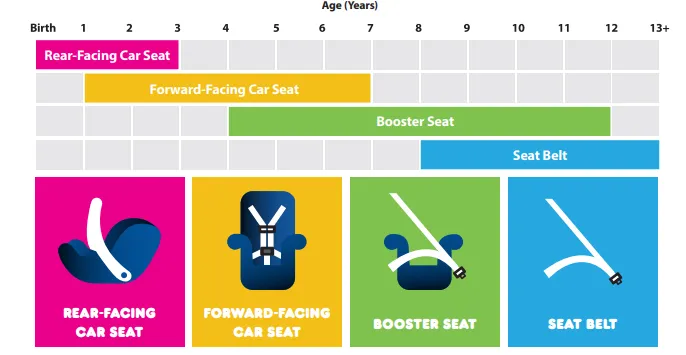
2.3 The Four Types of Child Restraint Systems in the U.S.
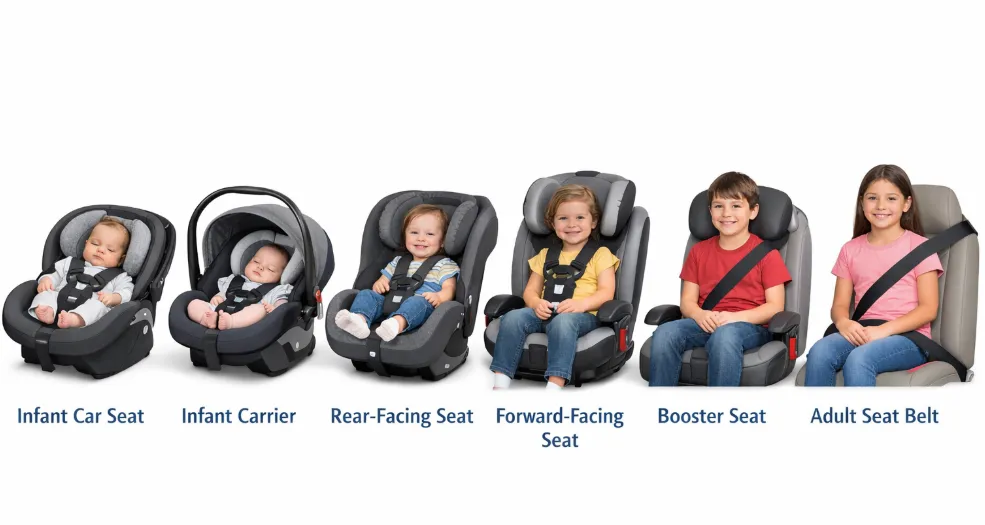
Safety is a progression. For maximum safety, children should stay in each stage until they reach the maximum height or weight limits allowed by the car seat manufacturer.
-
Stage 1: Rear-Facing (Infant and Convertible Seats) - The child faces the rear of the car
-
Target Group: Birth until at least age 2 (or until they reach the maximum height/weight of the seat).
-
Requirements:
-
Age: Mandated until age 2 in many states (CA, NY, NJ, PA, etc.).
-
Weight: Usually up to 22–35 lbs for infant carriers, and up to 40–50 lbs for convertible seats.
-
Height: The top of the child's head must be at least 1 inch below the top of the car seat shell.
-
-
The Science: Rear-facing seats support the head, neck, and spine by cradling the child and absorbing the crash forces. It is the safest position for young children whose bones are still developing.
-
-
Stage 2: Forward-Facing (Seats with a 5-Point Harness) - The child faces the front of the car
-
Target Group: Children who have outgrown their rear-facing seat, typically from age 2 to at least age 5.
-
Requirements:
-
Age: At least 2 years old (legal minimum in many states) and up to 7+ years.
-
Weight: Typically 40 lbs to 65 lbs (some seats go higher).
-
Height: The child's shoulders should be at or below the harness slots. The ears must be below the top of the seat shell.
-
-
The Tech: These use a five-point harness (shoulders, hips, and crotch) to keep the child firmly in the seat and distribute the energy of a collision across the body's strongest bones.
-
-
Stage 3: Booster Seats (High-back or Backless)
-
Target Group: Children who have outgrown their forward-facing harness but are still too small for an adult seat belt.
-
Requirements:
-
Age: Varies by state (often starting at 4 or 5), but best practice is 5 to 10+ years.
-
Weight: Usually 40 lbs to 100+ lbs.
-
Height: Under 4 feet 9 inches (145 cm).
-
-
The Purpose: A booster does not "restrain" the child; it "boosts" them so the vehicle's own lap-and-shoulder belt fits correctly over the middle of the shoulder and across the upper thighs/hips (not the stomach).
-
-
Stage 4: Adult Seat Belts
-
Target Group: Typically children aged 8 to 12 who have reached a height of 4'9".
-
The "5-Step Test" for Readiness:
-
Back: Does the child sit all the way back against the vehicle seat?
-
Knees: Do the child's knees bend comfortably at the edge of the seat?
-
Shoulder Belt: Does the belt cross the shoulder between the neck and arm?
-
Lap Belt: Does the lap belt sit low on the hips, touching the thighs?
-
Duration: Can the child stay seated this way for the entire trip?
-
-
Safety Note: Even when using a seat belt, all children under age 13 should ride in the back seat to avoid injuries from front-seat airbags.
-
3. How to Stay Legal When Driving Across U.S. State Lines
For families planning a multi-state road trip, such as driving from the Northeast down to Florida or exploring the Pacific Coast, the legal landscape changes every few hundred miles. Ignoring these shifts can lead to unexpected fines and safety risks.
3.1 Why Child Car Seat Laws Change When You Cross State Borders
The United States operates under a federalist system where individual states hold the power to regulate "police powers," which include traffic safety.
-
Legislative Lag: Some states update their laws annually to reflect the latest pediatric safety research, while others may not have updated their car seat statutes in over a decade.
-
The "Visitor" Misconception: Many travelers believe that if their car seat setup is legal in their home state (or the state where they rented the car), it is legal everywhere. This is false. Once you cross a state line, you are subject to the specific laws of the state you are currently driving in.
3.2 The “Most Restrictive Rule” Principle: Your Best Defense
To avoid the headache of researching every micro-detail of 10 different states, safety experts recommend adopting the "Most Restrictive Rule." This means identifying the strictest requirement across your entire route and applying it to the whole journey.
-
Example - Rear-Facing: If you are driving from a state that requires rear-facing until age 1 into a state that requires it until age 2, keep the child rear-facing for the entire trip.
-
Example - Booster Seats: If one state on your route requires a booster until age 8 and another requires it until age 10 or 4'9", follow the age 10/4'9" rule. This ensures that no matter where you are pulled over, you are exceeding the local minimum standard.
3.3 Practical Tips for Multi-State Family Road Trips
To stay ahead of law enforcement and ensure safety, follow these three steps:
-
Identify "Strict" Transit States: States like California, New Jersey, and New York have some of the country's most rigorous requirements. If your route touches these, plan your equipment around their standards.
-
Verify Rental Car Flexibility: If you are using a rental seat, ensure it is convertible. A seat that is only forward-facing might become illegal if you enter a state with a strict rear-facing mandate for your child's age.
-
Documentation: Keep a digital copy or a printed summary of the car seat laws for each state you visit. If stopped, being able to show you have researched the local requirements (and are following a higher safety standard) can sometimes help in discussions with law enforcement.
3.4 Official Sources for State Child Car Seat Regulations
-
GHSA (Governors Highway Safety Association): Provides a regularly updated chart of state-by-state laws.
-
State DMV/DOT Websites: The ultimate authority for specific wording of the law.
-
Safe Kids Worldwide: An excellent resource for practical safety tips and installation help.
4. Child Car Seat Laws in Popular U.S. Travel States
While the fundamentals are similar, popular travel destinations have specific nuances that can catch visitors off guard. Here is a deeper look into the laws of the most-visited states.
4.1 California Child Car Seat Laws
-
Rear-Facing Mandate: Children under age 2 must ride in a rear-facing seat unless they are at least 40 pounds OR 40 inches tall.
-
The "Back Seat" Rule: All children under age 8 must ride in the back seat. There are very limited exceptions (e.g., if the back seat is already occupied by younger children or if there are no back seats, such as in a sports car).
-
Fines: California is known for high fines, which can exceed $500 once court fees are added for a first-time offense.
4.2 New York Child Car Seat Laws
-
Age 2 Requirement: Like California, New York requires rear-facing until age 2.
-
School Buses & Taxis: In New York City, taxis are technically exempt from car seat laws, but safety experts strongly advise against this. However, for private vehicles and rentals, the law is strictly enforced.
-
Certification: NY law specifically emphasizes that the seat must be "certified" to FMVSS standards. Using an international seat without the U.S. label is technically a violation here.
4.3 Florida Child Car Seat Laws
-
Age 5 Limit: Florida law is slightly more lenient in its wording, requiring children aged 5 and under to use a crash-tested, federally approved restraint device.
-
Age 4-5 Transition: For children aged 4 through 5, a separate carrier, an integrated child seat, or a booster seat may be used.
-
Primary Enforcement: Florida officers will pull you over just for a car seat violation. Given the high-speed nature of Florida's turnpikes, enforcement is vigorous to prevent highway fatalities.
4.4 Nevada Child Car Seat Laws (Las Vegas & Grand Canyon Transit)
-
Thresholds: Children under age 6 AND under 57 inches tall must be secured in a child restraint system.
-
The "Heat" Factor: While not a law per se, Nevada authorities frequently issue warnings about car seat safety in extreme heat. Metal buckles can cause second-degree burns on a child's skin within minutes in the Vegas sun.
-
Public Transport: Rideshares (Uber/Lyft) in Vegas often do not provide seats unless you specifically book an "Uber Car Seat" vehicle, which is limited in availability.
4.5 Texas Child Car Seat Laws
-
Age 8 or 4'9": Texas law requires all children under age 8 to be in a child safety seat unless they are taller than 4 feet 9 inches.
-
Pickup Truck Warning: It is illegal in Texas for anyone under age 18 to ride in the open bed of a pickup truck, a rule often overlooked by tourists visiting rural areas.
-
Enforcement: Texas participates in "Click It or Ticket" mobilizations where car seat checkpoints are common near major holiday weekends.
4.6 Hawaii Child Car Seat Laws
-
Rear-Facing Mandate: Since June 2022, children under age 2 must be properly restrained in a rear-facing car seat.
-
Extended Requirement: Children under age 10 must be in a child safety seat or booster seat unless they are taller than 4 feet 9 inches.
-
Transition Ages: Children aged 2 to 4 must use a rear-facing or forward-facing seat with a harness. Children aged 4 to 10 must use a booster seat or child restraint system.
-
Penalties: Violators are required to appear in court and must attend a 4-hour safety class. Fines range from $100 to $500.
5. Expected Changes to U.S. Child Car Seat Laws (2026–2027)
The next two years represent a watershed moment for child passenger safety in the U.S., with major federal and state-level changes coming into effect.
5.1 FMVSS 213a: The New Side-Impact Standard (Starting Dec 2026)
This is the most significant federal update in decades.
-
The Regulation: Beginning December 5, 2026, all newly manufactured car seats for children up to 40 lbs must meet FMVSS 213a. This standard adds a mandatory 30-mph side-impact sled test to simulate "T-bone" collisions.
-
What it means for travelers: While existing seats aren't "banned," the market will see a shift toward seats with enhanced side wings and energy-absorbing materials. If you are buying a seat in 2026, check for compliance with this newer, safer standard.
5.2 California AB 435: The "Booster Seat Extension" (Starting Jan 2027)
California continues to push boundaries with a new law taking effect January 1, 2027.
-
Expanded Age Group: The law will extend safety requirements to children aged 8 to 16.
-
The Mandatory 5-Step Test: Even if a child is over 8, they cannot move to a regular seat belt until they pass the "5-Step Test" (detailed in Section 2.3). Drivers can face fines of up to $490 if a child under 16 is found improperly restrained.
-
Traveler Tip: If traveling to California in 2027 with a pre-teen, ensure they are tall enough for the belt or bring a backless booster to avoid heavy fines.
5.3 Weight and Design Shifts
Due to the new federal testing protocols, car seat manufacturers are adjusting product specs:
-
Infant Seats: Maximum weight limits will likely standardize at 30 lbs (down from some 35-lb models) to reflect more realistic infant usage data.
-
Forward-Facing Minimum: To encourage longer rear-facing, the minimum weight to turn forward will be standardized at 26.5 lbs.
-
Bus Safety: New bills in New York and California are moving toward requiring seat belts or proper restraints for children on charter buses and school buses by late 2027.
6. Child Car Seats and Rental Cars in the United States
For many travelers, the intersection of rental cars and child safety is where the most stress occurs. Understanding your options and the logistical reality of U.S. rental agencies is crucial for a smooth trip.
6.1 Are Rental Car Child Seats Legal and Safe
Renting a car seat (typically $10–$15 per day) is convenient but comes with significant caveats:
-
Unknown History: Rental companies are supposed to replace seats that have been in accidents, but there is no verifiable way for a customer to know a seat's history. A seat with hairline fractures from a previous crash may not protect your child.
-
Hygiene Issues: These seats are used by hundreds of families. While they are "cleaned," deep-seated grime or improperly washed harness straps (which can weaken the fibers) are common complaints.
-
Compatibility Risk: You may reserve a "toddler seat" and arrive to find only a "booster" available. Rental agencies often have limited stock and cannot guarantee a specific model.
6.2 Bringing Your Own Child Car Seat to the U.S.
Safety experts almost universally recommend bringing your own seat from home.
-
Free Airline Checking: Under FAA and most international airline policies, car seats do not count toward your baggage allowance and can be checked for free at the ticket counter or the gate.
-
Familiarity: You already know how to install your own seat and adjust the straps, which saves time and stress at the airport rental garage.
-
FAA Approval: If you want your child to sit in their car seat during the flight, ensure it has a sticker stating: "This restraint is certified for use in motor vehicles and aircraft."
6.3 Installing a Child Car Seat in a Rental Vehicle
It is a widespread myth that rental agents will help you install the seat.
-
Liability Block: For legal and insurance reasons, rental company employees are strictly prohibited from installing or even touching your car seat.
-
The LATCH System: Almost all U.S. rental cars (models 2002 and newer) are equipped with the LATCH system (Lower Anchors and Tethers for Children). Locate the metal anchors in the seat bight (where the seat back meets the cushion) and the tether anchor on the back shelf or seat back.
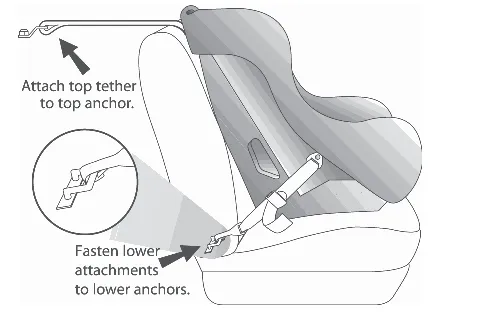 Image from www.health.ny.gov, Copyright by original author
 -
Manuals: If you rent a seat, ask for the manual. If it's missing, use your phone to find the digital version immediately before leaving the lot.
6.4 Common Rental Car Child Seat Mistakes
-
Relying on "Rideshare" Seats: In cities like Orlando or Los Angeles, don't assume every Uber or Lyft has a car seat. Only "Uber Car Seat" or "Lyft with Car Seat" options guarantee one, and they often carry a $10 surcharge.
-
Ignoring the Tether: Many parents install the lower anchors but skip the top tether for forward-facing seats. In a crash, the tether is vital for preventing the seat from tipping forward and causing head injuries.
-
Leaving the Garage Without a Fit Check: Never drive out of the rental garage until you've performed the "1-inch test": Grab the seat at the belt path and pull; it should not move more than one inch in any direction.
7. Child Car Seat Rules for Taxis and Rideshares (Uber/Lyft)
Navigating cities like New York, San Francisco, or Orlando often involves using taxis or rideshares. The rules here are notoriously confusing for visitors.
7.1 Rideshare Policies (Uber and Lyft)
In the U.S., Uber and Lyft drivers are generally considered private operators, and passenger car seat laws apply to them just like any other car.
-
The "Uber Car Seat" Option: Available in select cities (e.g., NYC, Orlando, Washington D.C.). For an extra $10 fee, you can request a car with one forward-facing seat (usually for children over 2 years, 22+ lbs, and 31+ inches).
-
Bringing Your Own: You can install your own car seat in an Uber or Lyft. Drivers are expected to wait for you to install it, but they are not required to help.
-
Refusal of Service: If you do not have a car seat for a child who requires one by law, the driver must refuse the ride. You may still be charged a cancellation fee.
7.2 Taxi Exemptions: Fact vs. Fiction
Some cities grant taxis "exemptions" from car seat laws, but these are rare and risky.
-
NYC Taxis: In New York City, children are technically permitted to ride in the back seat of a taxi without a car seat (using a seat belt), but safety experts strongly discourage this.
-
General Rule: Most states do not exempt taxis from child restraint laws. If you are in a city without a specific taxi exemption, the driver can be ticketed, and you will be responsible for the fine.
7.3 Practical Tips for City Travelers
-
Portable Boosters: For older children, consider a foldable or inflatable booster (like mifold or BubbleBum) that fits in a backpack.
-
Travel Stroller Systems: Use a stroller where the infant car seat clicks directly into the frame.
-
Wait Times: Booking a car with a seat (Uber Car Seat) can take significantly longer than a standard ride. Plan your airport transfers accordingly.
8. FAQ: International and Visiting Families
Q: Are child car seats required for tourists and visitors in the U.S.?
A: Yes. U.S. child car seat laws apply to everyone driving on American roads, regardless of citizenship or residency. Foreign tourists must follow the specific laws of the state they are visiting.
Q: Can I use a car seat purchased outside the U.S. (e.g., Europe or Asia)?
A: Technically, most states require seats to be FMVSS 213 compliant. While European (ECE R44/R129) seats are very safe, they lack the U.S. certification label and the mandatory "chest clip." Using a non-U.S. seat could theoretically result in a citation, although police usually prioritize proper usage over label checking.
Q: Do Uber and Lyft provide child car seats in the U.S.?
A: Only in select cities and for an additional fee. You must specifically book the "Uber Car Seat" or "Lyft with Car Seat" option. If you book a standard ride without your own seat, the driver is legally required to refuse the trip, and you may be charged a cancellation fee.
Q: Are child car seats required in RVs (Motorhomes)?
A: Yes. Children must be restrained in an RV just like in a passenger car. However, finding proper anchor points in an RV can be difficult. Never install a car seat on a side-facing or rear-facing bench; they must be on a forward-facing seat with a factory-installed seat belt or LATCH system.
Q: What should I do if the police pull me over for a car seat check?
A: Stay calm and keep your hands on the steering wheel. Inform the officer if you are a visitor. Most officers are helpful and may even offer tips on better installation. However, be prepared to show your child's age/weight if asked, as these determine which seat type is legally required.
Q: Is it safe to leave a car seat in a car in hot states like Arizona or Nevada?
A: Yes, but with caution. Extreme heat can make metal buckles hot enough to cause burns. Use a sunshade or cover the seat with a towel when parked. Also, check the car seat's expiration date; extreme heat can cause plastic to degrade faster over many years.
Q: Will rental car companies ensure my seat is legally compliant for my child?
A: No. Rental agencies provide seats as a convenience, but the legal responsibility to choose the correct seat for your child’s age and weight rests entirely on the driver.
9. Child Car Seat Checklist for Families Driving in the U.S.
|
Stage |
Action Item |
|---|---|
|
Before Arrival |
Research the laws for every state on your itinerary. |
|
Before Arrival |
Check your airline's policy for checking car seats (usually free). |
|
At Rental Counter |
Inspect the rental seat for the expiration date and FMVSS label. |
|
At Rental Counter |
Request a physical or digital manual for the specific seat model. |
|
Before Driving |
Perform the "Pinch Test": Ensure the harness is snug enough. |
|
Before Driving |
Perform the "1-Inch Test": Ensure the seat base is stable. |
|
Before Driving |
Check the top tether for all forward-facing installations. |
|
On the Road |
Use a sunshade to prevent metal buckles from overheating. |
|
State Lines |
Verify if the upcoming state has stricter rear-facing or booster age requirements. |
Conclusion | Safety and Responsibility
In the United States, child car seat compliance is not just about avoiding a $100 fine; it is about providing the best possible protection for your most precious cargo. By preparing in advance, understanding the nuances of state laws, and ensuring proper installation, you can focus on what matters most: enjoying a safe and memorable American road trip.