Finding the perfect rental car in the United States used to be a simple matter of price comparison. However, as we move through 2026, the landscape has shifted into a complex battlefield of AI-driven dynamic pricing, tiered loyalty ecosystems, and hidden surcharges. Whether you are planning a family road trip across the Pacific Coast Highway or a quick business sprint in Manhattan, choosing the right booking engine is now as critical as choosing the car itself.
This guide provides an exhaustive breakdown of the three dominant players in the 2026 market: Costco Travel, Expedia, and Priceline. We will move beyond the surface-level "teaser rates" to reveal the true cost of ownership, the value of membership, and the expert strategies required to secure a premium vehicle without the premium price tag.
1. Introduction: The State of US Car Rentals in 2026
By 2026, the industry has moved fully into the era of hyper-dynamic pricing. Unlike years past, rates are now adjusted in real-time by AI algorithms that factor in everything from local event attendance to current jet fuel prices. Consequently, the "out-the-door" cost has become more opaque, with airport concession fees and energy recovery surcharges often adding 30% or more to the initial quote at the final checkout screen.
The Booking Platform Problem: Why Does the Same Car Cost So Differently?
In 2026, renting a car is no longer a simple "search and book" task. The platform you choose determines which pricing ecosystem you enter, as each operates on a fundamentally different business logic.
-
Member-Based Pricing (Costco Travel): This is a "closed-loop" ecosystem. Major rental brands (like Enterprise or Avis) are often reluctant to publicly lower prices and devalue their brand. However, they are willing to offer "secret" negotiated rates to Costco’s millions of high-quality members. In 2026, these rates remain highly transparent, often including perks like a free second driver that are stripped out elsewhere.
-
Traditional OTA Ecosystems (Expedia): Online Travel Agencies (OTAs) focus on the "one-stop-shop" convenience. Their logic is built around the One Key loyalty program. While their base rental price might not always be the lowest, Expedia uses car rentals as a loss-leader or a point-earner to anchor your entire trip (flight + hotel + car), allowing you to offset costs through ecosystem-wide rewards.
-
Opaque Discount Platforms (Priceline Express Deals): This serves as the rental industry's "inventory clearinghouse." When vendors predict an oversupply for a specific week, they dump cars into Priceline’s "opaque" system at massive discounts. You trade brand certainty for price—you won't know if you're driving a Hertz or a budget-tier Fox until after you've paid.
2026 Core Observation: The price gap isn't about the car; it’s about the "distribution tier." The exact same Toyota RAV4 is a "member reward" on Costco, a "loyalty hook" on Expedia, and "excess inventory" on Priceline.
2. Platform Deep Dives: How Each System Actually Works
To navigate the 2026 rental market effectively, it is essential to look under the hood of these booking giants. While they may appear to offer the same inventory, their contractual obligations with rental vendors and their internal reward structures vary wildly. Below, we examine the mechanics of each platform to help you identify where the true value lies for your specific itinerary.
2.1 Costco Travel: The Premium-Tier Negotiator
Costco acts as a high-volume collective bargainer for its members, focusing exclusively on "Big Four" premium vendors: Alamo, Avis, Budget, and Enterprise. By narrowing its scope, it ensures a level of service consistency that other platforms lack.
2.1.1 Membership Mechanics: The Barrier to Entry
- Mandatory Membership: Access to the Costco Travel portal is strictly reserved for active Costco members. You cannot view final negotiated rates or complete a reservation without a valid membership number.
-
Gold Star vs. Executive Membership:
-
- Gold Star ($65/year): Standard access to all car rental discounts and the "Free Second Driver" perk.
-
Executive ($130/year): Includes all standard benefits plus a 2% Annual Reward on eligible Costco Travel purchases. In 2026, with average weekly rental rates often exceeding $600, a single long trip can effectively pay for the membership upgrade.
-
-
Counter Verification: While rare, rental agents at the pickup counter in 2026 may ask to see your physical or digital Costco membership card to honor the rate.
2.1.2 The Booking Workflow: How to Reserve
-
-
Authentication: Log in to
CostcoTravel.comusing your Costco.com account credentials or membership number. -
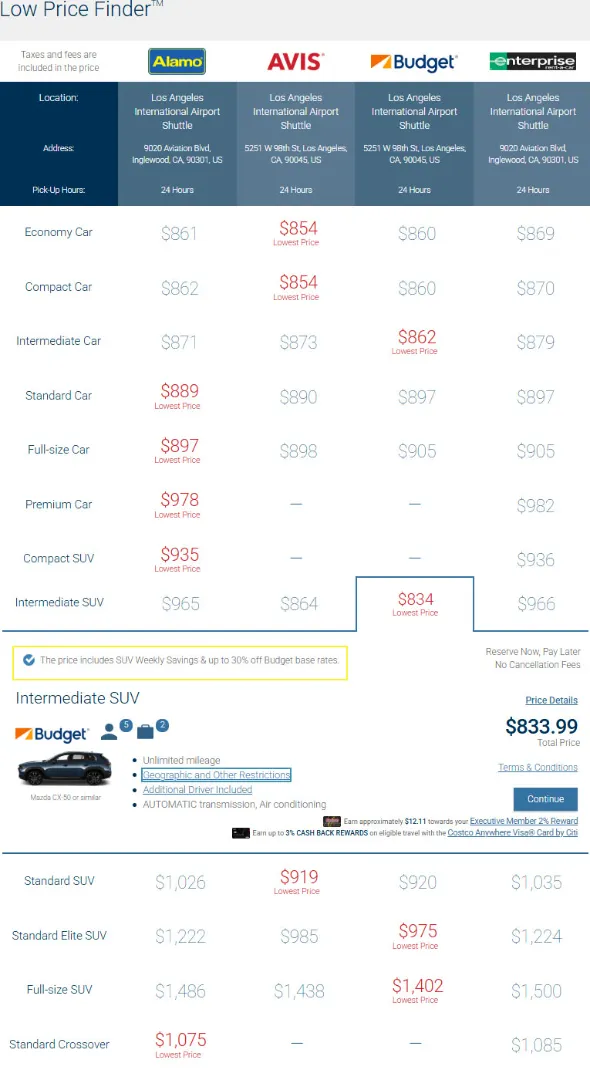
The Grid Comparison: Costco uses a unique grid view that allows you to compare four major brands and various car classes on one page, showing the total price for each.
-
No-Deposit Booking: Almost all Costco rentals utilize a "Pay at Counter" model. No credit card is required to secure the booking, providing maximum flexibility.
-
Dynamic Price Monitoring: Because there are no cancellation fees, the pro strategy in 2026 is to book early and "re-search" every few weeks. If the price drops, you simply book the new rate and cancel the old one.
-
2.1.3 The "All-In" Pricing Model
- Transparency First: Costco’s interface is famous for showing the total price including all taxes and fees on the search results page. Most competitors show a "base rate" and hide the 20-30% in airport surcharges until the final checkout screen.
-
Pay-at-Counter Flexibility: Almost 100% of Costco rentals are "Pay Later." This means no credit card is required to hold the reservation, making it the king of the "Book Early, Cancel Often" strategy.
2.1.4 Hidden Value & Niche Perks
- Free Additional Driver: In most US states, rental companies charge $10–$15 per day for a second driver. Costco includes one additional driver for free (must be a spouse or domestic partner in most cases). On a 10-day trip, this is a $150 hidden discount.
2.1.5 Is This Right for You?
- Best For: Families requiring an additional driver, travelers who prioritize premium brands (Enterprise/Alamo) over budget tiers, and anyone who wants a "no-surprises" total price upfront.
-
Skip It If: You are a solo traveler looking for the absolute lowest "Tier 3" price (e.g., Fox or Payless), or if you specifically need brands outside their network like Hertz or National.
2.2 Expedia: The One Key Ecosystem Player

Expedia is the flagship of the Expedia Group, and in 2026, it operates as a unified rewards powerhouse through the One Key program.
2.2.1 The "One Key" Loyalty Engine
-
Unified Rewards: The primary draw is OneKeyCash. Unlike airline miles which are hard to use, OneKeyCash is a simple dollar-for-dollar credit earned on every car rental, flight, or hotel stay.
-
Tier Status Benefits: By booking cars through Expedia, you accumulate "Trip Elements" that push you toward Silver, Gold, or Platinum status. Higher tiers often unlock "VIP Access" at hotels and specialized customer support lines.
2.2.2 Inventory Depth & The "Package" Trap
- Every Brand, Everywhere: Unlike Costco, Expedia lists everything from Hertz to the smallest local airport vendors. This makes it superior for finding specialty vehicles like Full-Size SUVs or high-end EVs (Teslas, Rivians).
-
Pay Now vs. Pay Later:
-
Pay Now (Prepaid): Often provides a lower headline rate. However, these are strictly governed by cancellation windows. In 2026, OneKeyCash rewards are often credited faster with prepaid bookings, but you lose the "re-book if price drops" flexibility.
-
Pay Later (Reserved): You pay at the rental counter. While the daily rate might be slightly higher than the prepaid option, it allows for free cancellation up until pickup, making it safer for volatile itineraries.
-
-
The Bundle Illusion: Expedia heavily promotes "Bundle and Save." While it can save you money to book a flight + car together, be wary: bundled car rentals are often prepaid and non-refundable.
2.2.3 Is This Right for You?
- Best For: Travelers already invested in the One Key ecosystem (flights/hotels), those seeking high-end EVs or specific niche vehicle classes, and those who value a consolidated "one-app" trip management experience.
-
Skip It If: You want the absolute lowest base price regardless of points, or if you prefer the "pay later" flexibility of Costco and hate the aggressive "Bundle" marketing pop-ups.
2.3 Priceline: The Budget Warrior’s Weapon
Priceline remains the "wild card" of US travel, built on their aggressive "opaque" pricing tools.
2.3.1 Retail vs. Express Deals: The Gamble
- Express Deals (The Opaque Model): You see the car class, general location, and a star rating, but the brand is hidden. In 2026, these deals can be up to 50% off retail.
2.3.2 Decoding the Mystery Brand
- The "Reveal" Trick: Experts look at the "Previous User Ratings" and "Exact Location" descriptions. If an Express Deal says "4.5/5 rating" and "In-Terminal," it is almost certainly a premium brand like National or Enterprise.
2.3.3 The "No-Flexibility" Trade-off
-
The moment you click "Book" on an Express Deal, your money is gone. This makes it a high-risk strategy for 2026, where itinerary disruptions (such as delayed flights or sudden plan changes) can leave you paying for a car you cannot pick up.
2.3.4 Suitability Assessment: Is This Right for You?
- Best For: Solo travelers on a tight budget, risk-takers who don't care about the specific rental brand, and last-minute bookers when retail inventory is scarce and overpriced.
- Skip It If: Your travel dates are not 100% firm, you have specific brand requirements (e.g., must be National for Emerald Club perks), or you need a free second driver for a family trip.
3. Comprehensive Comparison: A Side-by-Side Analysis
To truly understand the value differences, we conducted a real-world test for June 2026 (Peak Summer Season) with a pickup/return at Los Angeles International Airport (LAX).
3.1 Pricing Showdown (5-Day Mid-Size SUV Rental)
|
Feature |
Expedia (Retail) |
Priceline (Express Deal) |
|
|---|---|---|---|
|
Headline Rate |
$485 (All-In) |
$420 (Base Only) |
$295 (Base Only) |
|
Actual Total (Tax/Fees) |
$485 |
$545 |
$415 |
|
Payment Policy |
Pay at Counter |
Choice: Pay Now/Later |
Strict Prepaid Only |
|
Second Driver |
$0 (Included) |
$15–$25/day extra |
Market Rate |
|
Reward Value |
2% (Executive Only) |
~1.5% in OneKeyCash |
N/A |
Key Findings:
-
Airport vs. City: In 2026, airport concession fees at LAX add roughly 28% to any retail quote. Costco is the only platform that reflects this honestly at the start of the search.
-
Duration Logic: Daily rates on Costco are often high, but their Weekly/Long-term rates are unmatched due to fixed-contract negotiations for stays over 5 days.
3.2 Inventory & Brand Coverage
-
Costco: Limited to Tier 1 brands (Avis, Budget, Enterprise, Alamo). You are guaranteed a newer vehicle with high maintenance standards.
-
Expedia: Deepest inventory. If you want a specific Cadillac Lyriq or Tesla Model Y, Expedia's filters for EV/Luxury are far superior to Costco’s generic "Luxury" category.
-
Priceline: High volatility. You might end up with a premium Enterprise car, or a high-mileage vehicle from a budget vendor located in a remote off-site lot requiring a 20-minute shuttle ride.
3.3 Cancellation & Flexibility (The "Peace of Mind" Factor)
|
Platform |
Free Cancellation Deadline |
Modification Pricing |
Flexibility Summary |
|---|---|---|---|
|
Until the moment of pickup |
Free (Current market rate) |
Industry Gold Standard. No credit card required means zero financial risk. |
|
|
48-72 Hours before pickup |
Dependent on Rate Type |
High Variability. Prepaid rates are restrictive; "Pay Later" mirrors Costco's ease but at a premium. |
|
|
None (Express Deals) |
No modifications allowed |
Zero Flexibility. Express Deals are locked upon booking. No refunds for change of plans. |
-
Costco Strategy: The "Infinite Re-book." Since there are no penalties, members can modify their booking as many times as they want to capture price drops.
-
Expedia Strategy: Reserved for "Tier 1" status users. One Key Gold/Platinum members often get more lenient cancellation windows, but for standard users, the 48-hour cutoff is strict.
-
Priceline Strategy: "Final Sale Only." Only use this if you have independent travel insurance or if the 50% savings justifies the risk of total loss.
3.4 Insurance & Add-on Transparency
In 2026, the "base price" is rarely what you pay. Each platform handles the upsell of insurance and additional fees differently.
-
Insurance Presentation:
- Costco: Stays neutral. It does not aggressively push 3rd-party insurance during booking, as it assumes members use high-end credit card coverage.
-
Expedia & Priceline: Both utilize aggressive "dark patterns" to sell 3rd-party Collision Damage Protection (usually via Allianz or similar) at $11–$15/day. In 2026, these 3rd-party policies are often harder to claim than the rental agency’s own counter insurance.
-
One-Way (Drop-off) Fees:
3.5 User Experience & Customer Support
-
Expedia (The AI Leader): In 2026, Expedia’s AI chatbot is highly capable of handling simple cancellations and modifications. However, getting a human for complex billing disputes remains a challenge.
-
Costco Travel (The Human Touch): Costco maintains a dedicated US-based call center. During peak 2026 travel disruptions, Costco members often report shorter wait times and more empowered agents compared to OTA customers.
-
Priceline (Self-Service Focused): Excellent mobile app for rapid booking, but support is almost entirely automated. If an "Express Deal" goes wrong (e.g., the car is unavailable), the resolution process is notoriously slow.
4. 2026 Head-to-Head Comparison: Real-World Scenarios
To help you decide which platform to open first, we’ve simulated three common 2026 travel scenarios where these giants battle for your wallet.
4.1 Scenario A: The 10-Day Family Road Trip (California Coast)
-
The Goal: A reliable Minivan or Full-Size SUV with a second driver.
-
Costco Winner: In 90% of cases, Costco Travel crushes this scenario. Because weekly rates (5+ days) trigger heavy corporate discounts and the second driver fee ($150 savings over 10 days) is waived, Costco's "all-in" price is usually lower than even Priceline's retail rates.
-
Key Advantage: If you find a better price 3 days before the trip, you can cancel Costco and rebook instantly.
4.2 Scenario B: The Solo Business Sprint (3 Days in NYC/EWR)
-
The Goal: A reliable mid-size car, minimal fuss, maximum rewards.
-
Expedia Winner: Expedia shines here. For short trips, the price differences between platforms are often marginal (under $20). However, the "Trip Elements" earned on Expedia move you closer to Gold/Platinum status, which pays off in hotel upgrades later that year.
-
Key Advantage: Using the Expedia App to find "Mobile-Exclusive" deals at airport locations can often undercut Costco’s fixed negotiated rates for short-duration stays.
4.3 Scenario C: The Last-Minute Budget "Escape" (Miami Weekend)
-
The Goal: Absolute lowest price, zero brand loyalty.
-
Priceline Winner: Priceline Express Deals are the undisputed king here. When Florida rental agencies have excess inventory on a Thursday for a Friday pickup, they "dump" it on Priceline.
-
The Catch: In 2026, Miami airport shuttle buses for budget brands can take 45+ minutes. If you use Priceline, ensure you’ve "decoded" the deal (see 3.3.2) to ensure you aren't stuck at a vendor 5 miles off-site.
4.4 The 2026 "Inventory Crisis" Comparison (Holiday Peak)
-
Reliability vs. Price: During Christmas or Spring Break 2026, "Oversold" notices are common.
-
Costco/Expedia (Premium Brands): Vendors like National and Enterprise prioritize their direct and corporate-partner (Costco) bookings. Your car is "safe."
-
Priceline (Budget Brands): If you booked a "Mystery Brand" for $30/day when the market rate is $150, you are the first to be told "we are out of cars" if the fleet runs low.
- Verdict: Never use Priceline for high-stakes holiday travel in 2026.
4.5 EV & One-Way Logistics: A New Battleground
-
Electric Vehicles (EVs): Expedia has the best filters for EVs in 2026, allowing you to specifically search for "Long Range" or "Tesla Only" options. Costco's interface remains laggy in this specific category.
-
One-Way Rentals: If you are picking up in Vegas and dropping off in LA, direct-to-vendor or Expedia often show more accurate "Drop Fees." Costco occasionally fails to calculate the massive $300+ drop-off surcharges correctly until the very last step.
5. Is Costco Always the Cheapest? The Final Verdict
A common misconception in 2026 is that a Costco membership guarantees the lowest price. While often true, the reality is more nuanced.
5.1 When Costco is Unbeatable
-
Weekly Rentals (5+ Days): Costco's contract with Alamo/Enterprise is optimized for long durations. For a 7-day trip, Costco is almost always 15-20% cheaper than retail.
-
Family Travel: If you need a second driver, Costco saves you a hidden $100–$150 per week that Expedia/Priceline users pay at the counter.
-
Peak Season (Holidays): During high-demand periods like Christmas or Summer, Costco's "locked-in" rates don't spike as aggressively as the AI-driven prices on OTAs.
5.2 Best-Use Case Summary
-
Costco Travel: The "Safety First" choice. Best for families, premium brand loyalists, and long-term road trips.
-
Expedia: The "Ecosystem" choice. Best for business travelers stacking points and those needing specific EV/Luxury models.
-
Priceline: The "Hail Mary" choice. Best for solo travelers and ultra-low-budget trips where brand and schedule flexibility are sacrificed for raw savings.
5.3 When to Skip Costco for Expedia or Priceline
-
Solo/Short Trips (1-2 Days): Costco's daily rates can be high. Expedia often offers cheaper "Tier 2" brands (like Fox or Sixt) that Costco doesn't carry.
-
Last-Minute "Opaque" Wins: If you are booking 24 hours before pickup, Priceline Express Deals often undercut Costco by 40% as vendors desperately try to clear unrented fleet.
-
OneKeyCash Redemptions: If you have $200 in OneKeyCash from a previous flight, using it on an Expedia car rental makes it "cheaper" than any Costco cash price.
5.4 One-Sentence Takeaway
-
Costco: The most reliable value for premium service.
-
Expedia: The most versatile tool for rewards and selection.
-
Priceline: The most aggressive way to save, if you're willing to gamble.
6. Expert Hacks: How to Win at US Car Rentals in 2026
6.1 What if the price drops after I book?
The #1 mistake in 2026 is "one-and-done" booking.
-
The Re-booking Loop: If you used Costco Travel or Expedia’s "Pay Later" option, you should check prices every Tuesday. If the price drops, simply make a new reservation and cancel the old one.
-
AutoSlash: Use tools like AutoSlash.com to automate this. They track your specific confirmation number and notify you the moment a cheaper rate appears on any platform.
6.2 Avoiding Airport Surcharges & Hidden Fees
-
The "Uber-to-City" Strategy: For rentals longer than 4 days, check the rates at "Off-Airport" (Downtown) locations. Even after paying $40 for an Uber from LAX to a city office, you can often save $200+ by avoiding the "Airport Concession Recovery Fee" (often 15-20%).
-
Refueling Scams: Never opt for "Prepaid Fuel." AI-monitored fleet tracking now allows rental companies to charge you the exact market rate for gas + a massive service fee if you return the car even 1 gallon short.
6.3 The Credit Card Insurance Masterclass
In 2026, the cost of "Counter Insurance" (CDW/LDW) has soared to $35–$50 per day. To safely decline this, you must understand the Primary vs. Secondary distinction.
- Primary vs. Secondary: Most basic credit cards offer "Secondary" coverage (it only pays after your personal insurance). You want Primary coverage (available on Chase Sapphire Reserve, Amex Platinum, or Venture X) which keeps a rental accident off your personal record entirely.
| Item | Chase Sapphire Preferred | Standard Credit Cards (most Visa/Mastercard/AmEx) |
|---|---|---|
| Insurance Type | Primary — Pays first in case of an accident; no need to use personal auto insurance (if conditions met) | Secondary — Typically, personal auto insurance pays first; credit card covers remaining costs (e.g., deductible) |
| Coverage | Collision Damage Waiver (CDW), theft, reasonable loss-of-use fees, and towing by rental company (does not cover liability, personal injury, or personal property) | Usually covers vehicle collision/theft damage; similar coverage but as secondary insurance |
| Coverage Limit | Up to the vehicle’s actual cash value (commonly around $60,000) | Limits vary by issuer and card type; generally lower than premium cards, commonly covers CDW/LDW but at lower amounts |
| Requirements | Must pay full rental with the card and decline rental company CDW/LDW | Similar: must pay with the card and decline rental company insurance; terms may be stricter or claims process more cumbersome |
| Covered Drivers | Cardholder + authorized drivers on rental contract | Usually cardholder + authorized drivers on rental contract, but check individual card terms |
| Liability Coverage | ❌ Not included (personal auto insurance or rental company coverage needed) | ❌ Generally not included, whether primary or secondary |
| Claims Convenience | Usually straightforward (primary insurance handles directly) | More cumbersome (usually report to personal auto insurance first, then credit card coverage supplements) |
- The Amex Premium Hack: If you don't have a high-fee card, you can enroll any Amex in "Premium Car Rental Protection" for a flat fee of ~$20–$25 per entire rental period (not per day).
6.4 Should you buy the counter insurance?
-
When to say YES: If you are renting an EV (Teslas are expensive to repair), if you don't have personal auto insurance, or if you are an international traveler without a US-issued credit card.
-
When to say NO: If you have Primary CDW from your credit card and a personal auto policy with high liability limits. The agent will use fear tactics—stay firm.
6.5 Direct via Brand Website vs. OTA?
-
Direct (Avis.com, Hertz.com): Use this only if you are chasing Elite Status (e.g., Hertz President’s Circle) or using a specific corporate discount code (CDP/AWD).
-
OTA (Costco/Expedia): Use this for 90% of leisure trips. The "negotiated" OTA rates almost always beat the "retail" price on a brand’s own website, unless you are using a specialized business account.
7. Final Verdict: Which Platform Should You Use?
| Core Trigger | Costco Travel | Expedia | Priceline (Mystery Box) |
|---|---|---|---|
| Are you a member / ecosystem tie-in? | ✅ Clear advantage for Costco members | ✅ One Key points users benefit | ❌ No membership system |
| Second driver included? | ✅ Usually more generous / often free | ⚠️ Depends on the rental company | ⚠️ High uncertainty |
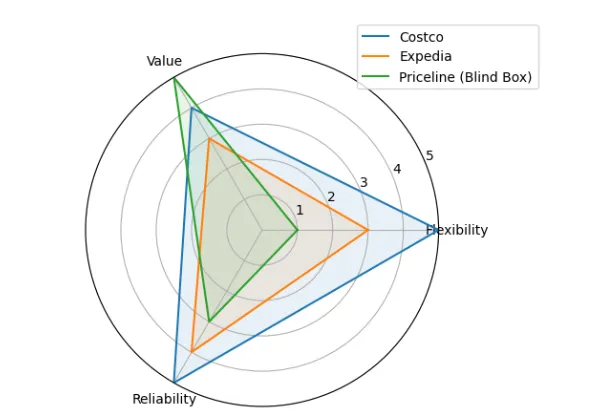
| Flexibility for cancellation / changes | ⭐⭐⭐⭐⭐ Can cancel anytime before pickup | ⭐⭐⭐ Must cancel 24–48h in advance | ⭐ 0 Flexibility |
| Car model selection precision | ⭐⭐ Basic, sufficient | ⭐⭐⭐⭐⭐ Very precise | ⭐ Almost none |
| Rental company quality control | ⭐⭐⭐⭐⭐ Mainstream major companies | ⭐⭐⭐⭐ Mostly mainstream | ⭐ Random |
| Cheapest possible price | ⭐⭐⭐⭐ Stable good price | ⭐⭐⭐ Market price | ⭐⭐⭐⭐⭐ Often the lowest |
| Best suited for | Uncertain schedule / family trips | Planning enthusiasts / integrated itinerary | Fixed schedule / budget travel |
Summary Decision Matrix
-
Families & Multi-Driver Groups → Costco Travel (Predictability & Free 2nd Driver).
-
Loyalty Maximizers → Expedia (Point synergy & EV selection).
-
Solo & Ultra-Budget Hunters → Priceline (Lowest "Opaque" prices).
8. Frequently Asked Questions (FAQ)
Q: Is it cheaper to rent a car at the airport or off-site?
A: In 2026, off-site car rental locations (city offices or suburban branches) are generally 20-30% cheaper because they avoid heavy airport concession recovery fees. However, factor in the cost of an Uber or shuttle to the location. For rentals under 3 days, the airport convenience often outweighs the savings.
Q: Can I find under 25 car rental deals on these platforms?
A: Yes, but policies vary. Costco Travel often restricts bookings to those 25+, though some Budget/Avis locations through Costco may allow younger drivers with a surcharge. Expedia allows you to filter for "Driver aged 20-24," but expect an "Underage Driver Fee" of $25–$50 per day to be added at the counter.
Q: How do one-way rental fees work on Expedia vs. Costco?
A: Costco Travel is excellent for one-way rentals (e.g., picking up in LA and dropping in San Francisco) because the "Drop-off Fee" is usually built into the initial quote. On Expedia, these fees are sometimes hidden in the fine print and collected at the counter, so always check the "Total Price" breakdown carefully before confirming.
Q: Are EV charging costs included in the rental price?
A: No. In 2026, you are responsible for EV charging fees during your trip. Most rental agencies (especially those on Expedia) now have a "Return at 70%" policy. If you return an Electric Vehicle with a low battery, you will be hit with a "Recharging Service Fee" that is significantly higher than public Supercharger rates.
Q: Is a debit card accepted for car rentals in 2026?
A: Most major brands on Costco and Expedia (Avis, Enterprise, Hertz) accept debit cards, but with a major caveat: they will often perform a credit check and place a "hold" of $200–$500 plus the rental cost on your account. Prepaid platforms like Priceline Express Deals often require a credit card for the security deposit even if the rental was paid with a debit card.
Q: What is the best time to book a rental car for peak holidays?
A: The sweet spot for peak holiday car rentals (Thanksgiving, Christmas) is 3 to 4 months in advance. Using the Costco "Pay Later" strategy, you should lock in a rate early and then re-check every week. AI pricing usually causes a massive spike in the final 14 days before a holiday.
Q: Can I add an additional driver after the booking is complete?
A: For Costco Travel, the first additional driver is usually free, but they must be added at the counter when you pick up the car. For Expedia or Priceline, adding a driver at the counter will trigger a daily fee of $10–$15. It is almost always better to choose a platform that includes the driver in the base contract if you aren't traveling solo.
9. Appendix: Quick Reference
9.1 Glossary of Terms
-
CFC (Customer Facility Charge): A per-day fee collected by the airport to fund transportation infrastructure (shuttles, rental centers).
-
Opaque Booking: A reservation where the specific rental brand (e.g., Hertz vs. Budget) is hidden until the booking is non-refundably confirmed.
-
Concession Fee: A percentage-based surcharge (often 10-15%) that airports charge rental companies for the right to do business on-site.
-
CDW/LDW (Collision/Loss Damage Waiver): The rental agency's optional insurance that waives your financial responsibility for damage to the vehicle.
9.2 2026 Rental Brand Tier List
Choosing the right brand is as important as choosing the platform. Here is the 2026 market hierarchy:
-
Premium Tier (Best for business & speed):
-
National: Known for the "Emerald Aisle" (choose any car).
-
Hertz: High-end EV fleet and "Gold Plus" bypass-the-counter service.
-
Avis: Premium loyalty perks and high-frequency airport locations.
-
-
Mid-Tier (Best for families & overall value):
-
Enterprise: The gold standard for customer service and off-airport locations.
-
Alamo: Often the best choice for Disney/Florida vacations; user-friendly kiosks.
-
Budget: The value-oriented sister brand to Avis.
-
-
Budget Tier (Best for raw savings):
-
Thrifty / Dollar: Reliable but with fewer counter agents and older fleets.
-
Fox Rent A Car: Often off-airport, requiring a longer shuttle ride.
-
Sixt: European-style fleet (BMW/Mercedes) but with strict damage inspection protocols.
-