Imagine this: You've just landed at JFK after a 12-hour international flight. You're exhausted, jet-lagged, and just want to reach your hotel in Long Island City—barely 5 miles away. You open Uber or Lyft, and the screen flashes a staggering $55.
You do a quick mental calculation. Back home, or even in downtown Manhattan, a 5-mile trip costs maybe $15 to $18. Is the driver taking advantage of you? Is the app broken?
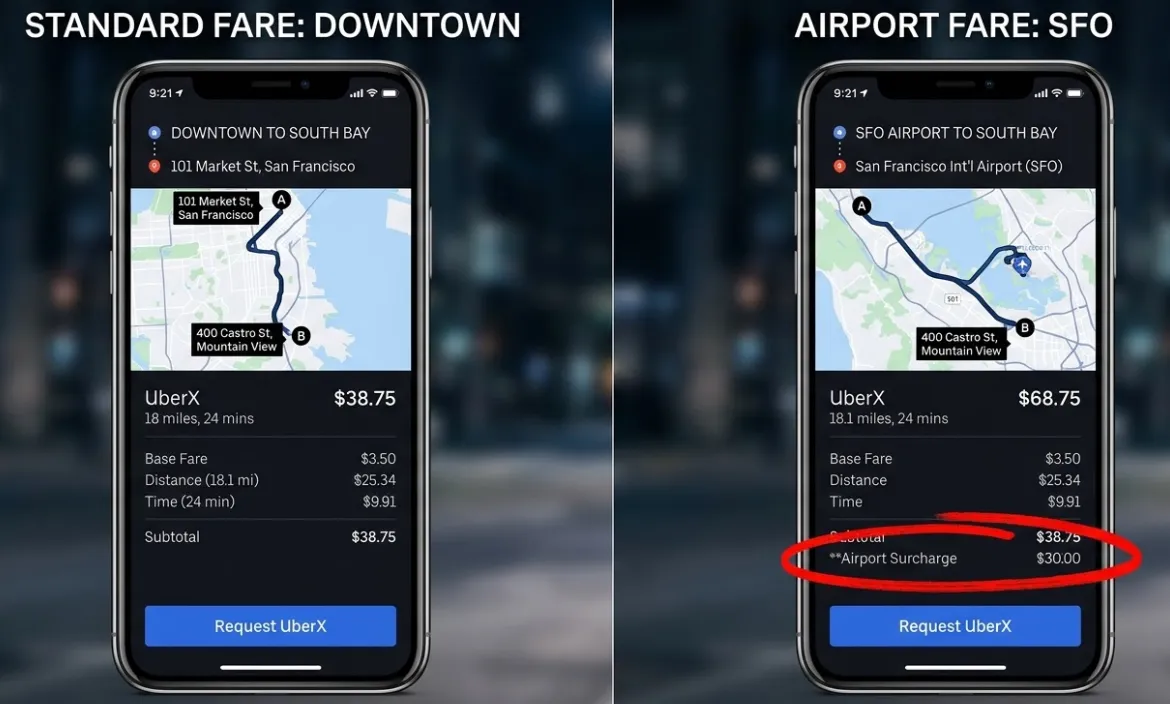
The reality is that airport premiums in the U.S. are a complex cocktail of local taxes, airport access fees, and aggressive algorithms. For international travelers, U.S. expats, and frequent flyers, these costs can add hundreds of dollars to annual travel budgets. This guide will deconstruct why these prices exist and, more importantly, give you 6 proven "hacks" to keep that money in your pocket.
Uber / Lyft Price Comparison: City vs Airport Pickup
| Airport | Example Route (Approx Distance) | Price from City Area | Price from Airport | Airport Premium | Premium Rate |
|---|---|---|---|---|---|
| LAX (Los Angeles) | 9 miles – Santa Monica ↔ Downtown area | $22 | $34.75 | +$12.75 | +58% |
| JFK (New York) | 12 miles – Manhattan Midtown | $38 | $52.40 | +$14.40 | +38% |
| SFO (San Francisco) | 13 miles – Downtown SF | $32 | $49 | +$17 | +53% |
Executive Summary: The "Quick Win" Checklist
Compare Apps: Always check both Uber and Lyft; prices can differ by $15+ instantly.
Exit the "Geo-Fence": Walking just 5-10 minutes outside the terminal boundary can reset surge pricing and remove airport fees.
The Shuttle Pivot: Hop on a free hotel or rental car shuttle to request your ride from a non-airport zone.
Timing is Key: Waiting 20 minutes for the "first wave" of passengers to clear can slash rates by 30%.
1. The Anatomy of an Airport Fare: Why is it so expensive?
Before you can beat the system, you have to understand it. Your airport fare isn't just "Time + Distance." It is inflated by four major "invisible" factors:
-
Airport Access Fees ($2.50 - $7.50): Most U.S. airports charge rideshare companies a "permit fee" to operate on their grounds. Whether your ride is 2 miles or 20 miles, this flat fee is passed directly to the passenger.
-
The Surge Algorithm (The "Demand Spike"): Algorithms detect when a massive "bank" of flights (e.g., three Boeing 777s from Europe) lands simultaneously. When 1,000 people open the Uber app in the same GPS "geo-fence," prices can jump 1.5x to 3x instantly.
-
Ground Transportation Taxes: Cities like Chicago (ORD) and Seattle (SEA) impose specific commercial vehicle taxes. These aren't just standard sales taxes; they are "ground transportation" levies that can add another $5 to $6 to your bill.
-
Logistical Deadhead & Rerouting: Due to congestion, major hubs (like LAX or SFO) force rideshare drivers to wait in a "holding lot" miles away. The time and distance it takes for them to loop around to the designated Ride-share Pickup Zone are factored into your upfront quote.
2. Data Snapshot: The Premium in Major Hubs
To truly understand the "Airport Tax," we must look at the numbers. Data from thousands of logged trips reveals that airport pickups are consistently the most expensive miles you will ever travel in a rideshare.
The "Premium Gap" Analysis
The following table compares a standard 5-mile trip (non-surge) starting from a city center versus the same 5-mile trip originating from an airport terminal.
|
City / Hub |
Standard 5-Mile Fare (City) |
Airport 5-Mile Fare (Terminal) |
Estimated Premium |
Mandatory Airport Fee |
|---|---|---|---|---|
|
New York (JFK) |
$18.50 |
$55.00 |
~297% |
$5.00 |
|
Los Angeles (LAX) |
$15.20 |
$42.50 |
~280% |
$4.00 |
|
San Francisco (SFO) |
$14.00 |
$38.00 |
~271% |
$5.50 |
|
Chicago (ORD) |
$13.50 |
$34.00 |
~252% |
$5.00 + City Tax |
|
Seattle (SEA) |
$16.00 |
$39.50 |
~247% |
$6.50 |
Why the Gap Fluctuates
While "Mandatory Fees" are fixed, the Premium Gap varies based on three real-time variables:
-
The "Wait-Time" Factor: Drivers at JFK and LAX often wait in virtual queues for 45–90 minutes. Platforms increase the passenger fare to compensate for the driver’s opportunity cost while idling.
-
Peak vs. Off-Peak: During a "Flight Bank" (when 10+ flights land within 30 minutes), the premium can skyrocket to 400% due to local supply depletion.
-
Vehicle Class Availability: Airports often restrict lower-cost tiers (like UberX Share) during busy hours, forcing passengers into "UberX" or "Uber Comfort" pricing.
Note: Crossing the "Geo-Fence"—the invisible digital boundary around the airport—is often the singular trigger that raises a base rate by $20 or more instantly.
3. The 6 Pro Hacks: Actionable Strategies to Save Money
1. Walk Past the "Geo-Fence"
Estimated Savings: $8 - $15
If you have light luggage and 10 minutes to spare, check the airport map. Often, if you walk just outside the official airport boundary—to a nearby gas station, a fast-food outlet, or an office park—the "Airport Access Fee" disappears and the surge multiplier resets to the standard city rate.
2. The "Double-App" Comparison (Uber vs. Lyft)
Estimated Savings: $5 - $20
The Pro Rule: Never rely on one app. Uber and Lyft use different algorithms to sense demand. While Uber might be surging because of a flight arrival, Lyft might not have caught up yet. Keeping both apps open can save you a $15 "impulse" premium. In New York specifically, Lyft is often significantly cheaper than Uber due to the way it calculates city-mandated driver pay and surcharges.
3. The Hotel Shuttle Pivot
Estimated Savings: $10 - $20
This is a favorite for savvy business travelers. Hop on a free shuttle for a nearby airport hotel (like a Hilton or Marriott). Once you arrive at the hotel lobby, call your Uber from there. You bypass the airport traffic, avoid the access fees, and get to wait for your car in a climate-controlled lobby instead of a chaotic curb.
4. The 20-Minute Grace Period
Estimated Savings: $15 - $30
The highest surge occurs exactly 15-20 minutes after a flight bank lands. Instead of rushing to the curb, go grab a coffee or use the lounge. By the time you finish your drink, the "first wave" of passengers has departed, and the algorithm often drops the price significantly.
5. Taxi Flat-Rates: The "Old School" Advantage
Estimated Savings: $10 - $25 during high surge
In cities like New York (JFK), taxis often have a Flat Rate to Manhattan. During heavy rain or holiday surges, Uber might quote you $120, while the yellow cab remains at its fixed price (plus tolls/tip). Always check the taxi board before you hit "Request" on your phone.
6. Uber Reserve: Lock in Your Fare
Estimated Savings: $15 - $40 during peak holidays
If you are landing during a known peak time (e.g., Sunday night or Monday morning), use the Uber Reserve feature at least 2 hours before landing. This locks in the price based on standard demand, protecting you from the 3x surge that will inevitably happen when you actually touch down.
4. City-Specific Tactics & Warnings
Every U.S. hub has its own logistical quirks. Understanding these specific terrains is the difference between paying $80 and paying $30.
🗽New York (JFK): The "Jamaica Station" Pivot
JFK is notorious for "hidden" tolls (Midtown Tunnel/RFK Bridge) that aren't shown in your initial Uber quote.
-
The Strategy:
-
Follow signs for the AirTrain (located in all terminals).
-
Take the train to Jamaica Station (approx. 15-20 mins).
-
Exit at Jamaica. Once you are outside the station gates, the "Airport Geo-fence" is gone.
-
Action: Request your Uber/Lyft from Sutphin Blvd. You save the $5 airport fee and typically see a $20–$35 reduction in base fare compared to terminal pickups.
-
-
Warning: Never take a ride from "unmarked" drivers in the arrivals hall. These are illegal "gypsy cabs" and will often overcharge you by double.
🌴Los Angeles (LAX): The "Century Blvd" Escape
LAX implemented "LAX-it" to move rideshares to a remote lot, but they didn't lower the fees.
-
The Strategy:
-
The Fast Track: If you land at Terminal 1, don't wait for the shuttle. The LAX-it pickup lot is only a 3-5 minute walk from the Terminal 1 baggage claim. It’s almost always faster than the bus.
-
The Hotel Pivot: Hop on any Free Hotel Shuttle. Choose a major hotel like the Hyatt Regency LAX or Sheraton Gateway.
-
Once at the hotel, walk into the lobby and call your ride.
-
Action: By calling the ride from Century Blvd (outside the airport perimeter), you avoid the "LAX-it" congestion and the $4 airport fee. Prices often drop another 15-20%.
-
🌉San Francisco (SFO): The "Rental Car Center" Shortcut
SFO has some of the highest airport fees in the country.
-
The Strategy:
-
Take the Blue Line AirTrain (Free) to the Rental Car Center.
-
From the Rental Car Center, walk to the nearby Westin or Aloft San Francisco Airport (a 5-minute walk).
-
Action: Request your ride from the hotel entrance. This bypasses the terminal-specific surcharges and usually helps you avoid the massive traffic loop at the departures level.
-
🛫Newark (EWR): The Cross-State Surcharge Trap
EWR is located in New Jersey. If you take an Uber from EWR to Manhattan, you are crossing state lines.
-
The Warning: Expect a mandatory $20 "TLC" or Cross-State Surcharge added to your bill. Drivers cannot pick up a passenger on the way back to NJ, so you are essentially paying for their empty return trip.
-
The Move: Take the New Jersey Transit (NJT) train from the airport to New York Penn Station for ~$16. It is faster than any car and saves you the $20 surcharge plus the $16 Holland/Lincoln Tunnel toll.
🌃Chicago (ORD): The Blue Line Strategy
-
The Strategy: Use the CTA Blue Line. For $5, it takes you directly into the Loop. If you must have a car, take the Blue Line just two stops to Rosemont. Call your Uber from the Rosemont station. The fare to downtown will be significantly lower because you've cleared the O'Hare commercial vehicle tax zone.
5. The "Advanced" Gamer: Optimizing Credit Card Perks
For expats and business flyers, your choice of plastic can slash your commute costs:
The Uber Masters: American Express
-
The Amex Ecosystem: The Amex Platinum card gives you $200 in annual Uber Credits ($15/month, $20 in December).
Pro Tip: This credit also applies to Uber Eats, making it useful even if you aren't traveling that month.
-
The Amex Gold Card: Provides $120 in Uber Cash ($10/month).
-
Stacking Logic: If you hold both cards, the credits stack automatically in your Uber wallet, giving you $25-$45 in "free" airport rides every month.
The Lyft Specialist: Chase Sapphire Reserve
-
10x Total Points: you'll receive an extra 4x bonus points on eligible Lyft rides through September 30, 2027.
⚠️ The "Foreign Transaction Fee" Warning
If you are using a non-U.S. credit card to pay for your rides, check for Foreign Transaction Fees (FX Fees). Many standard international cards charge 2.5% to 3% per transaction. If your card has this fee, the "savings" you gained from these hacks might be eaten up by bank charges. Always use a "No FX Fee" card (like a travel-branded Visa or Mastercard) when traveling in the U.S.
6. FAQ
Q: What is the standard tipping etiquette for airport rides?
A: Tipping is non-mandatory but culturally expected in the U.S. The standard is 10-15% for a standard ride. If the driver handles multiple heavy suitcases or navigates through extreme weather, 18-20% is the professional norm. You can tip through the app after the ride, or give $2-$5 in cash if you prefer.
Q: Why can't I find my driver at the arrivals curb?
A: To prevent terminal gridlock, most major U.S. airports (like LAX, SFO, and ORD) ban rideshare pickups at the immediate arrivals curb. You must follow the purple or green signs for "Ride-share Pickup" or "Transportation Center," which often requires a shuttle or a 5-minute walk.
Q: Should I choose UberX, Uber Comfort, or UberXL?
A: If you are a solo traveler with one bag, UberX is fine. However, if you have two large "international-sized" suitcases, an UberX (often a small sedan) might not fit them. Uber Comfort guarantees a mid-sized vehicle with more legroom, while UberXL is mandatory for groups of 3+ with luggage.
Q: Are there hidden tolls that aren't included in the app's upfront price?
A: Generally, the app estimates tolls, but if a driver takes a different bridge or tunnel due to traffic, the final price will adjust. In New York, the $15 toll for the Queens-Midtown Tunnel is a frequent "surprise" on the final receipt.
Q: Is it safe to use "unmarked" cars at the airport?
A: Absolutely not. If someone approaches you in the terminal saying "Taxi? Uber?", decline politely. These are unlicensed "solicitors" who operate without commercial insurance and often charge 2-3x the standard rate. Only use vehicles requested through an official app or the official taxi stand.
Q: Why is Newark (EWR) so much more expensive when going to NYC? 、
A: Because you are crossing from New Jersey into New York. Drivers must pay a $16 bridge/tunnel toll to enter NYC, and since they can't legally pick up a passenger in NY for a return trip, a mandatory $20 "Cross-State" surcharge is added to compensate for their empty return journey.
Q: Can I use the "Uber Share" (Carpool) option from the airport?
A: Some airports have banned "Share" options due to congestion, while others allow it. While it saves 10-20%, be warned: your driver may pick up another passenger, turning a 30-minute trip into an hour-long ordeal. It is not recommended for jet-lagged travelers.
Q: How do I handle a driver who asks for a cash payment instead of the app?
A: This is a violation of the terms of service. Never pay cash for the fare itself. It removes your insurance coverage and makes it impossible to track the ride. If a driver insists, cancel the ride and report them to the platform.
7. Summary & Final Disclaimer
A few minutes of strategic thinking can easily save you $20 to $40 on an airport transfer—money better spent on your first meal in the city.
Disclaimer: Rideshare pricing is highly volatile. Rates mentioned are based on current averages and can change due to local legislation, gas prices, and seasonal shifts. Always verify the final fare and breakdown in the app before confirming your ride.