Navigating the complexities of American DUI laws requires more than just a basic understanding of traffic rules; it demands a comprehensive awareness of the high-stakes legal and administrative machinery that mobilizes the moment a siren wails behind you. As enforcement technologies and federal policies evolve in 2026, the margin for error has vanished. This guide serves as a critical roadmap for anyone behind the wheel in the United States, detailing the sequence of events from the initial stop to the long-term repercussions on your finances and legal standing.

1. The Hidden Cost of a DUI in America
Editor's Note: According to the latest data from the NHTSA (National Highway Traffic Safety Administration), one person dies in a drunk-driving crash every 39 minutes in the United States.
A DUI (Driving Under the Influence) in the US is far more than a simple traffic ticket—it is a serious criminal offense. By 2026, state laws have reached an unprecedented level of strictness. Whether you are a US citizen, a green card holder, or a visa holder (F1, H1B, J1, L1), a single DUI arrest can derail your life, lead to thousands of dollars in debt, and even result in deportation.
2. Legal Definitions: DUI vs. DWI vs. DUID
While terms vary by state, the core legal logic remains consistent across the country:
-
DUI (Driving Under the Influence): The most common term, referring to impairment by alcohol, illegal drugs, or controlled prescription medications.
-
DWI (Driving While Intoxicated): Used in states like Texas and New York, often implying a higher level of impairment.
-
DUID (Driving Under the Influence of Drugs): 2026 has seen a surge in DUID cases involving legal cannabis, prescription antidepressants, and even over-the-counter cough syrups.
-
Actual Physical Control (APC): You do not need to be actively moving to be arrested. APC allows officers to arrest you if you are in a position to operate the vehicle.
-
Key Factors: Courts look at whether the keys were in the ignition, the engine was running, where you were sitting (driver’s seat vs. back seat), and where the keys were located (dashboard, pocket, or glove box).
-
The "Sleeping it Off" Trap: If you are found intoxicated and asleep in the driver's seat with the keys in your possession—even if the car is parked—you can be charged with a full DUI.
-
2026 Autonomous Driving Update: Sitting in the driver’s seat of a vehicle operating on Level 3 or Level 4 Autonomy (like Tesla FSD or Waymo) while intoxicated still constitutes Actual Physical Control and is treated as a standard DUI.
-
-
2026 Alert: The Cannabis & Delta-8 Trap As products like Delta-8/9 THC become widely available, many drivers unknowingly fall into DUID traps:
-
Impairment Over Legality: Even if a substance is legal (like recreational cannabis or hemp-derived Delta-8), driving while impaired by it is a crime. Police in 2026 use Oral Fluid Swab Tests to detect THC metabolites instantly.
-
The Cross-State "Zero Tolerance" Risk: Carrying or having any trace of THC in your system while driving from a "Legal" state into a "Non-Legal" state is a high-risk gamble. In states with zero-tolerance drug laws, any detectable amount—even from federally legal hemp—can trigger a DUID.
-
Federal & Immigration Conflict: Since cannabis remains federally illegal, a DUID charge is significantly more dangerous for visa holders than an alcohol-only DUI, potentially leading to immediate deportation or permanent bars.
-
3. Blood Alcohol Concentration (BAC) Demystified
What is BAC? Blood Alcohol Concentration (BAC) is the metric used to measure the amount of alcohol in your bloodstream. Specifically, it represents the percent of your blood that is concentrated with alcohol. For example, a BAC of 0.10% means that an individual's blood contains one part alcohol for every 1,000 parts blood.
How is BAC Tested?
Law enforcement utilizes three primary types of chemical tests to determine BAC levels:
-
Breath Test (Breathalyzer): The most common roadside test. It measures the alcohol in the air exhaled from the lungs. While convenient, it can be affected by "mouth alcohol" (e.g., from recent use of mouthwash or burping).
-
Blood Test: The most accurate method. It involves a clinical draw of blood, typically performed at a police station or hospital. It is harder to challenge in court but requires more time to process.
-
Urine Test: Less common in 2026, but still used in some jurisdictions if blood or breath tests are unavailable. It is generally considered the least accurate of the three.
The legal standard for "drunk"
|
Category |
BAC Limit |
Legal Standard |
|---|---|---|
|
Standard Drivers (21+) |
0.08% |
Per Se DUI: Automatic violation regardless of driving behavior. |
|
Commercial Drivers (CDL) |
0.04% |
Stricter standard due to the nature of the vehicle. |
|
Underage Drivers (<21) |
0.01% - 0.02% |
Zero Tolerance: Any trace of alcohol results in an arrest. |
|
Aggravated DUI |
0.15% - 0.20%+ |
Extreme impairment leads to mandatory jail time. |
Standard Drink Rule: One "standard drink" equals 12 fl oz of beer (5%), 5 fl oz of wine (12%), or 1.5 fl oz of distilled spirits (40%).
Estimating Your BAC: How Many Drinks Does it Take?
While factors like metabolism, food intake, and age play a role, the following chart provides a general estimation of BAC levels based on weight and number of drinks consumed within one hour:
|
Number of Drinks |
Weight: 120 lbs |
Weight: 160 lbs |
Weight: 200 lbs |
Weight: 240 lbs |
|---|---|---|---|---|
|
1 Drink |
0.032% |
0.024% |
0.019% |
0.016% |
|
2 Drinks |
0.063% |
0.047% |
0.038% |
0.031% |
|
3 Drinks |
0.095% (OVER) |
0.071% |
0.056% |
0.047% |
|
4 Drinks |
0.126% (OVER) |
0.094% (OVER) |
0.075% |
0.063% |
|
5 Drinks |
0.158% (OVER) |
0.118% (OVER) |
0.094% (OVER) |
0.078% |
- Note: Bold "OVER" indicates a BAC approaching or exceeding the 0.08% legal limit.
-
Crucial Variables: Women generally reach a higher BAC faster than men of the same weight due to differences in body fat and water content. Drinking on an empty stomach can cause BAC to spike significantly faster.
4. The Anatomy of a DUI Stop: SFSTs & Chemical Tests
A DUI investigation is a multi-step process designed to gather evidence that will hold up in a court of law. Understanding each phase is crucial for your defense.
Step 1: Reasonable Suspicion and the Stop
An officer cannot pull you over on a whim. They must have "Reasonable Suspicion" that a crime or traffic violation is occurring.
-
Visual Cues: Swerving, hugging the center line, braking erratically, or driving significantly below the speed limit.
-
The Approach: Once stopped, the officer will observe your "fine motor skills"—are you fumbling with your license? Is your speech slurred? Do your eyes appear glassy or bloodshot?
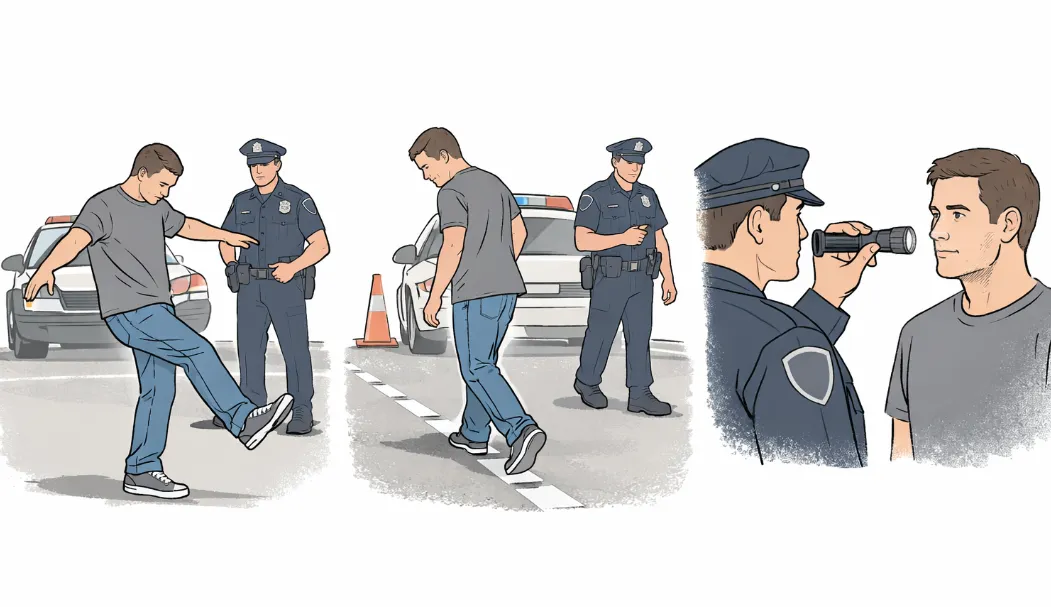
Step 2: Standardized Field Sobriety Tests (SFSTs)
If the officer suspects impairment, they will ask you to exit the vehicle to perform SFSTs. These are physical and cognitive tests designed to reveal impairment that might not be obvious.
-
HGN (Horizontal Gaze Nystagmus): The officer moves a pen or light in front of your eyes. They are looking for "nystagmus"—an involuntary jerking of the eyeball that alcohol makes more pronounced. You cannot control this response.
-
Walk and Turn: This is a "divided attention" test. You must walk heel-to-toe in a straight line for nine steps, turn in a specific manner, and return. The officer looks for eight specific clues, such as losing balance or starting before the instructions are finished.
-
One-Leg Stand: You must stand on one leg and count aloud. This tests both physical balance and the ability to process mental information simultaneously.
Step 3: Preliminary Alcohol Screening (PAS)
In many cases, the officer will ask you to blow into a handheld Breathalyzer at the scene.
-
For Drivers Over 21: In many states, this roadside test is voluntary unless you are on DUI probation. However, refusing it may give the officer "Probable Cause" to arrest you and take you to the station for a mandatory evidentiary test.
Step 4: Implied Consent and Evidentiary Testing
Once you are formally arrested, the Implied Consent Law takes full effect. By exercising the privilege of driving, you have legally agreed to submit to a formal chemical test (Blood or Breath) at the station or hospital.
-
The Penalty for Refusal: Refusing this post-arrest test is often a separate crime or a sentencing enhancement. It typically results in an automatic 1-year license suspension with no possibility of a restricted permit, even if you are ultimately found "not guilty" of the DUI.
5. The Timeline of Justice: From Stop to Verdict
A DUI case follows a strict chronological path where administrative and criminal actions often overlap. Missing a single deadline can have permanent consequences.
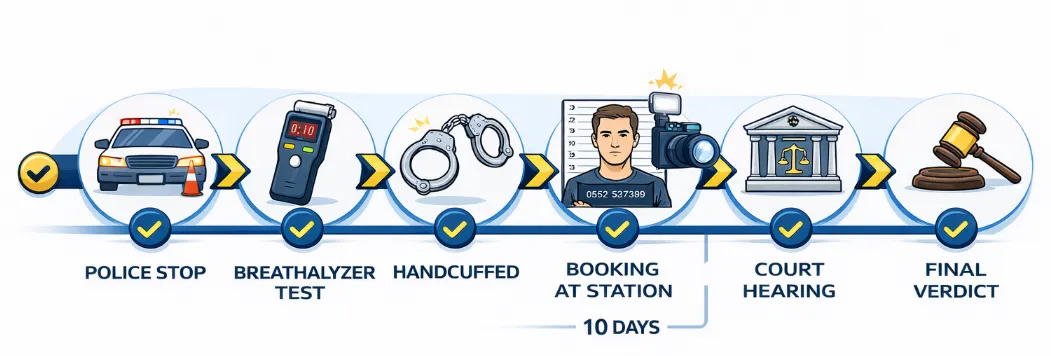
Stage 1: The Traffic Stop and Field Testing
The journey begins on the roadside. After the officer observes suspicious driving, you are pulled over. You undergo questioning and the Standardized Field Sobriety Tests (SFSTs). If the officer determines you are impaired, you are asked to blow into a preliminary breathalyzer.
Stage 2: Handcuffs and Arrest
If you fail the field tests or the breathalyzer, you are placed under arrest. You will be handcuffed, searched, and read your Miranda Rights. Your vehicle will likely be towed and impounded at your expense.
Stage 3: Booking and Station Sampling
You are transported to a police station or county jail for "Booking."
-
The Official Test: You are required to submit to an evidentiary blood or breath test. This result will be the primary evidence used against you.
-
Mugshots and Fingerprints: You will have your photo (mugshot) taken and your fingerprints recorded in the national criminal database.
-
The "Pink Slip": The officer seizes your driver's license and replaces it with a temporary paper permit. The 10-day countdown to save your license starts exactly now.
Stage 4: Arraignment and Entering a Plea
Weeks or months later, your first court date arrives. The judge formally presents the criminal charges.
-
The Plea: Most defendants plead "Not Guilty" at this stage to allow their attorney to subpoena the police body-cam footage and laboratory calibration records.
-
Immigration Alert: For visa holders, this is the point where "Prudential Revocation" of your visa usually occurs.
Stage 5: Pre-Trial Negotiations
Before a trial happens, the "Two-Front War" begins:
-
DMV Hearing: A separate administrative hearing to contest your license suspension.
-
Plea Bargaining: Your lawyer negotiates with the prosecutor. They may attempt to reduce the charge to a "Wet Reckless" or argue for the suppression of evidence if the stop was illegal.
Stage 6: The Verdict and Sentencing
The final stage of the timeline is the resolution of your case.
-
The Outcome: If found guilty or if you accept a plea deal, the judge issues a formal sentence. This includes heavy fines, mandatory enrollment in a DUI program, and usually a period of supervised probation.
-
IID Requirement: As part of the sentence, the judge may explicitly order the installation of an Ignition Interlock Device (IID) for a specific period (ranging from 6 months to several years), especially for first-time offenders with a high BAC or for repeat offenders.
-
Final Record: The conviction is recorded on both your criminal record and your driving history, triggering the long-term financial and immigration impacts discussed later in this guide.
Ignition Interlock Device (IID): The "Watchdog"
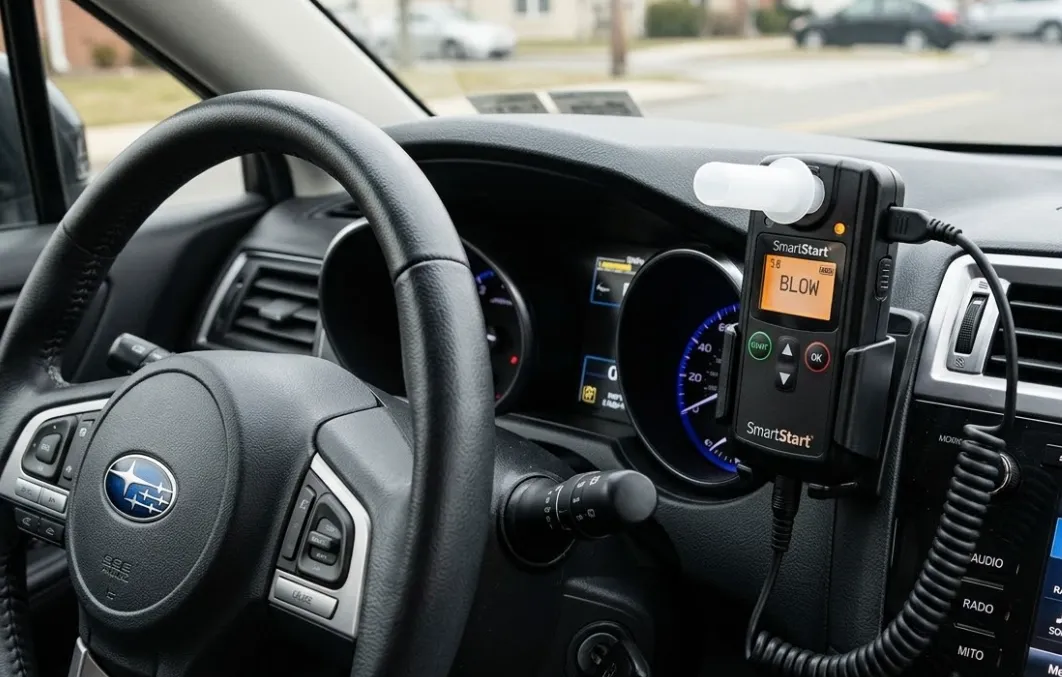
By 2026, most states require the installation of an Ignition Interlock Device for all DUI offenders.
-
What it is: A breathalyzer wired to your car’s ignition.
-
How it works: You must blow into it to start the car and perform "rolling retests" while driving.
-
Cost: You are responsible for all installation and monthly lease fees (typically $80–$120/month).
6. 2026 U.S. State-Specific DUI Penalties & Variances
Penalties in the United States are not uniform. While the federal government mandates certain standards (like the 0.08% BAC limit), each state exercises its own authority to determine the severity of punishment.
A. Key Factors Influencing Penalties
Judges and prosecutors weigh several "aggravating factors" when determining your sentence:
-
BAC Level: A "High BAC" (typically 0.15% or 0.20%+) triggers mandatory jail time and longer DUI schools.
-
Prior Offenses: Most states have a "look-back period" (usually 10 years). Multiple offenses within this window lead to felony charges.
-
Accidents & Injuries: If the DUI resulted in property damage, injury, or death, you face "Sentence Enhancements" that can turn a misdemeanor into a strike-level felony.
-
Chemical Test Refusal: Refusing a breath or blood test results in automatic administrative penalties and can be used as consciousness of guilt in court.
B. The Penalty Ladder (National Averages)
While specific numbers vary, the general escalation of penalties follows this trend:
-
1st Offense: Misdemeanor. Up to 6 months jail (often stayed for probation), $500–$2,000 fine, 3–9 months DUI school, 6-month license suspension.
-
2nd Offense: Misdemeanor. Mandatory 10–90 days jail, $1,000–$3,000 fine, 18–30 months DUI school, 1-year license suspension.
-
3rd Offense: Often a Felony. Minimum 120 days to 1 year in jail, $2,000–$5,000 fine, permanent license revocation or long-term suspension (3+ years).
C. DUI Penalties Comparison Across Major U.S. States (2026 Standards)
Although DUI laws vary by state, most U.S. states follow similar enforcement principles, including a 0.08 BAC legal limit, license suspension, and escalating penalties for repeat offenses.
| DUI Penalty Category | CA | NY | TX | FL | WA | IL | NV | AZ | CO | GA |
|---|---|---|---|---|---|---|---|---|---|---|
| BAC ≥ 0.08 considered DUI | ✔ | ✔ | ✔ | ✔ | ✔ | ✔ | ✔ | ✔ | ✔ | ✔ |
| Higher BAC (≥0.15) leads to enhanced penalties | ✔ | ✔ | ✔ | ✔ | ✔ | ✔ | ✔ | ✔ | ✔ | ✔ |
| Possible jail time for first DUI offense | ✔ | △ | ✔ | ✔ | ✔ | ✔ | ✔ | ✔ | ✔ | ✔ |
| Mandatory DUI education program | ✔ | ✔ | ✔ | ✔ | ✔ | ✔ | ✔ | ✔ | ✔ | ✔ |
| Driver’s license suspension or revocation | ✔ | ✔ | ✔ | ✔ | ✔ | ✔ | ✔ | ✔ | ✔ | ✔ |
| Ignition Interlock Device (IID) requirement | ✔ | ✔ | ✔ | ✔ | ✔ | ✔ | ✔ | ✔ | ✔ | ✔ |
| Additional penalties for refusing a chemical test | ✔ | ✔ | ✔ | ✔ | ✔ | ✔ | ✔ | ✔ | ✔ | ✔ |
| Repeat DUI offenses may become felony charges | ✔ | ✔ | ✔ | ✔ | ✔ | ✔ | ✔ | ✔ | ✔ | ✔ |
| DUI causing injury may result in felony charges | ✔ | ✔ | ✔ | ✔ | ✔ | ✔ | ✔ | ✔ | ✔ | ✔ |
| SR-22 high-risk insurance requirement | ✔ | — | ✔ | ✔ | ✔ | ✔ | ✔ | ✔ | ✔ | ✔ |
Notes
-
✔ Indicates the rule generally applies under state DUI laws
-
△ Indicates it applies in certain circumstances or is less common
-
— Indicates the requirement is uncommon or not typically mandated in that state
D. Deep Dive: Regional Nuances
-
California (The Bureaucratic Giant): California relies heavily on mandatory "DUI Programs." Even a first-timer must complete 3 months of classes. Failure to enroll or complete these results in a warrant for your arrest.
-
Texas (The "No Refusal" State): Texas often conducts "No Refusal" weekends where judges are on standby to issue immediate search warrants for blood draws if you refuse a breathalyzer.
-
New York (Leandra’s Law): NY has some of the nation's strictest child endangerment laws. Driving drunk with a child under 16 in the car is an automatic Class E Felony, even for a first-time offender.
-
Arizona (Zero Tolerance Leader): Known for the "Extreme DUI" category. If your BAC is 0.15% or higher, you face mandatory jail time even on your very first arrest, often including wearing a SCRAM ankle monitor. Additionally, Arizona was one of the first states to mandate that all DUI offenders, including first-time misdemeanor offenders with low BAC levels, must install an Ignition Interlock Device (IID).
-
Washington D.C. (The Zero Tolerance Capital): The District of Columbia enforces a "Zero Tolerance" policy for any driver under the influence of any measurable amount of alcohol. D.C. law is also unique in its "Sentencing Enhancements" for public safety employees or those carrying a firearm while intoxicated. Even a first-time DWI (Driving While Intoxicated) conviction in the District can lead to mandatory minimum jail time if the BAC is 0.20% or higher.
7. Immigration Consequences: Visas and Green Cards
For non-citizens, a DUI is not just a criminal matter; it is a direct threat to your legal status in the United States. In 2026, the intersection of criminal law and immigration ("Crimigration") has become more perilous than ever.
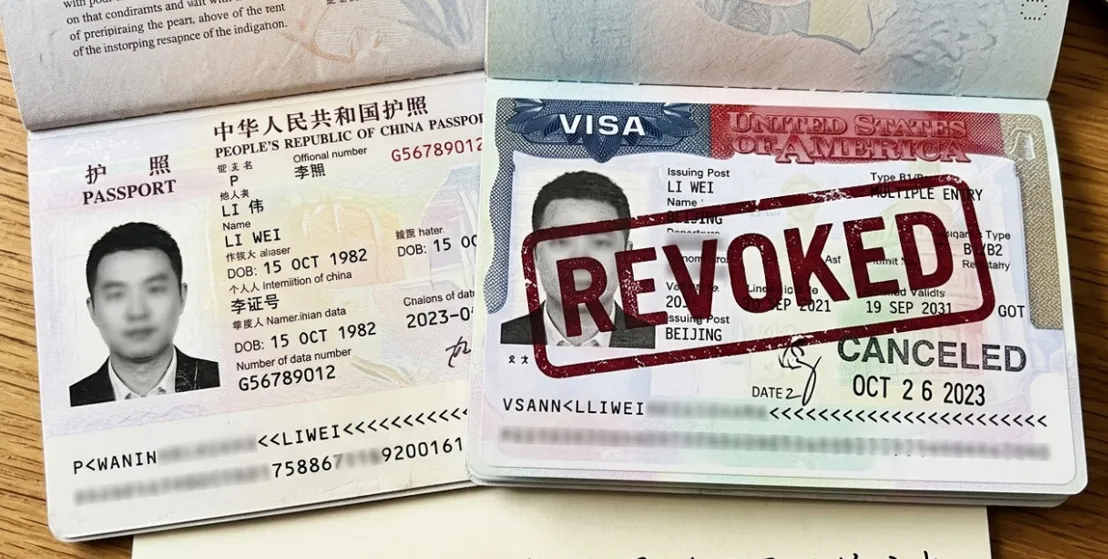
A. Prudential Visa Revocation (The "Automatic" Trap)
Under current Department of State (DOS) policy, a DUI arrest (even before a conviction) can trigger an automatic prudential revocation of your visa stamp (F, H, J, L, etc.).
-
The Mechanism: Consular officers receive automated alerts from the FBI database. You may receive a short email notifying you that your visa is no longer valid for entry.
-
The Catch: You do not have to leave the US immediately, but the moment you step outside the country, you cannot return without a new, rigorous visa interview.
B. The Medical Exam & The Panel Physician
If your visa is revoked or you apply for a new one after a DUI, you will be flagged for a mandatory Medical Evaluation.
-
The Assessment: You must see a government-certified "Panel Physician" to determine if you have a "physical or mental disorder" with associated harmful behavior (i.e., alcohol abuse/dependency).
-
The 1-Year Rule: If the physician determines you are a "problem drinker," you may be barred from a visa for at least one year until you can demonstrate a period of sustained sobriety.
C. Impact on Permanent Residency (Green Card)
While a single, simple DUI is generally not a "Crime Involving Moral Turpitude" (CIMT), it can still jeopardize a Green Card application:
-
Inadmissibility: During the Green Card medical exam (Form I-693), the civil surgeon will review your DUI history. Alcoholism-related findings can lead to a denial based on health-related grounds.
-
Aggravated Factors: If your DUI involved drugs (DUID) or was a felony (e.g., involving injury), it may be classified as an Aggravated Felony, which carries an automatic permanent bar and mandatory deportation.
D. The Naturalization (Citizenship) Barrier
To become a U.S. Citizen, you must demonstrate "Good Moral Character" (GMC) for the 3 or 5 years preceding your application.
-
The Statutory Period: A DUI conviction within this period is a massive red flag. USCIS officers have broad discretion; they may argue that a DUI—especially if combined with other minor infractions—shows a lack of respect for the law.
-
The Probation Trap: You cannot take the Oath of Allegiance while on probation. If your DUI probation ends after your application is filed, your case will be frozen or denied.
E. Risks for DACA and TPS Recipients
For DACA (Deferred Action for Childhood Arrivals) holders, a DUI is a "Significant Misdemeanor." A single conviction usually makes you ineligible for renewal, effectively ending your legal stay and work authorization.
8. Financial Aftermath: The "DUI Tax"
The true cost of a DUI often exceeds $15,000, including:
-
Legal Fees: $3,000 – $10,000 for a private attorney.
-
Insurance Premiums: Your rates will skyrocket (200% - 400% increase). You will likely need an SR-22 Certificate for 3–5 years.
-
Court Fines & Fees: $500 – $2,500.
9. FAQ
Q1: Can I be charged with DUI if I’m sleeping in my car?
A: Yes. Under "Actual Physical Control" (APC) laws, if you have access to the keys and are in the driver's seat, police can arrest you even if the engine is off. To avoid this, sleep in the back seat and keep keys in the trunk.
Q2: Will a DUI arrest affect my H1-B or F-1 visa application?
A: Absolutely. A DUI arrest triggers "Prudential Revocation." Even if not convicted, you must undergo a medical exam by a Panel Physician during your next visa interview, which often leads to a 1-year delay or denial if alcohol dependency is suspected.
Q3: Can I get my DUI record expunged for employment background checks?
A: This depends on the state. Some states allow "set-asides" or expungements that hide the conviction from private employers, but it will always remain visible to USCIS, the DMV, and law enforcement agencies.
Q4: Is it a DUI if I was using self-driving features like Tesla FSD?
A: Yes. In 2026, U.S. law still requires a "human-in-the-loop." Being intoxicated while in the driver's seat of an autonomous vehicle is treated legally the same as manual driving under the influence.
Q5: What happens if I refuse the breathalyzer or blood test at the station?
A: Under "Implied Consent" laws, refusal results in an automatic, non-negotiable license suspension (usually 1 year). It also allows the prosecution to argue you refused because you knew you were guilty.
Q6: Does a DUI count as a "Crime Involving Moral Turpitude" (CIMT) for Green Cards?
A: A simple first-time DUI is usually not a CIMT. however, a DUI involving drugs (DUID), driving with a suspended license, or a DUI that causes injury can be classified as a CIMT or an Aggravated Felony, leading to deportation.
Stay informed on 2026 USA DUI laws with our comprehensive guide. Understand critical penalties, the truth about automatic visa revocation for non-immigrants, and hidden IID costs. Learn how state-specific enforcement and federal immigration policies intersect, risking your legal status and finances. From blood alcohol limits (BAC) to mandatory ignition interlock devices, navigate the legal procedures to protect your future in the United States.
Legal Disclaimer: The information provided in this guide is for general informational purposes only and does not constitute legal advice. Laws vary significantly by state and are subject to change. Always consult with a qualified attorney in your jurisdiction regarding your specific situation.