Confused about TSA liquid rules in 2026? Learn exactly how to pack cosmetics, skincare, and contact lens solution in your carry-on—clear, updated, and TSA-approved.
This guide provides everything you need to navigate TSA checkpoints like a pro.
1. Decoding the 3-1-1 Rule for 2026
The "3-1-1" rule is the gold standard for carry-on liquids in the United States. While airport technology is evolving, these core numbers remain your baseline. Understanding the specific logic behind each digit is the first step to a stress-free screening:
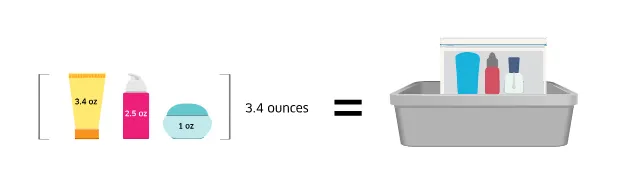
What is 311?
-
3: The "3.4-Ounce" Container Limit (100ml)
-
Every liquid, aerosol, gel, cream, or paste must be in a container that is 3.4 ounces (100 milliliters) or smaller.
-
The Container Rule: TSA focuses on the size of the bottle, not the amount of liquid inside. A 200ml bottle that is 90% empty will still be confiscated. Always look for the volume marked on the bottom or side of your products.
-
-
1: The "One-Quart" Bag
-
All your travel-sized containers must fit comfortably into one quart-sized, clear, plastic, zip-top bag.
-
In 2026, while high-end "TSA-approved" toiletry kits are popular, ensure they remain transparent. The transparency allows officers to quickly scan for prohibited items without opening your bag.
-
-
1: The "One Bag Per Passenger" Policy
-
Each traveler is limited to exactly one bag. If you are traveling as a couple or family, you cannot "pool" your liquids into one large bag; each person must have their own quart-sized kit.
-
-
What About Checked Bags?: If your liquids exceed the 3.4oz limit, they must be packed in your checked luggage. Unlike carry-on bags, there is generally no quantity limit for liquids in checked bags, provided they are not hazardous materials. This is the safest way to transport full-sized shampoos, large perfumes, or wine.
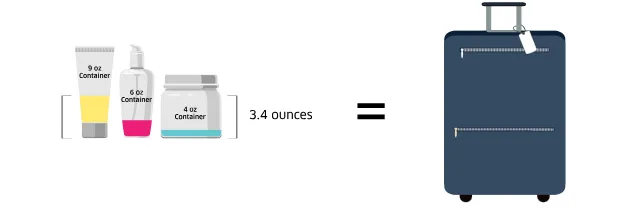 Image from TSA.GOV, Copyright by original author
The "Liquid" Litmus Test: The 5-Verb Rule
A common mistake is thinking "liquid" only means water or juice. In 2026, TSA continues to use a broad functional definition. If you are unsure about an item, apply the 5-Verb Test. If you can do any of the following to the substance, it is a liquid:
-
Spill it: Like perfumes, toners, or mouthwash.
-
Spray it: Like hairspray, setting spray, or spray deodorant.
-
Spread it: This is the "Skincare Trap." If you can smear it on toast, it's a liquid. This includes face creams, hummus, and hair wax.
-
Pump it: Like foundations, lotions, or liquid soaps.
-
Pour it: Like syrups or liquid makeup removers.
Common Traps for 2026 Travelers:
-
Gels: Toothpaste, hair gel, and even gel-based shoe inserts.
-
Pastes: Peanut butter, heavy concealers, and clay masks.
-
Aerosols: Dry shampoo remains one of the most frequently flagged items.
2. Beauty & Skincare: The Makeup Enthusiast’s Survival Kit
For beauty lovers, the 100ml limit is the biggest challenge when trying to maintain a multi-step routine. To navigate the checkpoint without losing your favorite products, you must categorize your vanity with precision.
Carry-on Quick Reference: Solid vs. Liquid
|
Category |
Solid (Put anywhere) |
Liquid (Must fit in 3-1-1 bag) |
|---|---|---|
|
Cleansing |
Bar Soap, Cleansing Sticks |
Micellar Water, Cleansing Oil, Balms |
|
Base |
Stick Foundation, Pressed Powder |
Liquid Foundation, BB Cream, Cushion |
|
Color |
Powder Blush, Wax Lipstick |
Lip Gloss, Liquid Blush, Mascara |
|
Skincare |
Eye Cream (solid stick), Sunscreen Stick |
Serums, Lotion, Liquid Sunscreen |
The "Hidden" Liquids: The Most Confiscated Items
Many travelers lose items because they misinterpret the "liquid" definition. In 2026, TSA officers are particularly vigilant about these "semi-solid" makeup items:
-
Mascara and Liquid Eyeliner: Even though the volume is tiny, these are 100% liquids.
-
Cushion Foundations and BB Creams: These are high-risk items. Because they contain a liquid-soaked sponge, they are categorized as liquids.
-
Lip Gloss, Tints, and Liquid Lipsticks: While a traditional wax-based lipstick is a solid (exempt), any lip product with a wand or squeeze tube is a liquid.
-
Nail Polish and Remover: These are allowed but must fit in your quart-sized bag. Note that some removers are flammable and have additional airline-specific restrictions.
The Red List: High-Risk "Luxury" Items
Expensive skincare often comes in beautiful but "illegal" packaging for carry-ons:
-
The "Container Size" Trap: If you have a 150ml bottle of toner that is only 20% full, it will be confiscated. TSA regulates the container capacity, not the remaining volume.
-
Glass Perfume Bottles: Most standard perfume bottles are 50ml or 100ml, which are fine. However, "Jumbo" or "Value Size" bottles (usually 125ml+) must be checked or decanted into a travel atomizer.
-
Setting Sprays: These are aerosols. Ensure the cap is secure to avoid accidental discharge, which can lead to additional screening.
Packing Strategy: The "Tetris" Method for 2026
-
Decant Everything: Use 5ml or 10ml airless pump bottles for foundations and serums. This allows you to fit 10+ products in a bag that usually holds only three full-sized items.
-
Label Your Decants: 2026 TSA officers appreciate clarity. Use a label maker to mark the volume (e.g., "30ml Foundation") to avoid disputes over container size.
-
The "Contact Lens Case" Hack: For very thick creams or primers, use a clean contact lens case. It’s the ultimate space-saver for a 2-3 day trip.
2026 Pro-Tip: Join the "Solid Revolution"
The absolute best way to save space in your one-quart bag is to switch to high-performance solids:
-
Shampoo and Conditioner Bars: Salon-quality bars are now widely available and completely exempt from the 3-1-1 bag.
-
Stick Cosmetics: Switch to stick foundations, stick blushes, and solid perfume balms.
-
Cleansing Balms vs. Oils: While some thick balms are still debated, "hard" cleansing sticks are treated as solids, saving precious liquid space.
3. Special Exemptions: The "Privileged Liquids"
Not everything has to fit in that tiny quart-sized bag. TSA provides exemptions for items considered medically necessary or essential for childcare. These items can exceed 3.4 ounces (100ml) and do not need to be stored in your plastic 3-1-1 bag.
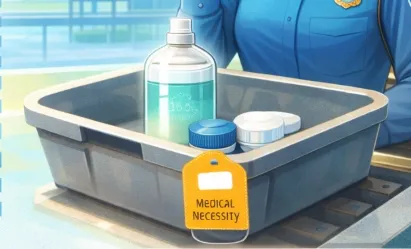
Medically Necessary Liquids: Contact Lens Solution & Beyond
-
Contact Lens Solution: This is the most common exemption for beauty and health-conscious travelers. TSA officially classifies contact solution as a medical necessity. You can bring "reasonable quantities" (e.g., a full 12oz or 16oz bottle) in your carry-on.
-
Prescription Medications: This includes liquid, gel, or aerosol medications for conditions like asthma (inhalers), diabetes (insulin), or severe allergies (EpiPens).
-
Eye Drops and Saline Nasal Sprays: Even over-the-counter eye drops are exempt if you use them for a medical condition like chronic dry eye.
-
Ice Packs and Gel Packs: If used to keep medically necessary liquids cool (like insulin), these are allowed even if they are larger than 100ml. However, they must be completely frozen solid when passing through security. If they are slushy or melted, they may be rejected.
The Baby & Parent Protocol
If you are traveling with an infant or toddler (or even without them in some cases), you have significant leeway:
-
Breast Milk, Formula, and Purified Water: You are allowed to bring these in "reasonable quantities."
-
Baby Food: This includes purees, jars of food, and juice.
-
Breast Milk Storage: You can carry breast milk even if the baby is not traveling with you. Simply inform the officer that you are transporting milk for a child.
How to Navigate Security with Exempted Liquids
To avoid delays or accidental confiscation, follow the "Declare and Separate" protocol:
-
Separate: Remove these items from your carry-on bag and place them in a separate bin. Do NOT put them in your 3-1-1 bag.
-
Declare: Before the screening begins, tell the TSA officer: "I have medically necessary liquids" or "I am carrying breast milk/formula."
-
Screening: Be prepared for additional screening. Officers may use a Bottle Liquid Scanner (BLS) or perform a Vapor Test (holding a test strip over the open bottle). They will never ask you to sip the liquid or touch it.
4. Security Checkpoint "Face-offs": Resolving Myths
The checkpoint is where rules meet reality. In 2026, misunderstanding these core concepts is the most common reason for secondary screening or item loss.
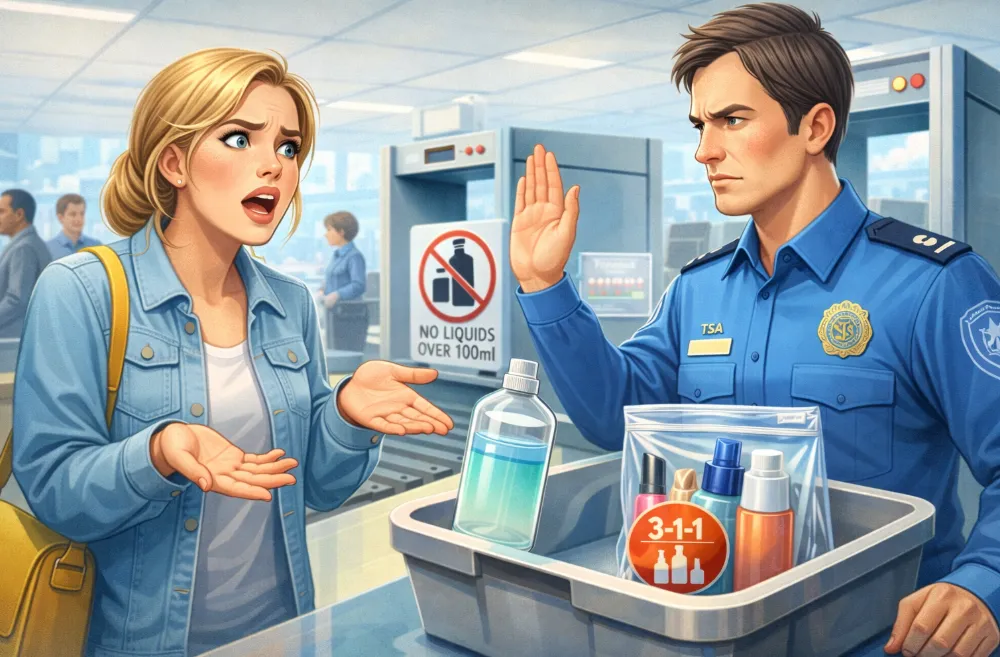
Myth 1: "But it's mostly empty!"
This is the #1 mistake. TSA officers prioritize the printed capacity of the bottle over the actual liquid inside.
-
The Reality: If you carry a 200ml bottle of expensive face wash with only 10ml left, it will be confiscated. The rule is designed to prevent the container itself from being used to hold larger volumes of hazardous liquids. Strategy: Always decant your favorites into marked 100ml travel bottles.
Myth 2: "Deodorant is a liquid."
Travelers often waste space in their 3-1-1 bags for items that don't belong there.
-
Stick Deodorant: Solid (completely exempt, put it anywhere in your bag).
-
Gel, Spray, or Roll-on Deodorant: Liquid (must be ≤100ml and inside the clear bag).
-
Bar Soap: Solid (exempt). Liquid Body Wash: Liquid (must follow 3-1-1).
Myth 3: "It passed security at my last airport."
"Inconsistency" is the most frustrating part of travel.
-
The Reality: TSA officers have final discretion. Security protocols can vary based on the airport's current threat level, the specific lane technology (Standard vs. CT), and the officer's interpretation of "spreadable" items.
-
Pro-Tip: If an officer flags an item, remain polite. Arguments rarely end in your favor. Instead, ask if you can go back and check the bag or mail the item to yourself if the airport has a mailing service.
Myth 4: "Duty-Free liquids are always safe."
Many passengers buy large perfumes or alcohol at duty-free, only to have them taken at a connecting flight's security.
-
The Reality: If you have a connecting flight, your duty-free items must be packed in a STEB (Secure Tamper Evident Bag) by the retailer, with the receipt visible inside. If the bag is opened or the receipt is missing, it will be confiscated during your next security check.
Myth 5: "Magic Powders are exempt."
Since 2024, TSA has tightened rules on powder-based substances (like loose setting powder, protein powder, or dry shampoo powder).
-
The Rule: If you have more than 350ml (12oz) of powder, it must be removed for separate X-ray screening. While it doesn't count as a liquid, it can trigger a manual bag search.
The "Oops" Protocol: What if I'm flagged?
If a cherished $150 serum is flagged for being oversized, don't panic. You have options:
-
Airport Mailing Services: Check if your terminal has a "Post-it" kiosk or a mailing service like Airport Mailers.
-
Check it at the Gate: If you have time, you can ask to return to the check-in counter to place the item in your checked luggage.
-
Transfer to a Friend: If someone is seeing you off, you can hand it to them before clearing security.
5. What’s New in 2026? The Tech Transformation
The landscape of airport security is undergoing its most radical shift since 2006. As we move through 2026, the deployment of Computed Tomography (CT) Scanners is reaching a tipping point, promising a future where the 3-1-1 bag might finally become obsolete.
The Rise of the "Large Blue Boxes" (CT Scanners)
In major hubs like JFK, LAX, London Heathrow, and Frankfurt, traditional 2D X-ray machines are being replaced by high-speed CT scanners. These machines are massive and typically feature a blue or silver exterior.
-
3D Visualization: Unlike old machines that provided a flat image, CT technology creates a high-resolution 3D rendering of your bag's contents. Security officers can rotate the image 360 degrees, virtually "opening" your bag without touching it.
-
Explosive Detection: Sophisticated algorithms can now distinguish between the molecular structure of a harmless bottle of shampoo and liquid explosives. This is the technical breakthrough that makes the 100ml limit scientifically unnecessary in certain lanes.
The "Hands-Off" Experience: Next-Gen Lanes
In "Next-Gen" lanes equipped with full CT integration, the screening experience has changed:
-
Liquids and Laptops Stay Inside: In these specific lanes, you no longer need to pull your quart-sized 3-1-1 bag or your laptop out of your carry-on. You simply place your suitcase into a bin and walk through.
-
The "Small Tunnel" Constraint: Note that CT scanners often have slightly smaller tunnels than traditional machines. If your carry-on is overstuffed, it may get stuck, leading to the very delays the tech was meant to prevent.
Global Discrepancy: The 2026 Transition Gap
The biggest challenge for 2026 travelers is inconsistency. While the tech exists, it is not everywhere yet:
-
The US Stance: Despite the tech rollout, the TSA officially maintains the 3-1-1 rule nationwide for most passengers to ensure a "standardized security baseline." Even if a machine can see through your liquids, you are still legally required to follow the 100ml limit unless otherwise instructed.
-
The European/Swiss Pivot: Airports in Switzerland (Zurich) and parts of Germany (Frankfurt, Munich) have begun officially scrapping the 100ml limit in CT-equipped terminals, allowing passengers to carry full-sized bottles (up to 2 liters in some cases).
-
The "Return Trip" Trap: Always pack for the strictest airport on your itinerary. If you fly from Zurich (no limit) to a smaller US airport (strict 3-1-1) for your return, your full-sized souvenirs will be confiscated at the connecting gate.
6. Pre-Flight Packing Checklist
Before you head to the airport, run this 5-minute audit:
-
Check the Labels: Is every container in the carry-on ≤100ml?
-
The Zip-Top Test: Does the quart-sized bag close comfortably? (If it's bursting at the seams, they may ask you to toss items).
-
The "Med-Liquids" Separation: Is your contact lens solution or prescription meds easily accessible for declaration?
-
The STEB Check: If you bought duty-free liquids at a previous stop, is the bag still sealed with the receipt visible?
7. FAQ: Hot Questions for 2026 Travelers
Q: Are makeup wipes or baby wipes considered liquids?
A: No. TSA officially classifies wet wipes (makeup, baby, or disinfectant) as solids. They do not need to go in your 3-1-1 bag and have no quantity limit. They are the ultimate "hack" for staying fresh without using up your liquid allowance.
Q: Can I bring a large bottle of contact lens solution if it's unopened?
A: Yes, but not because it's unopened. It is allowed because it is a medically necessary liquid. Inform the officer and keep it separate. Note: Some brands contain chemicals that may trigger a "positive" on explosive scanners; if this happens, the officer may ask you to pack it in checked luggage or leave it behind.
Q: What about "Frozen" liquids? Can I bring a frozen smoothie?
A: Technically, yes. If a liquid is frozen solid when it passes through the X-ray, it is treated as a solid. However, if it is even slightly "slushy" or has melted liquid at the bottom, it must be ≤100ml and fit in your 3-1-1 bag.
Q: Is there a limit on powder makeup (like loose setting powder)?
A: While not a "liquid," powders over 350ml (12oz)—about the size of a soda can—require separate screening. To avoid delays, TSA recommends packing large containers of powder in checked bags.
Q: What about Duty-Free liquids on connecting flights?
A: If you have a connection, your duty-free items must be in a STEB (Secure Tamper Evident Bag) with the receipt visible. If the bag is tampered with, it will be confiscated at the next checkpoint.
Q: Do I need to remove my 3-1-1 bag at every airport now?
A: It depends on the lane. If you see the "Next-Gen" CT scanners (large blue/silver boxes) and the officer says "Keep everything inside," you can leave it. If you are in a standard lane or a smaller airport, you must still take it out. When in doubt, take it out.
Summary: Travel in 2026 is faster than ever, but the 3-1-1 rule remains the gatekeeper of the skies. By maximizing solids, utilizing medical exemptions for your contact solution, and choosing the right containers, you can ensure your beauty routine stays intact from takeoff to landing.
Safe travels!