Traveling to the U.S. can sometimes mean long lines at customs, but with fast-track options like MPC (Mobile Passport Control) and APC (Automated Passport Control), you can save valuable time. Both services aim to speed up your entry process, but which one is right for you? And is Global Entry still the ultimate option? In this guide, we break down everything you need to know for 2026.
Quick Comparison at a Glance (2026 Edition)
|
Feature |
Mobile Passport Control (MPC) |
Automated Passport Control (APC) |
Global Entry (GE) |
|---|---|---|---|
|
Cost |
Free |
Free |
$120 (5 Years) |
|
Tool |
Smartphone App |
Airport Kiosk |
Kiosk + Dedicated Lane |
|
Pre-Approval |
No |
No |
Yes (Interview Required) |
|
Best For |
Families & Occasional Flyers |
ESTA Travelers |
Frequent Business Travelers |
|
Efficiency |
Very High (Dedicated Lane) |
High |
Highest |
What Is MPC (Mobile Passport Control)?
MPC (Mobile Passport Control) is a U.S. Customs and Border Protection (CBP) program designed to help travelers enter the United States faster using their mobile devices. It’s a digital alternative to filling out the traditional paper customs declaration form. Here's a detailed breakdown:
1. How It Works
-
Travelers download the Mobile Passport app (available on iOS and Android).
-
Before landing in the U.S., they fill out their passport information and customs declaration directly in the app.
-
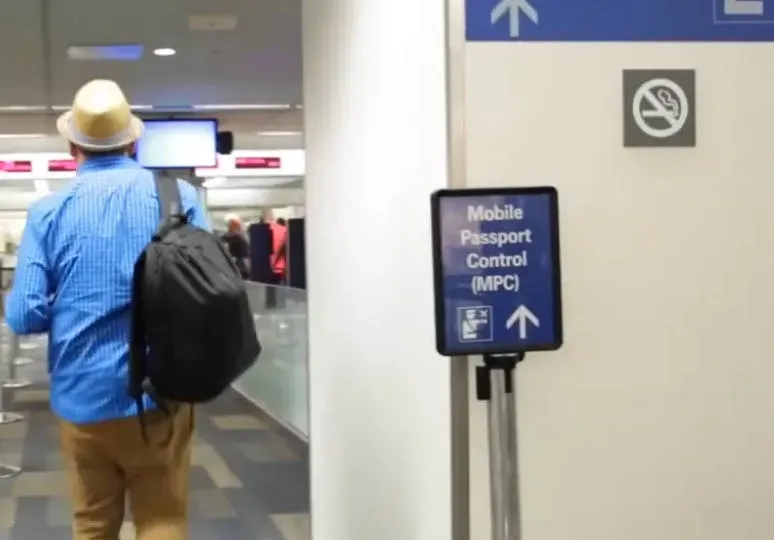
Upon arrival, travelers skip the regular passport control lines and use the dedicated MPC lane at participating airports.
-
A digital receipt (QR code) is generated in the app, which CBP officers scan to process your entry.
2. Who Can Use MPC
-
U.S. Citizens with a valid passport.
-
Canadian Citizens with a valid passport (only at certain airports).
-
Families traveling together can submit information for all members under one profile in the app.
3. Key Advantages
-
Faster processing than traditional paper forms and standard lines.
-
No pre-approval or fee required—unlike Global Entry.
-
User-friendly app—allows you to save your passport information for future trips.
4. Limitations
-
Only available at participating U.S. airports and cruise ports.
-
Only for air and cruise travelers entering the U.S. (not land border crossings).
-
Some travelers may still need to undergo additional screening by CBP officers.
In short, MPC is a convenient, paperless way to speed up U.S. entry, especially for casual travelers who don’t want to pay for Global Entry.
How to Use MPC (Step-by-Step)
Step 1: Download the Mobile Passport App
-
Available for iOS on the App Store and Android on Google Play.
-
Official app is called “Mobile Passport” by U.S. Customs and Border Protection.
-
Free to use; no subscription or pre-approval needed.
Step 2: Create a Profile
-
Open the app and tap “Create New Profile.”
-
Enter your passport information:
-
Passport number
-
Expiration date
-
Country of issuance
-
-
Include basic personal info (name, date of birth, gender).
-
You can create profiles for all family members traveling together.
Step 3: Fill Out Your Customs Declaration
-
Before arrival in the U.S., select “New Trip” in the app.
-
Complete the customs declaration questionnaire, similar to the paper form:
-
Purpose of visit
-
Items you are bringing into the U.S.
-
Agricultural products, alcohol, or currency over $10,000
-
-
Submit the information in the app.
Step 4: Receive Your QR Code
-
Once submitted, the app generates a digital QR code receipt.
-
This QR code is valid for 4 hours from the time of issuance.
Step 5: Use the Dedicated MPC Lane
-
Upon arrival at the U.S. airport, look for signs that say “Mobile Passport Control” or “MPC Lane.”
-
Show the QR code on your phone to a CBP officer.
-
They may ask a few questions but processing is typically much faster than the regular line.
Step 6: Proceed to Baggage Claim
-
After CBP processing, you’re free to collect your luggage and continue through customs.
Tips for a Smooth Experience
-
Complete your profile before traveling to save time.
-
Keep your phone charged—you need the QR code visible for CBP scanning.
-
Check airport participation in advance; not all U.S. airports offer MPC lanes.
-
Update the app to ensure smooth functionality and the latest customs rules.
 MPC-participating U.S. Airports and Seaports
| Type | Location / Port | Notes |
|---|---|---|
| Airport | Atlanta (ATL) | Major international hub |
| Airport | Chicago O’Hare (ORD) | Dedicated MPC lanes available |
| Airport | Dallas/Fort Worth (DFW) | Check terminal signage |
| Airport | Denver (DEN) | Available in select terminals |
| Airport | Fort Lauderdale (FLL) | International arrivals |
| Airport | Honolulu (HNL) | MPC lanes for all international flights |
| Airport | Houston George Bush (IAH) | MPC lane in customs area |
| Airport | Los Angeles (LAX) | MPC lanes at Tom Bradley International Terminal |
| Airport | Miami (MIA) | Major international hub, MPC lanes active |
| Airport | New York JFK (JFK) | MPC lanes at multiple terminals |
| Airport | Orlando (MCO) | International arrivals only |
| Airport | San Francisco (SFO) | Dedicated MPC lane available |
| Airport | Seattle-Tacoma (SEA) | MPC lane in customs hall |
| Airport | Washington Dulles (IAD) | MPC lane for international arrivals |
| Seaport | Port of Miami | Cruise passengers only |
| Seaport | Port Everglades (Fort Lauderdale) | Cruise terminal MPC lanes |
| Seaport | Port Canaveral (Orlando area) | Cruise passengers |
| Seaport | Port of Los Angeles / Long Beach | Cruise and some private yachts |
| Seaport | Port of Seattle | Cruise arrivals, Alaska routes |
Tip: Travelers should check the official MPC app or the CBP website before travel to confirm the latest participating locations.
What Is APC (Automated Passport Control)?
APC (Automated Passport Control) is another U.S. Customs and Border Protection (CBP) program designed to speed up entry for travelers, but it works differently from MPC. Here’s a detailed breakdown:
1. How It Works
-
APC uses self-service kiosks at the airport instead of a mobile app.
-
Travelers scan their passport and answer customs declaration questions directly at the kiosk.
-
The kiosk prints a receipt with a barcode.
-
Travelers then present this receipt to a CBP officer at a designated entry lane for final processing.
2. Who Can Use APC
-
U.S. Citizens with a valid passport.
-
U.S. Lawful Permanent Residents (Green Card holders).
-
Visa Waiver Program (VWP) travelers from eligible countries.
-
Canadian citizens (with electronic passports) in some airports.
3. Key Advantages
-
Faster than traditional paper processing at immigration lines.
-
No pre-registration or app download required.
-
Available to a wider range of travelers (including visitors on visas and green card holders).
4. Limitations
-
Only available at participating U.S. airports.
-
Travelers still need to interact with a CBP officer after using the kiosk.
-
Not as convenient as MPC for families unless each traveler uses the kiosk separately.
In short, APC is ideal for travelers who don’t want to use a mobile app or are ineligible for MPC, while MPC is perfect for U.S. and Canadian citizens seeking a paperless, fast-track entry.
How to Use APC (Step-by-Step)
Step 1: Look for APC Kiosks
-
After deplaning, follow signs for “Automated Passport Control” or “APC Kiosks”.
-
APC kiosks are available at participating U.S. airports for international arrivals.
Step 2: Scan Your Passport
-
Place your passport on the scanner at the kiosk.
-
The kiosk will read your passport data automatically.
-
Some kiosks may ask you to scan your visa (if applicable).
Step 3: Answer Customs & Immigration Questions
-
The kiosk will prompt you to answer a series of questions similar to the traditional paper form, such as:
-
Purpose of your visit
-
Items you are bringing into the U.S.
-
Agricultural products, alcohol, or currency over $10,000
-
-
For Visa Waiver Program travelers, it may ask additional visa-related questions.
Step 4: Review & Print Your Receipt
-
After completing the questions, the kiosk prints a receipt with a barcode.
-
This receipt is your ticket to the APC lane with a CBP officer.
Step 5: Proceed to the CBP Officer
-
Take the printed receipt and move to a CBP officer lane (sometimes called APC lane).
-
The officer will scan your receipt and may ask brief questions.
-
Once cleared, you’re officially admitted into the U.S..
Step 6: Collect Baggage & Exit
-
After CBP processing, continue to baggage claim and exit customs.
Tips for a Smooth APC Experience
-
Have your passport ready—kiosk scanning works best if the passport is clean and undamaged.
-
Follow on-screen prompts carefully; kiosks may time out if idle.
-
Keep the printed receipt until you’ve completed CBP inspection.
-
Families traveling together may need a separate receipt for each traveler.
-
Check airport signage—APC may not be available in all terminals.
APC-participating U.S. Airports and Seaports
| Type | Location / Port | Notes |
|---|---|---|
| Airport | Atlanta (ATL) | Major international hub |
| Airport | Chicago O’Hare (ORD) | APC kiosks available in customs area |
| Airport | Dallas/Fort Worth (DFW) | Check terminal signage for APC lane |
| Airport | Denver (DEN) | APC kiosks in select terminals |
| Airport | Fort Lauderdale (FLL) | International arrivals only |
| Airport | Honolulu (HNL) | APC kiosks for all international flights |
| Airport | Houston George Bush (IAH) | Kiosks in customs hall |
| Airport | Los Angeles (LAX) | APC kiosks at Tom Bradley International Terminal |
| Airport | Miami (MIA) | Dedicated APC lanes active |
| Airport | New York JFK (JFK) | APC lanes at multiple terminals |
| Airport | Orlando (MCO) | International arrivals only |
| Airport | San Francisco (SFO) | APC kiosks available in customs hall |
| Airport | Seattle-Tacoma (SEA) | APC lane in customs area |
| Airport | Washington Dulles (IAD) | APC lane for international arrivals |
| Seaport | Port of Miami | Cruise passengers only |
| Seaport | Port Everglades (Fort Lauderdale) | Cruise terminal APC lanes |
| Seaport | Port Canaveral (Orlando area) | Cruise passengers |
| Seaport | Port of Los Angeles / Long Beach | Cruise and some private yachts |
| Seaport | Port of Seattle | Cruise arrivals, Alaska routes |
Tip: Travelers should check the official CBP website or APC signage at airports/seaports to confirm current participation.
Is Global Entry Still Worth It?
✅ What You Get with Global Entry
-
Expedited U.S. customs and immigration when returning from international travel — you skip long lines and go straight to a Global Entry kiosk.
-
TSA PreCheck included at no extra cost, which speeds up domestic security screening (no shoes off, no laptop/out liquids removal).
-
Membership is valid for 5 years, so benefits accumulate over time.
-
Often credit card reimbursement — many travel rewards cards reimburse the entire $120 fee when you pay with the card.
Bottom line: you’re getting both international fast-track entry + domestic security perks in one package.
💸 Cost & Value
-
The current Global Entry fee is $120 for 5 years — an increase from the previous $100.
-
That works out to about $24 per year — a bargain compared with the time you save.
-
And with many travel credit cards offering a full reimbursement, the net cost to many travelers can be $0.
👍 When It’s Definitely Worth It
Global Entry makes sense if you:
-
Travel internationally even once or twice every few years. Even one long customs line can justify the value.
-
Want TSA PreCheck benefits without paying separately for both programs.
-
Fly frequently for work or leisure — the time savings over multiple trips add up.
-
Have a card that reimburses the fee. Getting it for “free” makes the decision much easier.
Many travelers say that the combined Global Entry + TSA PreCheck benefits justify the cost even for occasional flyers because the time saved (often 30–90+ minutes per international arrival) is huge.
👎 When It Might Not Be Worth It
Global Entry might not be worth it if:
-
You only travel domestically and never leave the U.S. — you’re better off with just TSA PreCheck or MPC/APC.
-
Your international travel is very infrequent (e.g., once every 5 years).
-
You don’t have credit cards that reimburse the fee.
-
You don’t mind waiting in customs lines — some travelers just don’t see queues as a burden.
🤔 Real-World Feedback
Traveler communities often say:
-
For international trips, skipping the long customs line at the end of a long flight can feel priceless.
-
Some find it especially worth it if their credit card covers the $120 fee — they do it for free and enjoy the benefits.
-
If you already have TSA PreCheck, the cost difference to add Global Entry is small, making it a natural upgrade.
✅ Final Verdict
Yes — Global Entry is still worth it for most international travelers, especially if:
✔️ You travel abroad more than once every few years
✔️ You want TSA PreCheck included
✔️ Your travel card reimburses the fee
If you mainly fly domestically and don’t care about customs lines, then Global Entry might be overkill — consider just TSA PreCheck or using free options like MPC/APC.
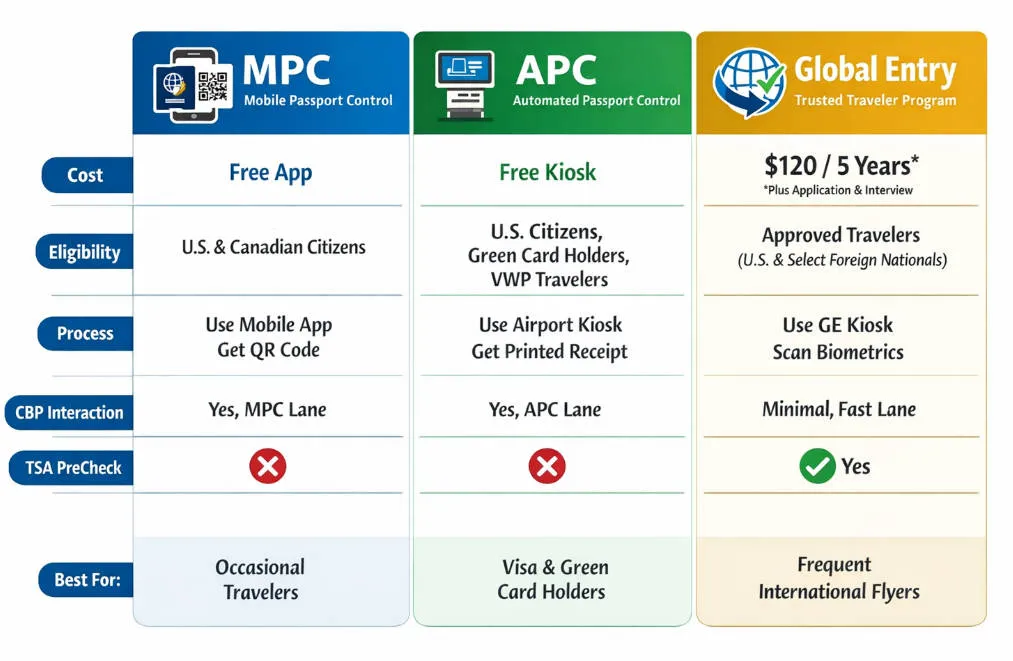
In-Depth Comparison: MPC vs APC vs Global Entry
Global Entry, MPC, and APC all aim to cut US entry times, but differ in requirements, costs, perks, and experience. APC kiosks are being phased out by MPC and Global Entry.
Detailed Comparison Table:
| Feature | Global Entry (GE) | Mobile Passport Control (MPC) | Automated Passport Control (APC) |
|---|---|---|---|
| Program Type | Pre-approved TTP | Free mobile app | Self-service kiosk |
| Cost | $120 (5 years) | Free | Free |
| Pre-Approval/Background | Required: App, check, interview | None: Download app | None: Use on-site |
| Eligibility | US/residents & reciprocal countries | US/residents, Canadian B1/B2, returning VWP | US/Canadians & VWP (ESTA) |
| Key Perk | Includes TSA PreCheck® | None | None |
| Clearance Process | Dedicated kiosk/biometrics, fastest | App submit, QR code, dedicated lane + officer | Kiosk scan/questions, receipt + officer |
| Family/Groups | Individual only | Up to 12 per device | Separate or group kiosk use |
| Speed/Stability | Most reliable/fastest; lanes rarely close | Next best; depends on officer | Slower; being replaced |
Which One Is Best For You?
📌 Choose MPC if:
-
You want a free, quick option with no application.
-
You travel internationally occasionally and want to avoid paper forms.
📌 Choose APC if:
-
You don’t want an app and prefer kiosk interaction.
-
You travel with a visa or don’t qualify for MPC.
📌 Choose Global Entry if:
-
You travel internationally frequently and want consistent speed and TSA PreCheck benefits.
-
You want the most predictable and fastest entry experience possible.
In short, for occasional travelers, MPC or APC might be more practical. For frequent travelers, Global Entry is worth the investment.
Global Entry ≥ MPC > APC > Standard Lane
Tips & Tricks for Faster U.S. Customs Clearance
Passing U.S. Customs quickly isn’t just about which program you use—how you prepare matters just as much. These expert tips can easily save you 30–90 minutes on arrival.
1. Always Have a Backup Option
-
Even if you have Global Entry, keep MPC installed on your phone.
-
Some airports temporarily close Global Entry or MPC lanes due to staffing.
-
Smart travelers check which lane is moving fastest before committing.
👉 Pro tip: Global Entry members are allowed to use MPC if the MPC lane is open.
2. Complete Everything Before Landing
-
MPC: Submit your declaration as soon as the plane lands (or while taxiing).
-
APC: Have your passport ready so you can move through kiosks quickly.
-
Global Entry: Make sure your passport is linked and up to date in your account.
⏱️ Preparation often matters more than the program itself.
3. Choose the Right Arrival Time
-
The worst congestion usually happens:
-
Early afternoon (multiple international arrivals)
-
Late evening bank arrivals
-
-
Red-eye arrivals and early morning flights often clear customs much faster.
4. Sit Near the Front of the Plane
-
Getting off the aircraft 5–10 minutes earlier can mean:
-
Shorter lines
-
Open kiosks
-
Less crowding at MPC/APC lanes
-
If customs speed matters, seat selection is a hidden weapon.
5. Use the Right Program for Your Situation
-
Traveling with family? → MPC is often faster than APC kiosks.
-
On a visa or green card? → APC may be your best free option.
-
Frequent international traveler? → Global Entry still wins on consistency.
There’s no single “best” option—the best one depends on your profile.
6. Keep Your Phone Ready (MPC Users)
-
Phone battery above 20%
-
Screen brightness up
-
QR code already open
CBP officers won’t wait while you unlock your phone or reload the app.
7. Declare Honestly (It’s Faster)
-
If you’re unsure, declare it.
-
Secondary inspection from under-declaring can cost far more time than answering a quick question.
Honesty = speed.
8. Follow CBP Officer Instructions Exactly
-
Don’t switch lines without permission.
-
Don’t take photos.
-
Don’t use your phone unless instructed.
Small mistakes can slow you down—or send you to secondary screening.
9. Know When Global Entry Is Worth It
-
If you travel internationally 2+ times per year, Global Entry usually pays for itself.
-
Especially valuable if:
-
Your credit card reimburses the fee
-
You also want TSA PreCheck for domestic flights
-
Otherwise, MPC + APC can cover most casual travelers for free.
10. Think Like a Frequent Flyer
The fastest travelers:
-
Know multiple options (MPC, APC, Global Entry)
-
Adapt based on airport, time, and staffing
-
Don’t blindly follow signs—they observe line movement first
👉 Speed at U.S. Customs is a strategy, not luck.
Use the right tool, prepare in advance, and stay flexible—and you’ll beat 90% of arriving passengers every time.
Frequently Asked Questions (FAQs)
Q1: Are MPC/APC still free in 2026?
A: Yes, CBP has no plans to charge.
Q2: MPC vs Global Entry—which is faster?
A: Global Entry edges out (fully automated), but MPC's dedicated lines often match, and it's free.
Q3: Does APC support Chinese?
A: Yes, full multi-language support including Simplified/Traditional Chinese since 2026.
Q4: What if Global Entry expires?
A: Renew 3 months early—$120 for another 5 years.
Q5: Can Chinese citizens use these?
A: With ESTA/visa; MPC/APC for VWP-eligible, Global Entry for qualifying (check reciprocity).
Q6: Do all US airports have MPC/APC?
A: Most internationals have APC; MPC is expanding but not universal.
Q7: Can I use MPC and APC together?
A: Yes, but you only need to choose one lane. MPC is mobile-based; APC is kiosk-based.
Q8: Does using MPC/APC affect Global Entry?
A: No. Global Entry is separate and offers the fastest access.
In 2026, MPC is the "Budget King"—it offers 90% of the speed of Global Entry for 0% of the cost. However, Global Entry remains the "Gold Standard" for those who value their time and want the added luxury of TSA PreCheck.
Download the MPC app before your next flight regardless—it’s the best "Plan B" you can have!😀