Navigating a U.S. airport connection can be one of the most confusing experiences for international travelers. Unlike many global hubs that offer seamless, "airside" transfers, the United States requires every passenger to officially enter the country, regardless of their final destination. This guide is designed to demystify the complex web of immigration, customs, and security, providing you with the strategic knowledge needed to handle your transit with confidence and ease.
Why Transiting Through U.S. Airports Is Different
If you’ve transited through Singapore Changi or London Heathrow, forget everything you know. The U.S. doesn’t do "transit zones." The moment your plane touches American soil, you aren't just a passenger in limbo—you are an entrant. You face the full force of U.S. Customs and Border Protection (CBP) before you can even think about your next gate. This guide breaks down why this system exists and how you can beat the clock.
U.S. Customs and Border Protection (CBP) is the U.S. authority that conducts immigration and customs inspections for all international arrivals.
Who This U.S. Transit Guide Is For
Whether you are a first-time traveler feeling the pre-flight jitters or an international passenger connecting to a domestic hub, this is your playbook. We’ve tailored this for students hauling their lives in two suitcases, business travelers with zero time to waste, and those brave souls navigating separate tickets across different airlines.
Why All Passengers Must Clear Immigration and Security
The U.S. operates on the "First Port of Entry" rule. Uncle Sam wants to know who you are and what’s in your bag the second you arrive. You’ll deal with three main hurdles:
-
CBP Immigration: Proving you have the right to be here (or pass through).
-
Customs: Declaring that high-end beef jerky or that extra bottle of duty-free scotch.
-
TSA Security: Stripping off your shoes and belt because you technically left the "secure area" when you claimed your bags.
U.S. Airport Transit Basics Every Traveler Must Know
Before diving into the step-by-step logistics, it is essential to understand the fundamental rules that govern U.S. travel. From the way your tickets are structured to the specific protocols for handling checked luggage, these basics form the foundation of a successful connection and determine who is responsible if things go wrong.
Through Tickets vs. Separate Tickets — What’s the Difference?
A through ticket (booked under one confirmation number) is your safety net. If Flight A is late, the airline owns the problem. Separate tickets (Self-transfer) are a high-stakes gamble. If your first flight lags, the second airline owes you nothing. You’re effectively a "no-show."
Airline Responsibility and Passenger Risk Explained
When you're on a through ticket, the airline is your best friend during a missed connection. They’ll rebook you on the next available flight, often providing meal or hotel vouchers if the delay is their fault. On separate tickets? You’re on your own. You’ll be paying last-minute fares out of pocket while your luggage sits in a different terminal.
How Checked Baggage Works During U.S. Connections
Even if your tag says your final destination is Orlando, you must reclaim your baggage at your first stop in the U.S. After clearing customs, look for the "Baggage Recheck" belt. Just drop it off—you don't need to go to the main check-in counter. Note: The only exceptions are certain "Pre-clearance" flights from Canada, Ireland, or the Caribbean where you clear U.S. customs before you even take off.
Step-by-Step Transit Process by Connection Type
Not all airport transfers are created equal. Depending on whether you are arriving from abroad or heading to an overseas destination, your path through the terminal will vary significantly. The following breakdown provides a clear, chronological roadmap for each connection scenario to ensure you never miss a beat.
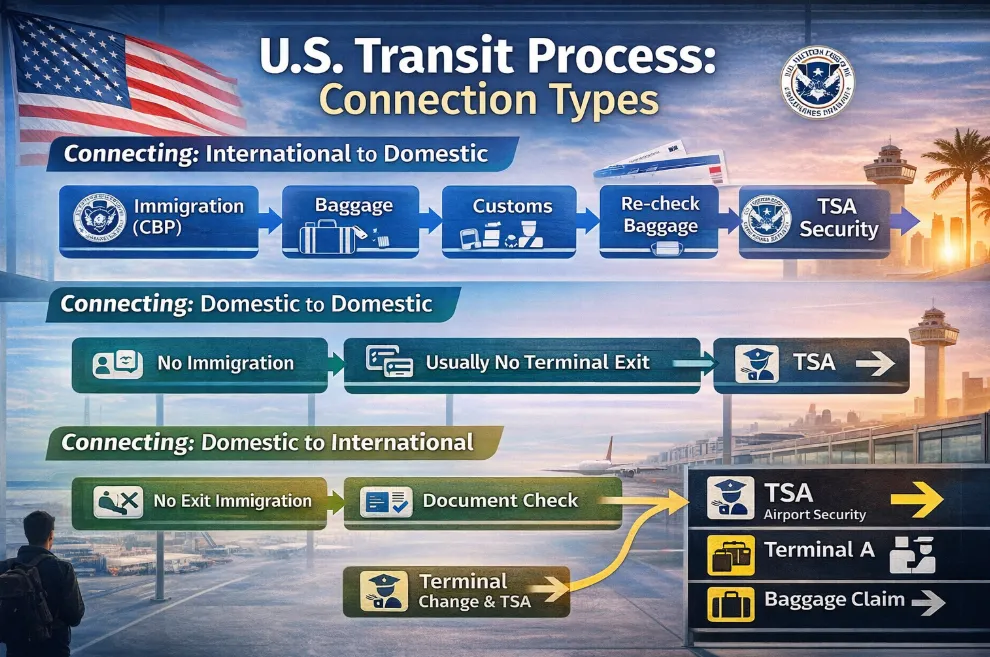
International to Domestic Connections in the U.S. (Full Process)
-
Touchdown & Deplane: Follow the "International Arrivals" signs.
-
Immigration: Face the CBP officer. Have your passport and visa/ESTA ready.
-
Baggage Claim: Grab your bags from the carousel—yes, all of them.
-
Customs: Walk through the green or red lane.
-
Recheck: Hand your bags to the staff at the "Connecting Flights" counter.
-
TSA Screening: Head to your connecting terminal and join the security line.
-
Boarding: Find your gate and breathe.
Domestic to Domestic Connections at U.S. Airports
This is the easiest scenario. Usually, you stay "airside." Just walk from Gate A1 to B12. However, if your connection requires a terminal change (like at LAX or JFK), check if there’s an airside shuttle. If you have to exit the terminal to take a train or bus, you’ll be facing the TSA line again.
Domestic to International Connections — What to Expect
Unlike most countries, the U.S. has no exit immigration. You won't see an officer on your way out. However, your airline will do a final document check at the gate to ensure you have the visas needed for your final destination.
Do You Need a Transit Visa for the United States?
Before you book your flight, you must ensure you have the legal right to land on U.S. soil. Because there is no "visa-free" transit zone, your paperwork must be in order before you even board your initial flight. This section clarifies the specific requirements for different nationalities and document types.
Is There Visa-Free Transit in the U.S.?
In short: No. Even if you’re just touching the tarmac for two hours on your way to Mexico, you need legal entry documents.
ESTA vs. U.S. Visa for Transit Passengers
-
ESTA (Visa Waiver Program): If you’re from a VWP country (like Japan, UK, or much of Europe), you can apply for an ESTA. It’s fast, cheap, and valid for two years.
-
C-1 Transit Visa: If you aren't VWP-eligible, you need a C-1 visa. It requires an interview at a U.S. Embassy. Don't skip this—airlines won't even let you board the first leg without it.
Transiting via the U.S. from Canada or Mexico
If you fly from Vancouver or Toronto, you likely handled U.S. Customs at the departure airport. This means you arrive in the U.S. as a "domestic" passenger. You walk straight to your next gate. Coming from Mexico? Expect the full international arrival treatment.
Minimum Connection Time (MCT) Explained for U.S. Airports
Minimum Connection Time (MCT) refers to the shortest possible time an airline or airport system considers acceptable for a passenger to transfer between two flights.
What Is Official Minimum Connection Time (MCT)?
Airlines use a mathematical formula called MCT to decide if a connection is "legal" to sell. If it’s 90 minutes, they’ll sell it to you. Does it mean you’ll make it? Not necessarily. It is calculated based on factors such as: terminal distance, aircraft type, typical processing times and airport infrastructure.
Why MCT Does Not Guarantee a Successful Connection
MCT doesn't account for a 30-minute taxi time on the runway, a massive line at immigration, or the fact that Terminal 1 and Terminal 8 are in different zip codes. At airports like JFK, LAX, and ORD, the physical layout alone can eat up your entire layover.
Important Disclaimer
MCT is not a guarantee of a successful connection.
MCT represents the minimum possible transfer time under ideal conditions—not a promise that a connection will be achieved. Immigration delays, weather, aircraft arrival time, and security screening are all variables beyond the airline’s control.
When in doubt, always choose a longer layover—especially when transiting through the United States.
How Much Layover Time Do You Really Need in the U.S.?
Given the gap between "official" MCT and the reality of U.S. Customs, we recommend the following buffer zones to ensure a stress-free transit:
-
International to Domestic Connections: Safe Bet: 3 to 4 hours.
-
The "Stress Zone": Anything under 2 hours is a high-stakes gamble. One slow bag on the carousel or a surge in the CBP hall could cause you to miss your flight.
-
-
Domestic Connections:
-
Same Terminal: 45 minutes to 1 hour.
-
Terminal Change: 1.5 to 2 hours (especially at hubs like LAX or ORD
-
12 Major U.S. Hub Airports — Transit Guides & Tips
1. John F. Kennedy International Airport (JFK)
-
Airport Overview: JFK is a massive international gateway in NYC, handling ~60 million passengers annually. It is the gold standard for challenging transits due to its non-connected terminal pods and massive volume.
- Transit Difficulty: ⭐⭐⭐⭐⭐ (Extreme)
-
Hub Airlines & Alliances:
-
American Airlines (Oneworld) (T8)
-
Delta Air Lines (SkyTeam) (T4)
-
JetBlue (T5)
-
Note: Alliances don't guarantee same-terminal transfers here.
-
Terminal Layout & Transfers:
-
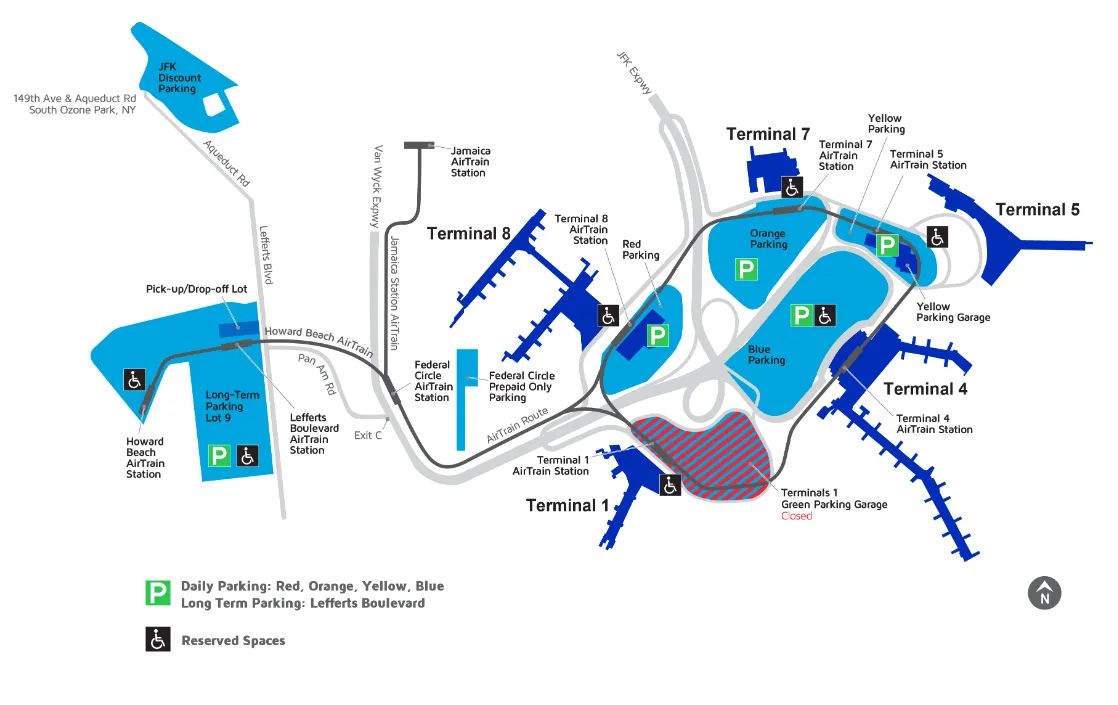
Active terminals: 1, 4, 5, 7, and 8.
-
AirTrain JFK: Your only landside connection. AirTrain JFK operates 365 days a year, 24 hours a day. It's free between terminals. Since the AirTrain operates outside the secure area, if your two flight segments are with different airlines located in different terminals, you will need to go through security screening again to enter the other terminal. During peak hours, transferring between the furthest terminals can take 20-30 minutes of travel and waiting time.
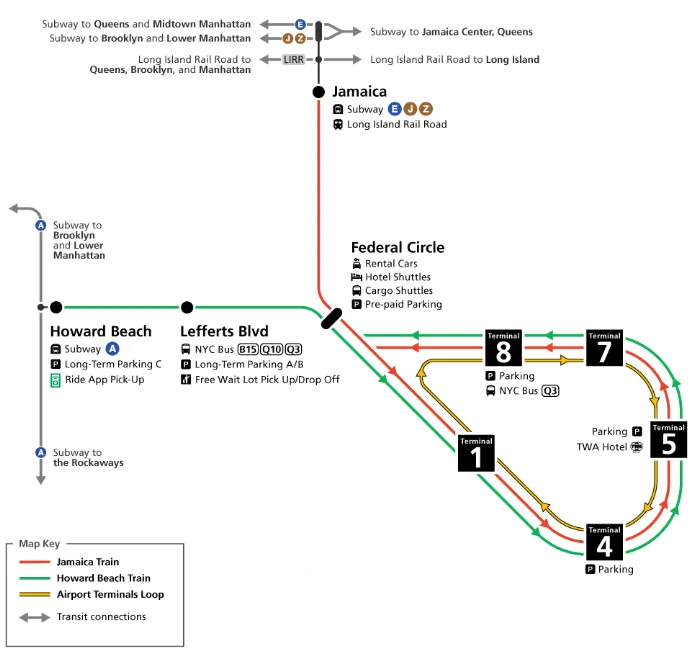 Image from jfkairport, Copyright by original author
 -
The Trap: Changing terminals almost always means exiting the secure zone and re-clearing TSA.
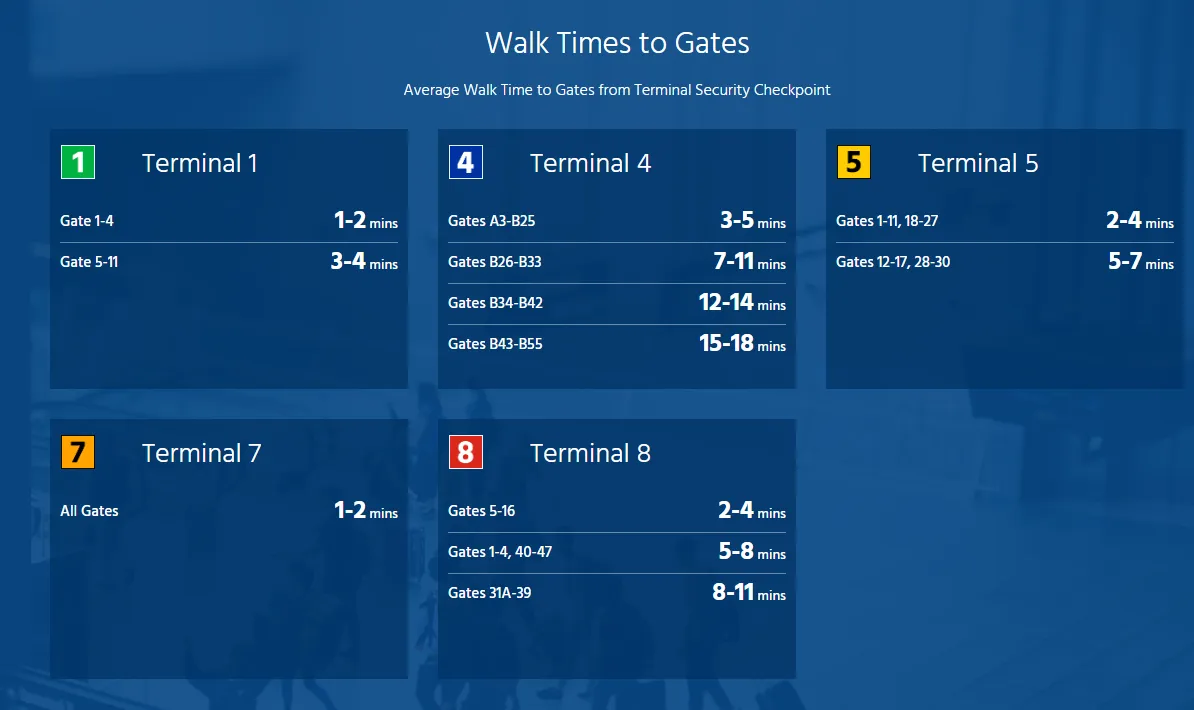 Image from jfkairport, Copyright by original author
 -
Immigration & Customs:
-
International arrivals are primarily at T4, T1, and T8.
-
CBP: Global Entry and Mobile Passport Control (MPC) are heavily utilized. Wait times can hit 90 mins.
-
-
Baggage & Recheck:
-
Int'l to Domestic: Grab bags, clear Customs, find the airline recheck counter before boarding the AirTrain.
-
Separate Tickets: Lug your bags onto the AirTrain and re-check at your new airline’s main desk.
-
-
Connection Time:
-
Minimum: 90 mins (Official); Recommended: 4–5 hours for International connections.
-
- Terminal Layout & Inter-Terminal Transit Scenarios:
-
Scenario A: International to Domestic (Terminal Change required)
-
Deplane & CBP: Clear immigration at your arrival terminal (e.g., T4).
-
Baggage & Customs: Reclaim luggage and exit customs.
-
Recheck: Drop bags at the "Connecting Flights" desk.
-
AirTrain: Take the "All Terminals" loop to your next terminal (e.g., T8).
-
TSA: Re-enter the security checkpoint at the new terminal.
-
-
Scenario B: Domestic to International (Terminal Change required)
-
Arrival & Exit: Follow "Baggage Claim/Exit" signs to leave the secure area.
-
AirTrain: Take the AirTrain to the International terminal (e.g., T1).
-
TSA: Clear security at the new terminal. No exit immigration required.
-
-
-
Common Transit Mistakes & Expert Tips:
-
Mistake: Assuming you can walk between terminals. You can't.
-
Expert Tip: Use MPC to bypass the standard queue. Avoid separate tickets here if possible.
-
2. Los Angeles International Airport (LAX)
-
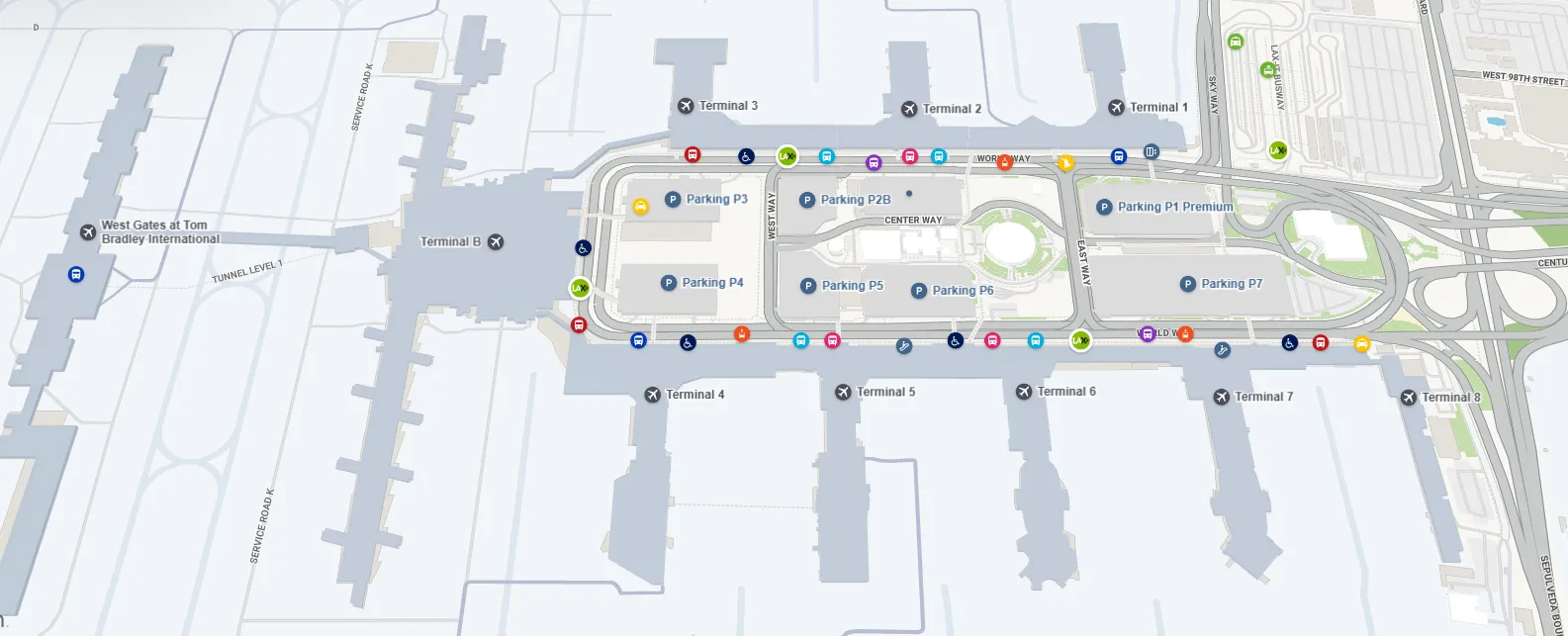
Airport Overview: Featuring nine passenger terminals arranged in a U-shaped layout. Tom Bradley International Terminal (TBIT) is the primary gateway for international arrivals.
- Transit Difficulty: ⭐⭐⭐⭐☆ (High)
-
Hub Airlines & Alliances:
- United (Star Alliance) - T7/T8.
-
Delta (SkyTeam) - T2/T3.
-
American (Oneworld) - T4/T5.
- Southwest - T1
-
Alaska Airlines - T6
-
Terminal Layout & Transfers: LAX consists of 9 terminals connected by a horseshoe-shaped road.
-
Airside Connection: Airside tunnels and bridges now connect T4 through TBIT and T2/T3. Moving from TBIT to T7 is a long walk (20+ mins).
-
Airline/Terminal Connector Shuttle Bus: For landside transfers, use the "Terminal Connector" shuttle bus (Pink Sign) that circles the Central Terminal Area.
-
Terminal Connections Pedestrian Path: You can walk between all terminals on the landside (upper/departures level) via sidewalk paths. Following recent renovations, airside pedestrian pathways now link T1-T8 and TBIT, allowing many travelers to change terminals without re-clearing TSA (if already airside).
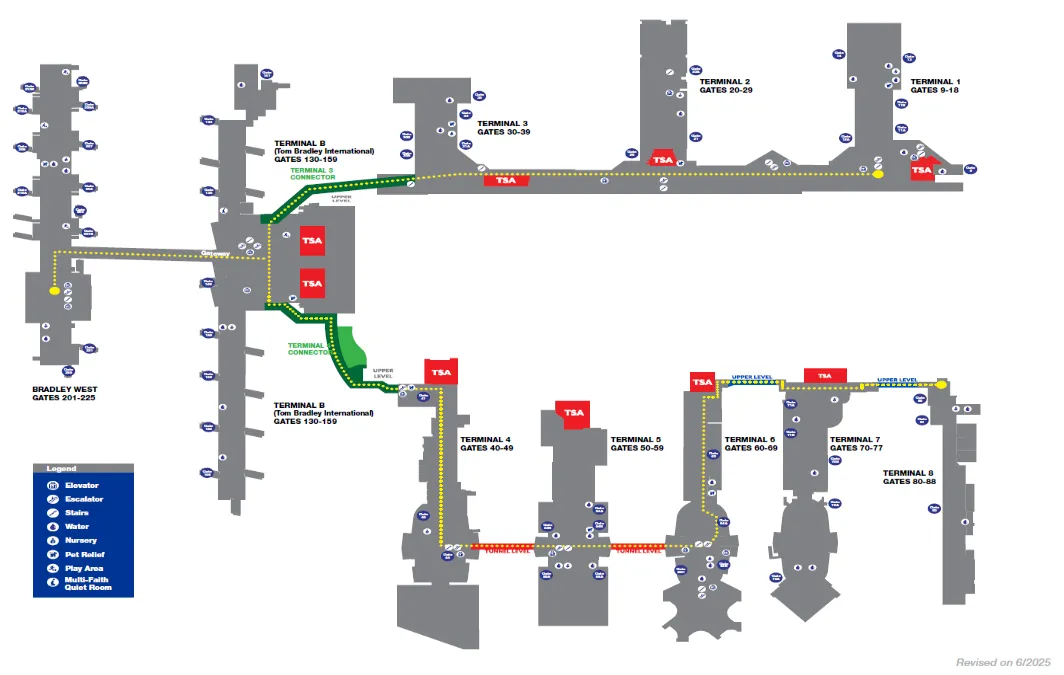 Image from LAX, Copyright by original author
 -
2026 Modernization Update: With the full completion of the Landside Access Modernization Program (LAMP) in 2026, the Automated People Mover (APM) is the primary transit method. The APM connects all terminals, the new consolidated Rent-A-Car facility, and the Metro rail system, significantly reducing the reliance on shuttle buses and landside traffic.
-
-
Immigration & Customs: TBIT handles most foreign carriers. Processing is efficient but the sheer volume of passengers is overwhelming.
-
Baggage & Recheck: Recheck counters are located just outside the customs exit at TBIT.
-
Connection Time: * MCT: 120 mins.
-
Recommended: 3 hours.
-
-
Inter-Terminal Transit Scenarios:
-
International-to-Domestic (TBIT to T4-T8):
-
Arrive at TBIT: Clear CBP (Immigration) and follow signs to baggage claim.
-
Claim Baggage & Clear Customs: You must pick up all checked luggage for customs inspection.
-
Baggage Recheck: Right after customs exit, look for the recheck counters for your airline (United, Delta, American, etc.) to drop your bags.
-
Determine Transfer Route:
-
To T4, T5, T6, T7, T8: Follow signs for "Connecting Flights" and use the Airside Walkways/Tunnels if you wish to stay within security (avoiding the bus/APM).
-
To T1, T2, T3: Exit the terminal and take the Pink Shuttle (Landside) or the APM Train (Post-2026) to your terminal.
-
-
Clear TSA Security: Re-clear security at your departing terminal.
-
-
Domestic-to-International (T1-T8 to TBIT): Use the airside walkways that connect T1 through T8 to TBIT. This allows you to transfer without leaving the secure area or re-clearing security.
-
Landside Transfer (TBIT to T1/T2/T3): If you must exit the terminal, use the "Terminal Connector" shuttle or walk along the departures level sidewalk. Post-2026, use the APM train for all landside movements between terminals.
-
-
Common Transit Mistakes & Expert Tips: * Mistake: Leaving the secure area to take the "A" shuttle when an airside walkway is available.
-
Tip: Post-2026, prioritize the APM for landside terminal changes, but always check if your airline offers an airside shuttle for domestic-to-domestic transfers to avoid re-clearing TSA.
-
3. Hartsfield-Jackson Atlanta International Airport (ATL)
-
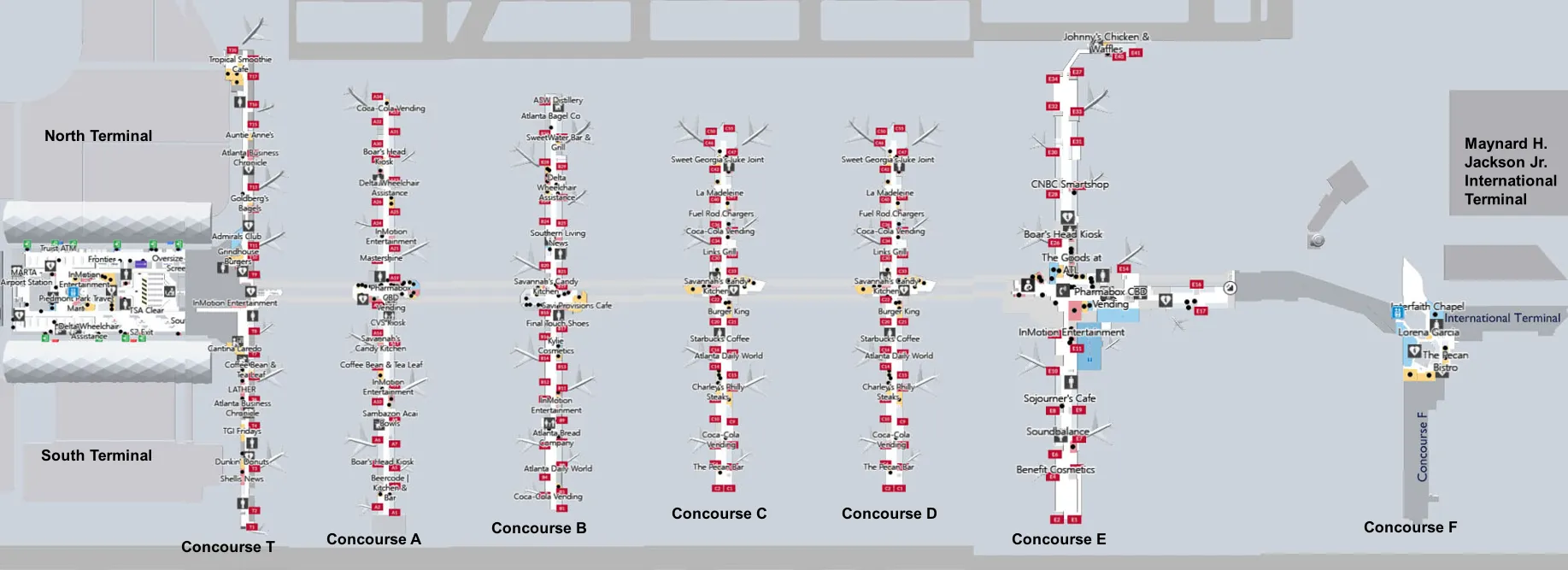
Airport Overview: The world's busiest airport but highly organized. The airport is split into two main terminal buildings: the Domestic Terminal (on the west side) and the Maynard H. Jackson Jr. International Terminal (on the east side). The Domestic Terminal is further divided into North and South wings for airline check-in, while all international arrivals and departures are centralized at the International Terminal (Concourse F).
- Transit Difficulty: ⭐⭐☆☆☆ (Moderate)
-
Hub Airlines & Alliances: * Delta Air Lines (SkyTeam) - Main Hub.
-
Terminal Layout & Transfers: Linear layout (Concourses T, A, B, C, D, E, F) connected by the underground Plane Train (Airside).
-
The Plane Train (Airside Transfer): This automated people mover is the primary way to navigate the airport. It operates 24/7 and runs in a loop beneath the concourses.
-
Route: T → A → B → C → D → E → F. It connects the Domestic Terminal (at the west end) with Concourse T, A, B, C, D, E, and finally Concourse F (International Terminal) at the east end.
-
How to Ride: Once you clear security, follow signs for "Plane Train." It arrives every 2 minutes and provides audio announcements for the next stop.
-
Purpose: Use this to travel between any gate in the airport without leaving the secure area. The journey from the Domestic Terminal to Concourse F takes about 12 minutes.
-
-
-
Inter-Terminal Transit Scenarios:
-
Airside Transfer (Domestic-to-Domestic/International): Use the underground Plane Train. It runs every 2 minutes and connects all concourses (T through F). Moving between the most distant concourses (T and F) takes approximately 10-12 minutes.
-
International-to-Domestic (Landside): After clearing customs at Concourse F, if you do not recheck your bags or need to access the Domestic Terminal (Ground Transportation/MARTA), take the landside terminal shuttle bus that runs between the International and Domestic terminals (approx. 15-minute ride).
-
Domestic-to-International (Landside): If you are starting your journey or have exited the secure area, use the landside terminal shuttle to move between the Domestic and International terminals. Note that there is no airside connection for passengers who have already exited security.
-
-
Immigration & Customs: Located in Concourse F (International Terminal).
-
Baggage & Recheck: Very streamlined Delta recheck counters immediately after customs.
-
Connection Time: * MCT: 90 mins.
-
Recommended: 2 - 2.5 hours.
- The distances between the seven terminals are not significantly different, with walking times between each terminal ranging from 8 to 15 minutes. The walking time between International Terminals E and F is 15-18 minutes. The entire distance from the domestic terminal to International Terminal F (from the far left to the far right in the diagram above) is approximately 2.5 kilometers. Taking the airport's underground Plane Train is recommended.
-
-
Common Transit Mistakes & Expert Tips: * Mistake: Attempting to walk between concourses instead of taking the Plane Train.
-
Tip: ATL is a "mega-hub"; if your arrival is delayed 15 mins, your connection is already at risk.
-
4. Chicago O'Hare International Airport (ORD)
-
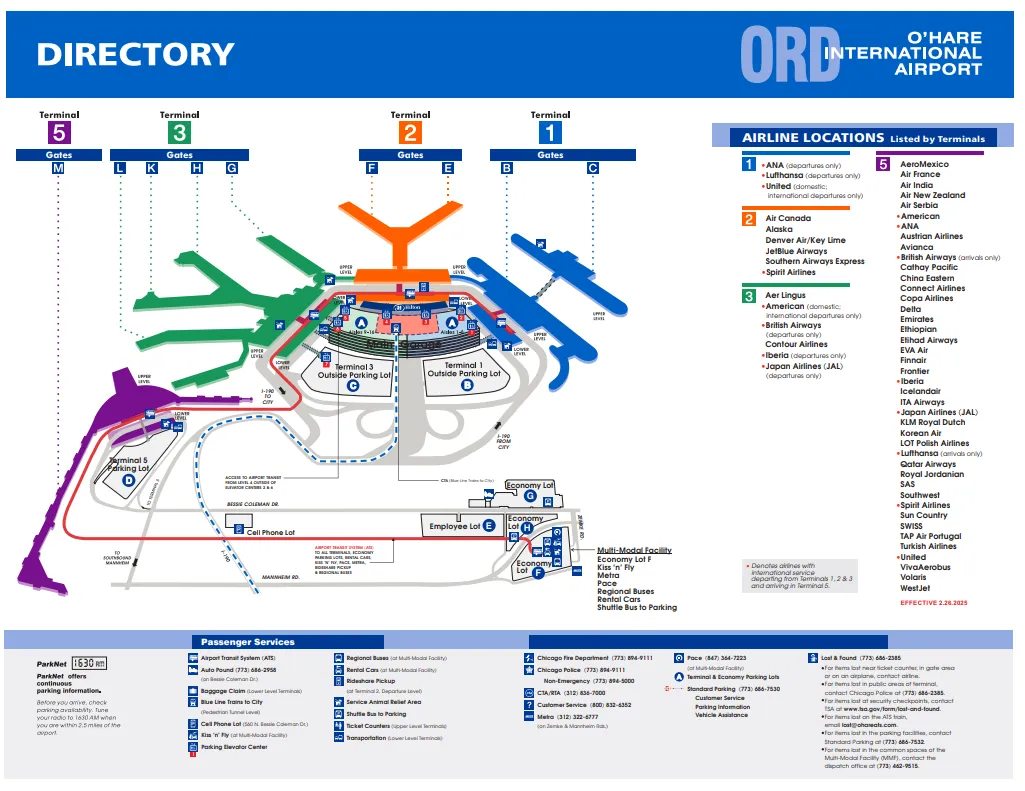
Airport Overview: ORD consists of four active terminals: Terminals 1, 2, and 3 (primarily domestic and North American departures) and Terminal 5 (the primary international terminal). Terminal 4 is currently non-existent (formerly a temporary bus shuttle center). Extreme weather can cause cascading delays, and Terminal 5 is physically isolated from the main terminal complex.
- Transit Difficulty: ⭐⭐⭐⭐☆ (High)
-
Hub Airlines & Alliances:
-
American (Oneworld) - T3.
- United (Star Alliance) - T1.
-
-
Terminal Layout & Transfers:
-
Airport Transit System (ATS):
 An automated landside people mover connecting all terminals and the Multi-Modal Facility (Rental Cars/Economy Parking).
-
Status: Operates 24/7.
-
Frequency: Trains arrive every 3-5 minutes during the day and every 10 minutes at night.
-
Route: T1 ↔ T2 ↔ T3 ↔ T5 ↔ Multi-Modal Facility (MMF).
-
-
Terminal Transfer Bus (TTB - Airside): A free shuttle bus that allows passengers to transfer between terminals without leaving the secure area (avoiding a second TSA screening).
-
Route 1: Connects Terminal 1 (Gate B1) and Terminal 5 (Gate M13).
-
Route 2: Connects Terminal 3 (Gate G17 & K20) and Terminal 5 (Gate M13).
-
Operating Hours: Daily from 11:30 AM to 9:30 PM (Hours may vary by season/airline schedules).
-
Requirement: Only for passengers with a valid boarding pass for a departing flight from the destination terminal.
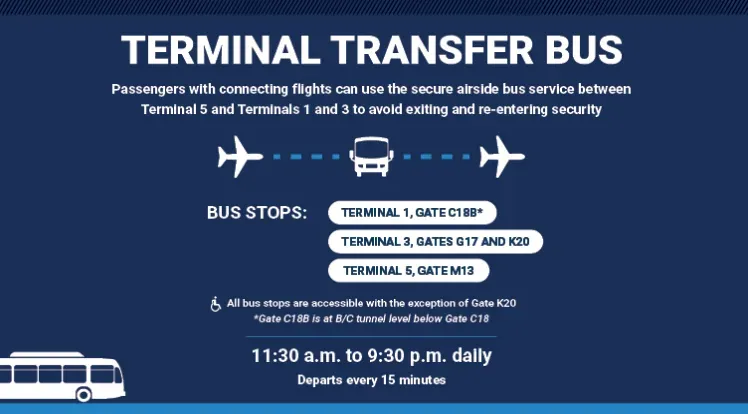 Image from FlyChicago, Copyright by original author
-
-
-
Inter-Terminal Transit Scenarios:
-
International-to-Domestic (T5 Arrival):
-
Arrive at Terminal 5: All international flights land here.
-
Clear CBP & Claim Baggage: Complete immigration and collect all checked bags.
-
Baggage Recheck: Drop bags at the UA/AA recheck counters immediately after customs exit.
-
Board ATS Train: Exit T5 and take the landside ATS train to your departing terminal (T1, T2, or T3).
-
Clear TSA Security: Re-enter the secure area at your domestic terminal.
-
-
-
-
Domestic-to-International (T1/T2/T3 to T5): If your airline offers it (United/American), use the TTB (Airside Bus) to stay within security. Otherwise, you must take the ATS train (Landside) and re-clear security at T5.
-
Domestic-to-Domestic (T1, T2, T3): These terminals are connected airside via pedestrian walkways. You can walk between them without re-clearing security.
-
-
Immigration & Customs: Most international flights arrive at T5.
-
Baggage & Recheck: Reclaim at T5. Recheck counters for UA/AA are inside T5 after customs.
-
Connection Time: * MCT: 90 mins.
-
Recommended: 3.5 hours.
-
-
Common Transit Mistakes & Expert Tips: * Mistake: Not allowing enough time for the ATS train and re-clearing TSA at T1/T3.
-
Tip: If arriving on United at T1 and departing from T5, check for the airside shuttle bus (TTB) to save at least 45 minutes of transit time.
-
5. San Francisco International Airport (SFO)
-
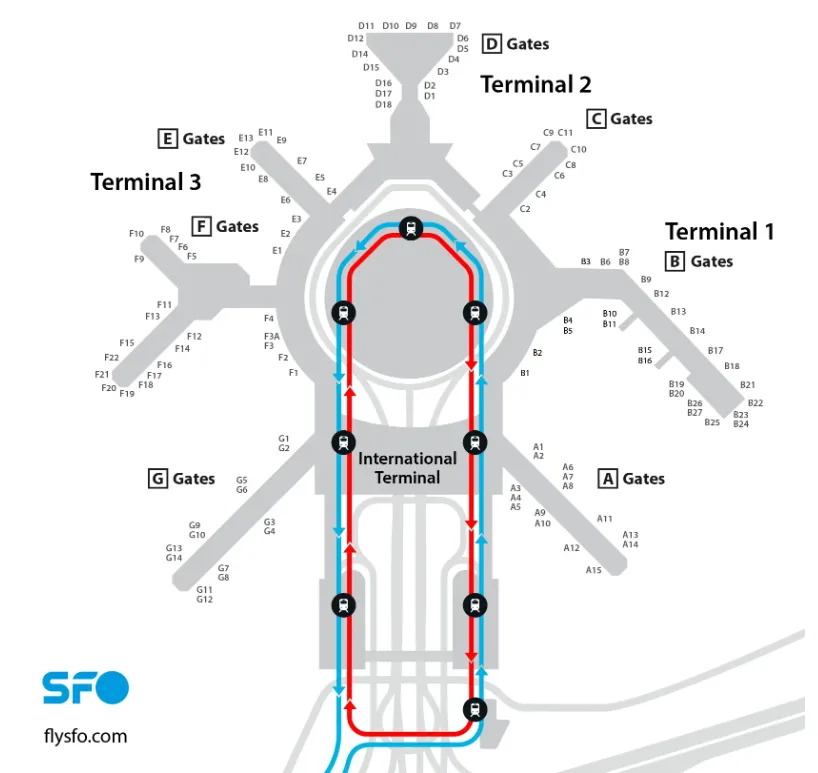
Airport Overview: SFO features a logical circular layout consisting of four terminals: Terminals 1, 2, 3 (Domestic) and the International Terminal (divided into Boarding Areas A and G). United Airlines occupies T3 and Int'l Concourse G, while other major carriers like Alaska (T2) and Delta (T1) are spread across the domestic complex.
- Transit Difficulty: ⭐⭐☆☆☆ (Moderate)
-
Hub Airlines & Alliances:
- United (Star Alliance) - T3 & Int'l Terminal G.
-
Alaska Airlines - T2.
-
Terminal Layout & Transfers:
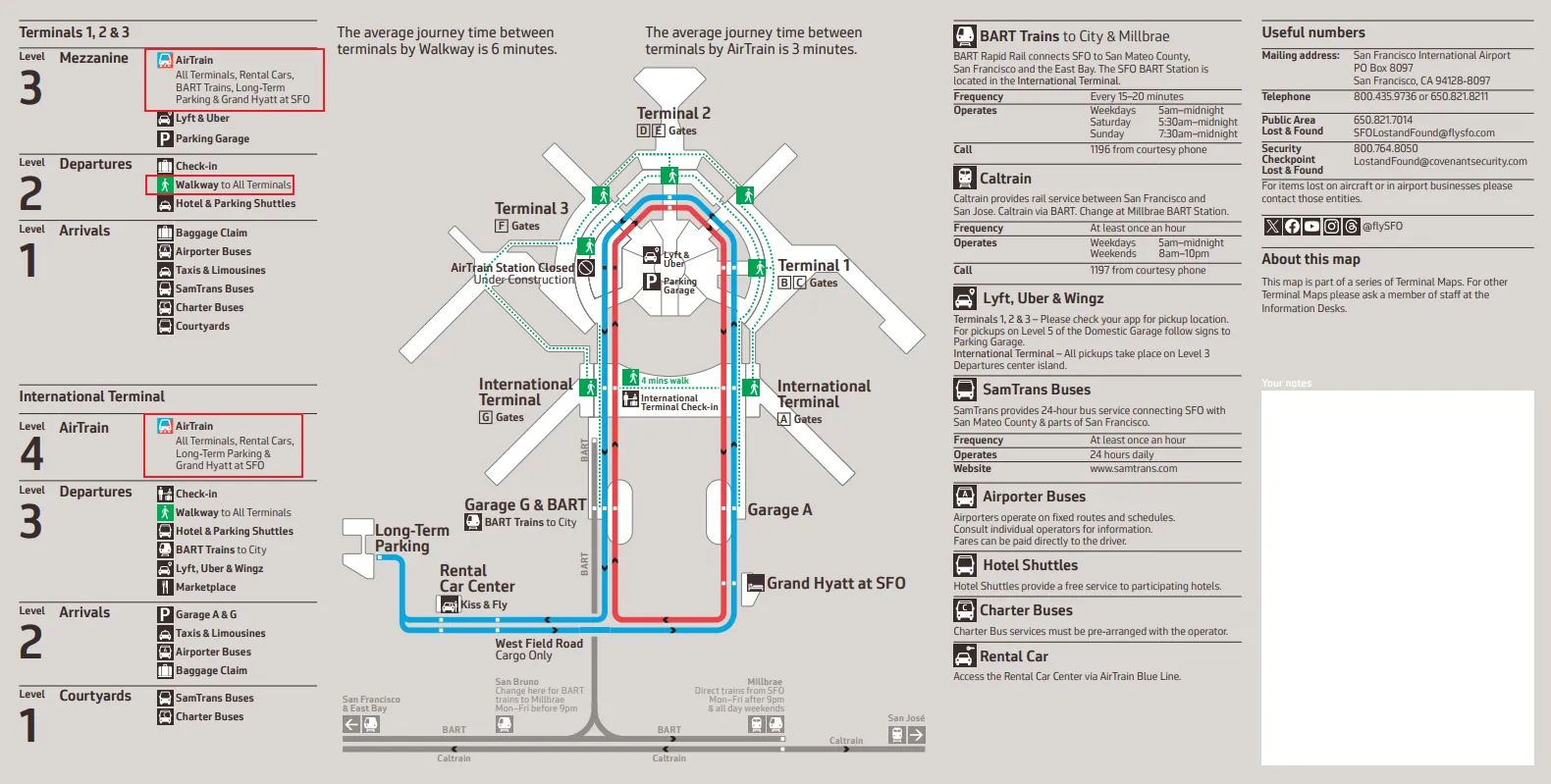 Image from FlySFO, Copyright by original author
-
AirTrain Connections (Landside): The automated AirTrain operates 24/7 on two lines.
-
Red Line: Connects all terminals, terminal garages, and the BART Station. It runs in a loop every 4 minutes.
-
Blue Line: Connects all terminals, the Rental Car Center, and the Long-Term Parking.
-
Note: AirTrain is landside (outside security). If you use it, you must re-clear TSA.
-
-
Airside Walkways (Post-Security): SFO is highly walkable "airside," allowing transfers without re-clearing security.
-
T3 to International G: A seamless 5-10 minute walk via the connector bridge. Primary route for United connections.
-
T2 to T3: Connects Alaska/Delta gates to United gates (approx. 10-15 minute walk).
-
T1 to International A: Connects the newly renovated Harvey Milk Terminal 1 to the International A gates.
-
-
Transfer Tip: Almost all terminals are now connected airside, making it possible to walk from T1 all the way to International G (approx. 25-30 minute walk total).
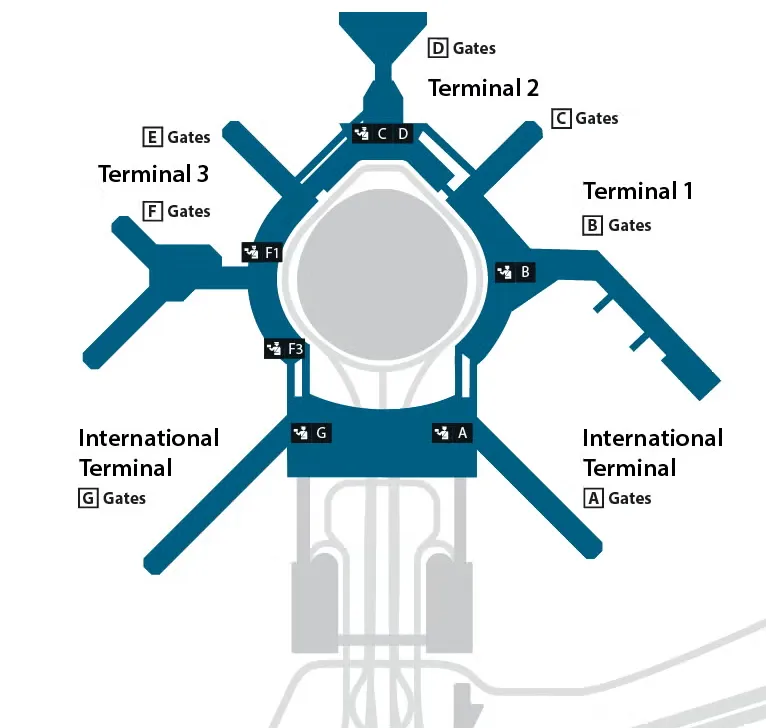 Image from FlySFO, Copyright by original author
-
-
Inter-Terminal Transit Scenarios:
-
International-to-Domestic (Int'l Terminal Arrival):
-
Arrive at Int'l Terminal: Clear CBP and collect your baggage.
-
Customs & Recheck: After customs, drop bags at the recheck counter (United is just outside the exit).
-
Security Clearance: You must re-clear TSA. You can do this at the Int'l Terminal security checkpoints or walk to your domestic terminal (T1, T2, or T3) and clear security there.
-
Accessing Domestic Gates: Use the Airside Walkways if you clear security at the Int'l Terminal, or take the Red Line AirTrain (Landside) if you prefer to travel outside security.
-
-
Domestic-to-Domestic (T1, T2, T3):
-
Airside Walkway: Follow the "Connecting Flights" signs. Pedestrian walkways connect all domestic terminals post-security.
-
No Re-screening: As long as you stay airside, you do not need to clear TSA again.
-
-
-
Immigration & Customs: International Terminal (Concourse G or A).
-
Baggage & Recheck: Recheck counters for United are conveniently located right outside customs.
-
Connection Time: * MCT: 90 mins.
-
Recommended: 2.5 hours.
-
-
Common Transit Mistakes & Expert Tips: * Mistake: Taking the AirTrain when you could have walked the airside connector.
-
Tip: SFO has some of the best airport food; Concourse G has great options if you have time.
-
6. Dallas/Fort Worth International Airport (DFW)
-
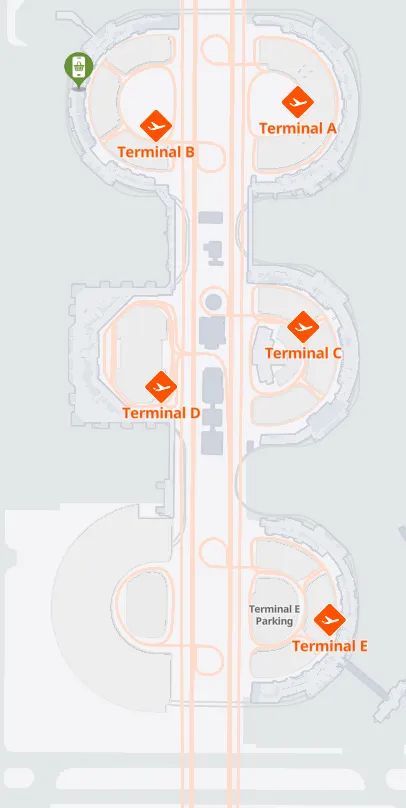
Airport Overview: A massive sprawling airport, but the Skylink is world-class. DFW consists of five terminals (A, B, C, D, and E) arranged in a semi-circular layout.
-
Terminal D: The primary international terminal, though some American Airlines international flights depart from other terminals.
-
Terminals A, B, C: Primary hubs for American Airlines (Domestic). Terminal B also serves American Eagle.
-
Terminal E: Serves other domestic carriers (Delta, United, Spirit, etc.) and flights to Canada/Mexico.
-
- Transit Difficulty: ⭐⭐⭐☆☆ (Moderate)
-
Hub Airlines & Alliances: American Airlines (Oneworld) - Main Hub.
-
Terminal Layout & Transfers: Skylink (Airside): The fastest way to move between all five terminals while staying inside security.
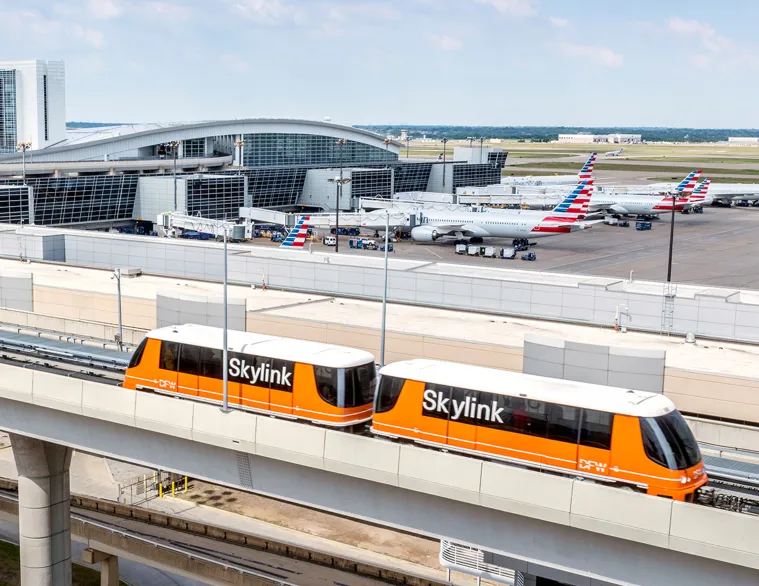 Image from DFW Airport, Copyright by original author
-
Status: Operates 24/7.
-
Frequency: Trains arrive every 2 minutes.
-
Travel Time: Maximum 9 minutes between any two points.
-
Route: Stops at two locations in each terminal (e.g., A1-A21 and A22-A39).
-
Terminal Link (Landside): A free shuttle bus service for passengers outside security or with oversized luggage. Except for Terminal D, the Terminal Link stations are located on the upper level.
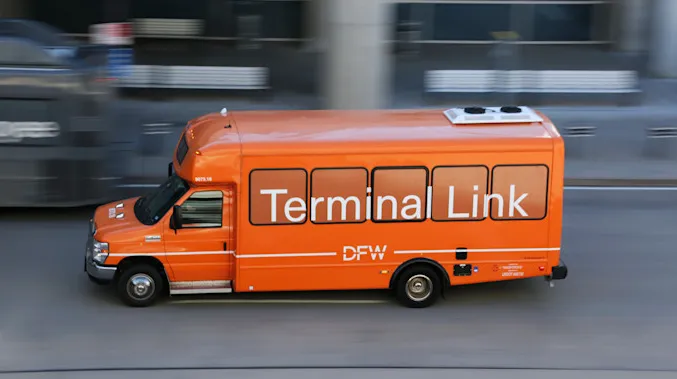 Image from DFW Airport, Copyright by original author
-
Status: Operates 24/7.
-
Frequency: Every 10-15 minutes.
-
Route: Connects all terminals at the departures/ticketing level. Look for the green "Terminal Link" signs.
-
-
-
Inter-Terminal Transit Scenarios:
-
International-to-Domestic (Terminal D Arrival):
-
Arrive at Terminal D: Clear CBP immigration and collect checked baggage.
-
Customs & Recheck: After customs, drop bags at the baggage recheck counter.
-
Security Checkpoint: You must re-clear TSA security at Terminal D.
-
Skylink Transfer: Once airside, take the Skylink train to your departing terminal (A, B, C, or E).
-
-
Domestic-to-International (Staying Airside): If your luggage is checked through and you arrive from a domestic U.S. city, you will stay in the secure area. Simply follow signs for Skylink and take the train to Terminal D. You do not need to clear security again.
-
Landside Transfer (Exited Security): If you have exited the terminal or are arriving via ground transportation and need to change terminals, use the Terminal Link shuttle bus. Note that you will have to clear TSA security at your new terminal.
-
-
Immigration & Customs: Terminal D (International Arrivals).
-
Baggage & Recheck: Standard recheck area in Terminal D immediately after customs exit.
-
Connection Time: * MCT: 70 - 90 mins.
-
Recommended: 2 hours.
-
-
Common Transit Mistakes & Expert Tips: * Mistake: Exiting to the Landside "Terminal Link" bus instead of staying Airside for the Skylink.
-
Tip: DFW is huge; check your gate on the AA app as soon as you land.
-
7. Newark Liberty International Airport (EWR)
-
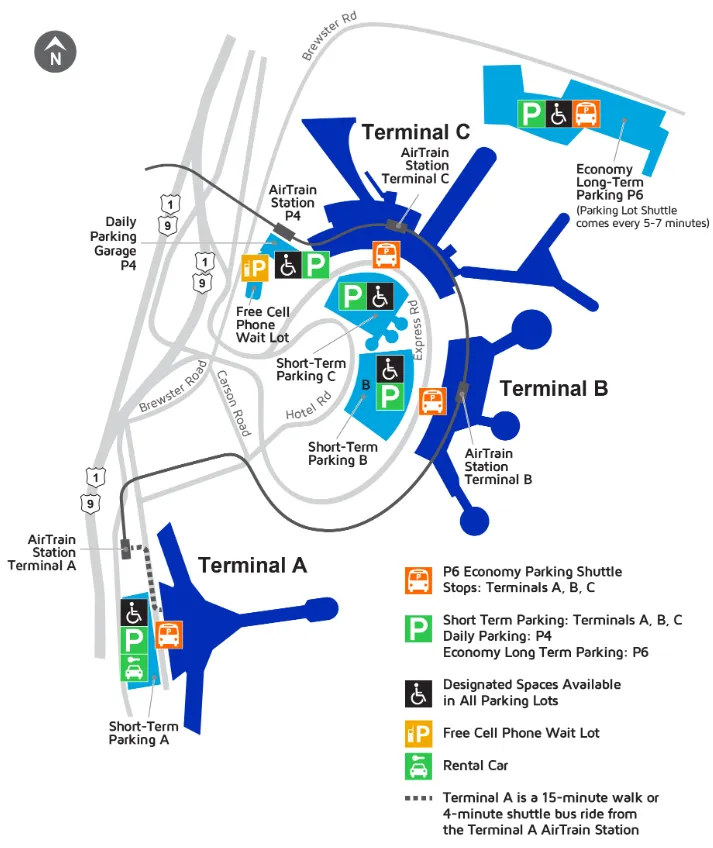
Airport Overview : Newark (EWR) is a critical hub for the Tri-State area but is notorious for congestion and complex layout.
-
Terminal A: A brand-new, state-of-the-art terminal serving domestic and Canadian flights for Delta, United, JetBlue, and American.
-
Terminal B: The primary international gateway for non-United foreign carriers.
-
Terminal C: Exclusively for United Airlines (Domestic and International), featuring a vast array of amenities and high-tech lounges.
-
- Transit Difficulty: ⭐⭐⭐⭐☆ (High)
-
Hub Airlines & Alliances: * United (Star Alliance) - T-C & T-A.
-
Terminal Layout & Transfers: EWR uses two primary transit systems to manage its decentralized layout:
-
AirTrain Newark (Landside):
-
Purpose: Connects all terminals (A, B, C), parking lots, and the EWR Rail Station (NJ Transit/Amtrak).
-
Operating Hours: 24/7, 365 days a year.
-
Frequency: Every 3 minutes during peak hours (5 AM – midnight) and every 15 minutes at night.
-
Note: This system is outside security. If you take the AirTrain between terminals, you must re-clear TSA security at your next terminal.
-
-
United Airside Shuttle (Airside):
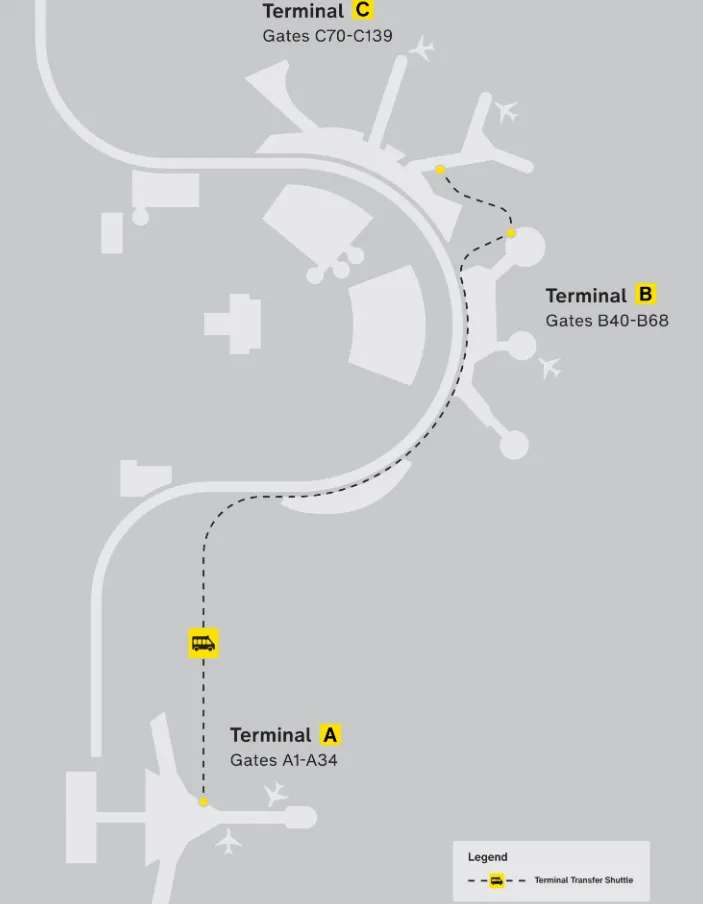 Image from Newark Airport, Copyright by original author
-
Purpose: Specifically for United/United Express passengers to transfer without leaving the secure area.
-
Operating Hours: Daily, typically 5:00 AM – 11:00 PM (aligns with flight schedules).
-
Frequency: Every 10-15 minutes.
-
Stops: * Terminal A: Near Gate A28.
-
Terminal C: Near Gate C71.
-
Terminal B: Near Gate B67 (Note: only for specific international connection windows).
-
-
-
-
Inter-Terminal Transit Scenarios: United-to-United Connections (Terminal A ↔ Terminal C):
-
Locate Shuttle Point: In Terminal A (Gate A28) or Terminal C (Gate C71).
-
Board Airside Shuttle: Use the free United shuttle bus.
-
Stay Airside: Since you never leave the secure zone, you skip TSA re-screening at the destination terminal.
-
International-to-Domestic (Terminal B Arrival):
-
Clear CBP: Complete immigration at Terminal B.
-
Claim Baggage & Clear Customs: You must collect all luggage.
-
Recheck Baggage: Drop bags at the recheck counter for your airline.
-
Board AirTrain (Landside): Follow signs for AirTrain and take the train to Terminal A or C.
-
Re-clear TSA Security: You must undergo full security screening at your departing terminal.
-
-
Landside Terminal Movement: Use the AirTrain for all landside movements (e.g., if you have already exited the secure area or are arriving from the train station). It is free for travel between terminals.
-
-
Immigration & Customs: Terminal B (Foreign carriers) or Terminal C (United).
-
Baggage & Recheck: Recheck available at Terminal C for United passengers.
-
Connection Time:
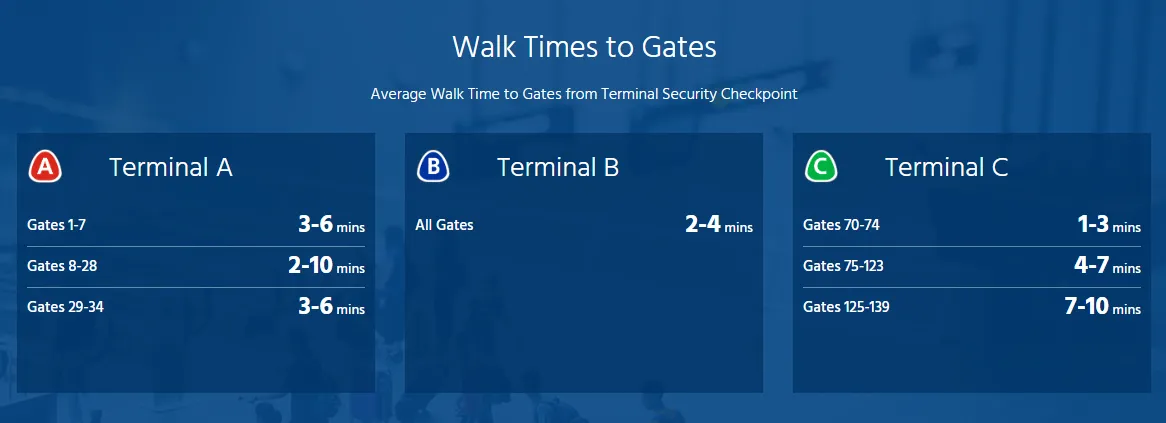 Image from Newark Airport, Copyright by original authorMCT: 90 mins.
-
Recommended: 3 hours.
-
-
Common Transit Mistakes & Expert Tips: * Mistake: Assuming the AirTrain is fast; it can be unreliable.
-
Tip: The new Terminal A is a long way from C; use the shuttle bus if possible to stay airside.
-
8. Seattle-Tacoma International Airport (SEA)
-
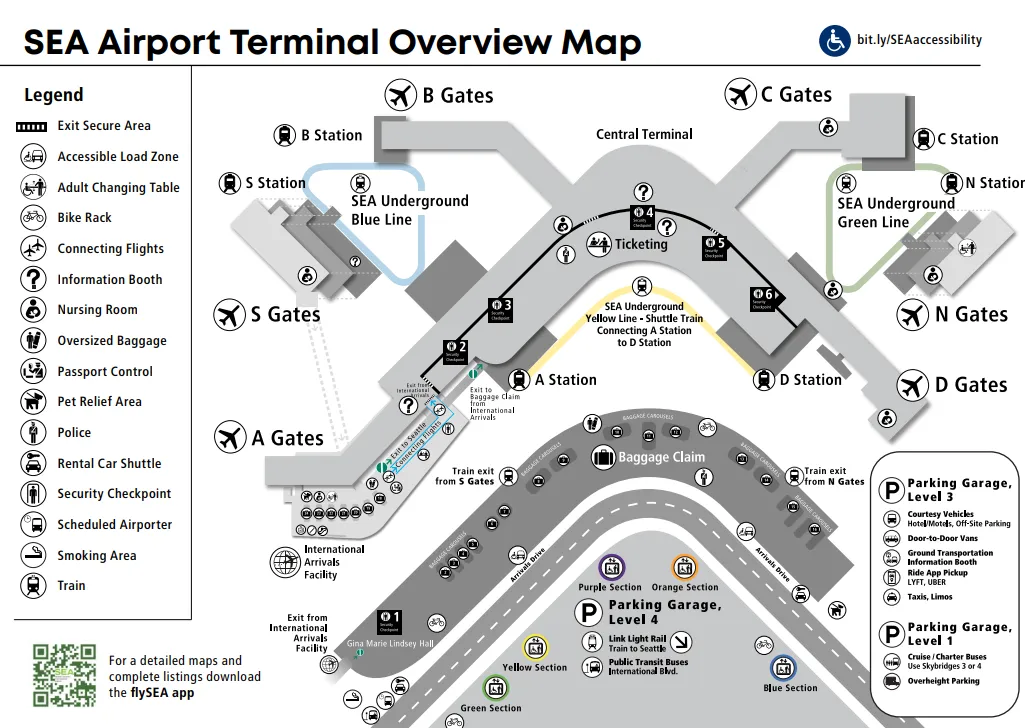
Airport Overview: Seattle-Tacoma (SEA) features a highly centralized layout but relies heavily on an underground train system to reach its detached satellites. The airport consists of a massive Main Terminal (housing Concourses A, B, C, and D) and two satellite terminals: the North Satellite (N Gates) and the South Satellite (S Gates). While they appear physically separate, they are seamlessly linked airside via the SEA Underground trains.
- Transit Difficulty: ⭐⭐⭐☆☆ (Moderate)
-
Hub Airlines & Alliances:
- Alaska Airlines (Oneworld) - Primary Hub (Main Terminal & N Gates).
-
Delta Air Lines (SkyTeam) - Hub (Main Terminal & S Gates).
-
Terminal Layout & Transfers: SEA is navigated using the SEA Underground (Satellite Transit System - STS), an automated airside people mover.
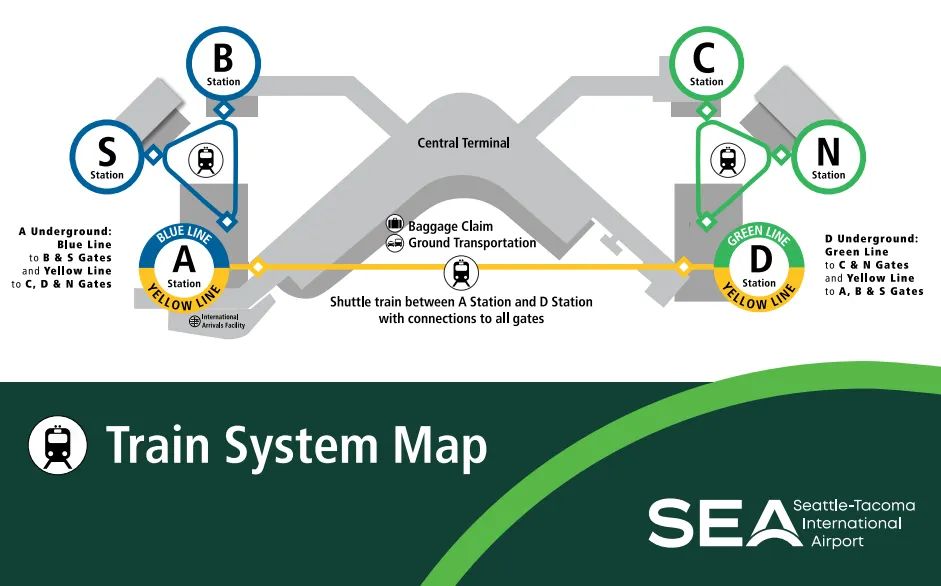 Image from Port Seattle, Copyright by original author
-
The SEA Underground Trains (STS): The system consists of three distinct underground loops that allow for rapid airside transit without re-clearing security.
-
North Loop: Connects the Main Terminal (near Concourse D/N Gates) with the North Satellite (N Gates) and Concourse C.
-
South Loop: Connects the Main Terminal (near Concourse A/S Gates) with the South Satellite (S Gates) and Concourse B.
-
Shuttle Train: A dedicated line connecting the North and South loops within the Main Terminal (Concourse A to Concourse D).
-
Operating Hours: Trains run 24/7, synchronized with flight activity.
-
Frequency: Trains arrive every 2 to 5 minutes.
-
-
-
Inter-Terminal Transit Scenarios:
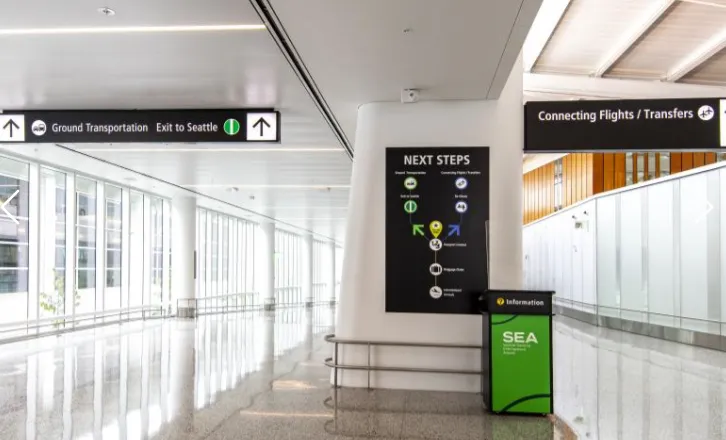
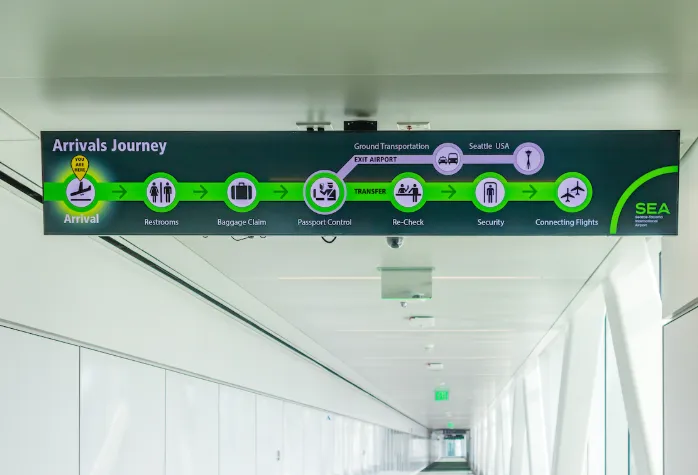 Image from Port Seattle, Copyright by original author
-
Connecting between Main Terminal Concourses (A, B, C, D): These concourses are physically connected and walkable. However, if you are traveling from A to D, taking the Shuttle Train or the underground loops is much faster than walking the entire length of the Central Terminal.
-
Moving from Main Terminal to N or S Satellites:
-
Identify your gate: Gates starting with 'N' are in the North Satellite; 'S' are in the South Satellite.
-
Locate Train Stations: Station entrances are clearly marked on the concourse level (e.g., the N Gates station is located near the end of Concourse D).
-
Board the STS: Ride the underground train (usually just one stop) to reach your satellite terminal.
-
-
International-to-Domestic (S Gates/IAF Arrival):
-
Arrive at IAF: Most international flights arrive at the South Satellite (S Gates) and use the International Arrivals Facility (IAF).
-
Clear CBP & Claim Baggage: Follow the signs to the IAF, clear immigration, and collect all checked luggage.
-
Customs & Recheck: Exit customs and drop your bags at the recheck counter located just outside the arrivals hall.
-
Accessing the Main Terminal: You must take the South Loop STS Train from the S Gates to the Main Terminal (Exit to Baggage Claim or Security Re-entry).
-
Re-clear Security: If you have a connecting flight, you must re-clear TSA security to access any of the gates (A, B, C, D, N, or S).
-
-
-
Immigration & Customs: The new IAF features a dramatic aerial walkway connecting the S Satellite to the Main Terminal for arrivals.
-
Baggage & Recheck: Baggage claim is within the IAF. Recheck is just after customs.
-
Connection Time: * MCT: 90 mins.
-
Recommended: 2.5 hours.
-
-
Common Transit Mistakes & Expert Tips: * Mistake: Assuming you can walk to the "N" or "S" gates without taking the train.
-
Tip: The aerial bridge in the IAF offers great views of Mt. Rainier on clear days.
-
9. Washington Dulles International Airport (IAD)
-
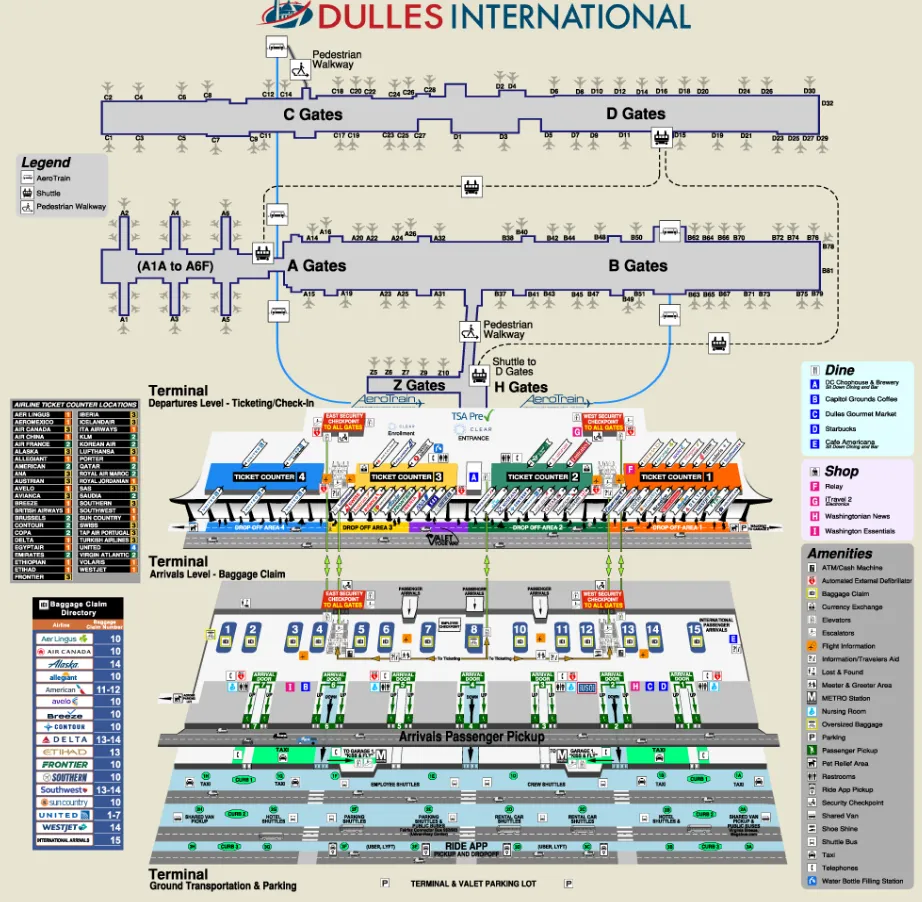
Airport Overview: Washington Dulles (IAD) features a unique, albeit somewhat confusing, layout consisting of a magnificent Main Terminal and two parallel midfield concourse buildings: Concourse A/B and Concourse C/D. Unlike most airports where international arrivals are processed at the gate, all non-precleared international passengers are transported to the International Arrivals Building (IAB) located at the Main Terminal to complete CBP immigration and customs formalities.
- Transit Difficulty: ⭐⭐⭐☆☆ (Moderate)
-
Hub Airlines & Alliances: * United (Star Alliance) - Primary Hub (Concourse C/D).
-
Terminal Layout & Transfers: Dulles uses a mix of modern rail and legacy transport methods to move passengers across its vast airfield.
-
The AeroTrain (Airside):

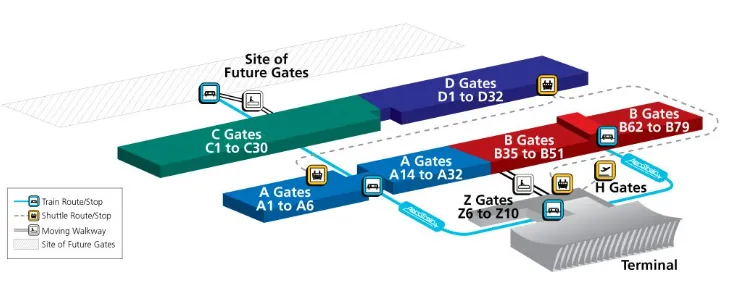 Image from FlyDulles, Copyright by original authorThis automated underground people mover is the primary way to travel between the Main Terminal and most concourses.
-
Route: Connects the Main Terminal to Concourse A, B, and C.
-
Operating Hours: Trains run 24/7, synchronized with flight schedules.
-
Frequency: Every 2-3 minutes.
-
Note: The AeroTrain does not stop at Concourse D. To reach Concourse D, you must use the Mobile Lounges or walk from Concourse C.
-
-
Mobile Lounges ("Moon Buggies"): These iconic, elevated transport vehicles are used primarily to ferry international arrival passengers from their gates to the IAB at the Main Terminal. They also serve as the primary link between the Main Terminal and Concourse D.
-
Pedestrian Walkways:
-
A long underground walkway with moving sidewalks connects the Main Terminal to Concourse B.
-
Concourses C and D are physically connected in one continuous building, allowing you to walk between them (approx. 5-15 minutes).
-
-
-
Inter-Terminal Transit Scenarios:
-
Moving from Main Terminal to Concourses (A, B, or C): After clearing security at the Main Terminal, follow signs for the AeroTrain. It is the fastest way to reach these concourses.
-
Moving to Concourse D: Follow signs for the Mobile Lounges located in the Main Terminal. Alternatively, if you are already at Concourse C (via the AeroTrain), you can walk to Concourse D.
-
International-to-Domestic (International Arrival):
-
Deplane at Concourse: Upon arrival, you will be directed to a Mobile Lounge.
-
Transit to IAB: The lounge will take you directly to the International Arrivals Building (IAB) at the Main Terminal.
-
Clear CBP & Claim Baggage: Complete immigration and collect your checked luggage.
-
Customs & Recheck: Clear customs and drop your bags at the recheck counter just outside the customs hall.
-
AeroTrain to Gate: Follow signs for "Connecting Flights," re-clear TSA security, and take the AeroTrain to your departing concourse (A, B, or C). If departing from D, take a Mobile Lounge.
-
-
-
Immigration & Customs: Centrally located at the International Arrivals Building (IAB) in the Main Terminal.
-
Baggage & Recheck: Baggage claim is within the IAB. United recheck is located immediately after customs.
-
Connection Time: * MCT: 90 mins.
-
Recommended: 3 hours.
-
-
Common Transit Mistakes & Expert Tips: * Mistake: Confusing the AeroTrain with the Mobile Lounge destinations (the train doesn't go to D!).
-
Tip: United's Concourse C/D is often criticized for being dated; if you have a long layover, take the AeroTrain to Concourse B for much better dining and lounge options.
-
10. Denver International Airport (DEN)
-
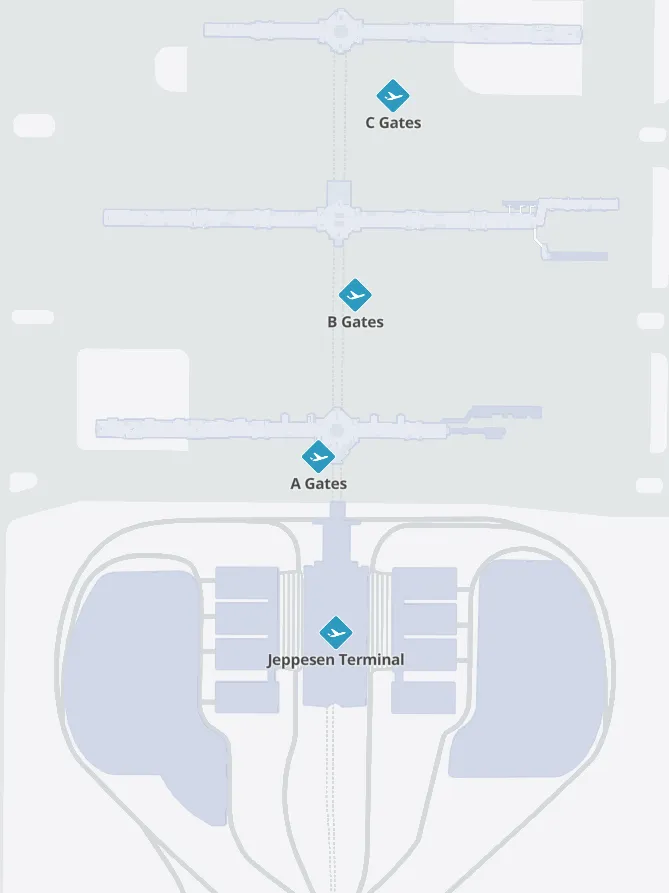
Airport Overview: DEN features a decentralized structure consisting of the Jeppesen Terminal (Landside) and three detached midfield concourses: Concourse A, B, and C. International arrivals and immigration procedures are handled in Concourse A.
-
Jeppesen Terminal: Contains check-in, baggage claim, and ground transport. No flights depart from here directly.
-
Midfield Concourses: Island-like buildings where all gates are located.
-
- Transit Difficulty: ⭐⭐☆☆☆ (Moderate)
-
Hub Airlines & Alliances:
-
United (Star Alliance) - Concourse B.
-
Southwest - Concourse C.
-
Frontier - Concourse A.
-
-
Terminal Layout & Transfers:
-
Automated Guideway Transit System (AGTS): * Route: Jeppesen Terminal ↔ Concourse A ↔ Concourse B ↔ Concourse C.
-
Operating Hours: 24/7. Every 2 minutes.
-
Note: The only way to reach B and C from the main terminal.
-
-
Pedestrian Bridge (A-Bridge): Connects Jeppesen Terminal directly to Concourse A.
-
-
Inter-Terminal Transit Scenarios:
-
International-to-Domestic (Concourse A Arrival):
-
Arrival: Deplane at Concourse A.
-
CBP: Clear immigration and customs within the Concourse A FIS facility.
-
Recheck: Drop bags at the recheck counters.
-
Next Gate: * To A gates: Walk.
-
To B/C gates: Take the AGTS Train.
-
-
Security: You must re-clear TSA if you exited the sterile area.
-
-
-
Common Transit Mistakes & Expert Tips:
-
Mistake: Assuming you can walk to Concourse B or C. You must take the train.
-
Tip: Use the Bridge Security at Concourse A (Level 6) for typically shorter lines.
-
11. Houston George Bush Intercontinental Airport (IAH)
-
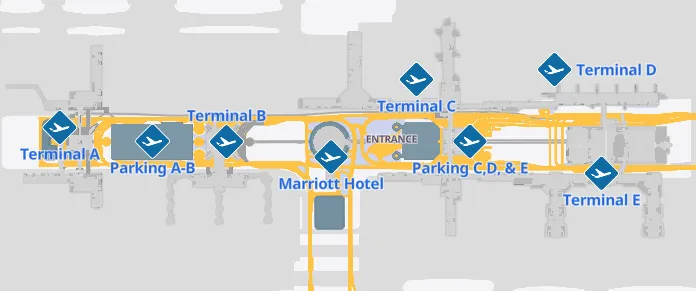
Airport Overview : IAH is a sprawling five-terminal complex (A, B, C, D, E). Terminal E is the primary gateway for international arrivals, while Terminal D serves foreign flag carriers.
- Transit Difficulty: ⭐⭐⭐☆☆ (Moderate)
-
Hub Airlines & Alliances:
-
United Airlines (Star Alliance) - Primary Hub (Terminals B, C, and E).
-
-
Terminal Layout & Transfers:
-
Skyway (Airside):
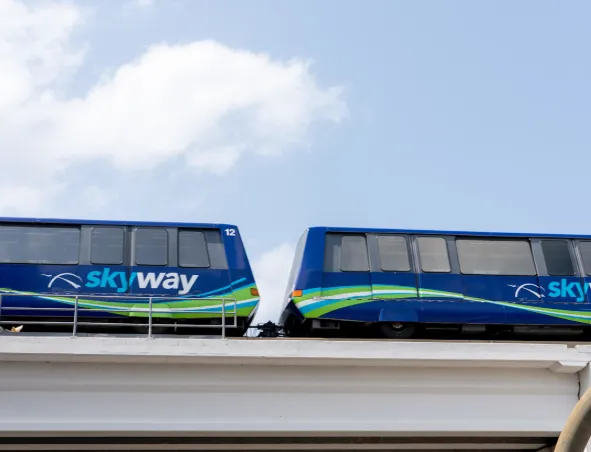 Image from Fly2Houston, Copyright by original authorAn automated people mover that runs above ground, connecting all five terminals (A, B, C, D, E) inside the secure area.
 -
Subway (Landside):
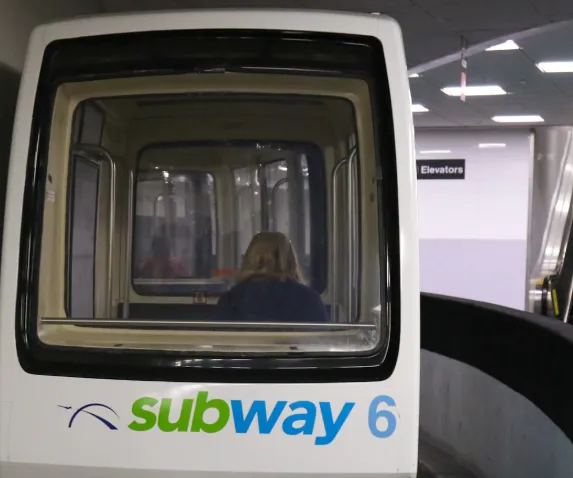 Image from Fly2Houston, Copyright by original authorAn underground train that connects all terminals and the airport hotel outside the secure area.
 -
Note: Use the Skyway for connections unless you have exited security.
-
-
Inter-Terminal Transit Scenarios:
-
International-to-Domestic (Terminal E/D Arrival):
-
Arrival: Clear CBP at the Terminal E arrivals hall.
-
Baggage & Customs: Claim checked bags and pass through customs.
-
Recheck: Drop bags at the United recheck counter immediately following customs.
-
Next Gate: Re-clear TSA security and use the Skyway to reach your departing terminal.
-
-
Domestic-to-International: If your bags are checked through, simply use the Skyway to travel between terminals without re-clearing security.
-
-
Common Transit Mistakes & Expert Tips:
-
Mistake: Taking the "Subway" instead of the "Skyway" for an airside connection.
-
Tip: Terminal C and E are also connected by airside walkways, which can be faster than waiting for the Skyway if your gates are close.
-
12. Detroit Metropolitan Airport (DTW)
-
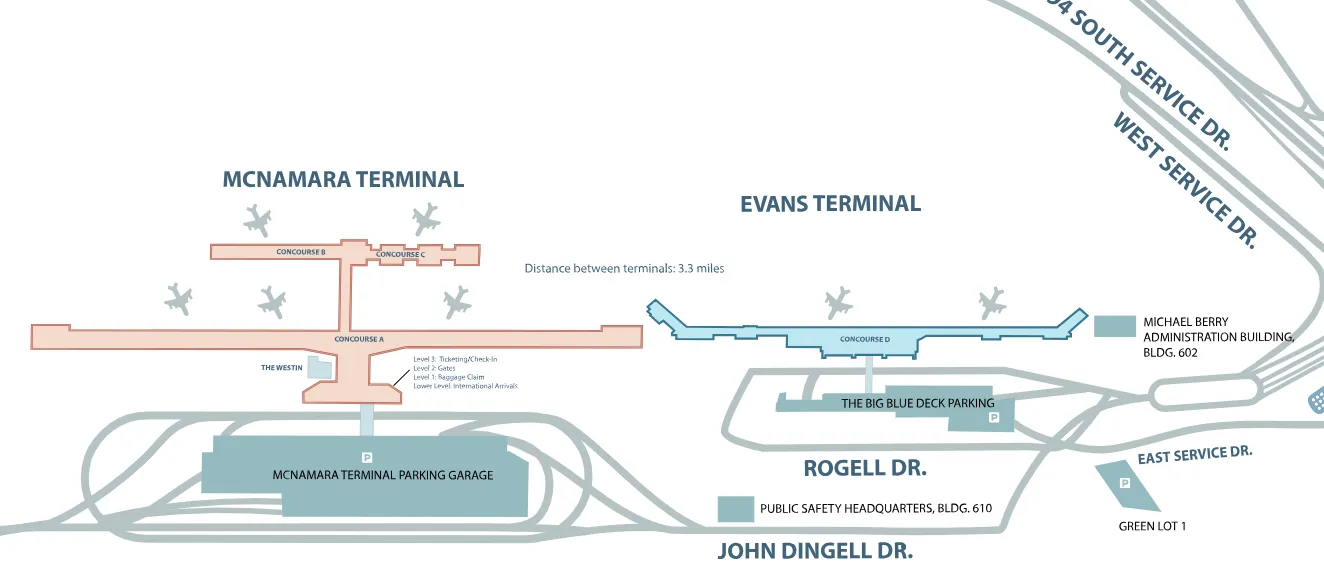
Airport Overview: DTW is widely considered one of the most efficient transit hubs in the U.S. It consists of two major, distinct terminal buildings:
-
McNamara Terminal: The hub for Delta and its partners. It handles the vast majority of international and domestic traffic for the SkyTeam alliance.
-
Evans Terminal: Serves all other airlines, including American, United, JetBlue, Southwest, and various international carriers like Lufthansa and Royal Jordanian.
-
- Transit Difficulty: ⭐☆☆☆☆ (Easy)
-
Hub Airlines & Alliances:
-
Delta Air Lines (SkyTeam) - McNamara Terminal (Concourses A, B, and C).
-
Other Airlines (Oneworld/Star Alliance/Budget) - Evans Terminal.
-
-
Terminal Layout & Transfers:
-
ExpressTram (Airside - McNamara Terminal):
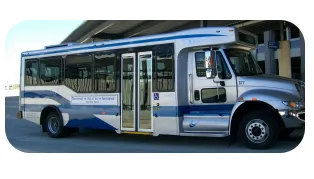 Image from MetroAirport, Copyright by original authorA high-speed, automated red tram that runs the length of the 1-mile long Concourse A.
-
Stations:
-
Terminal Center Station: Located at the midpoint, near the Water Feature and the Light Tunnel to Concourses B/C.
-
North Station: Located near Gate A66. For gates A56-A78
-
South Station: Located near Gate A9. For gates A1-A28
-
-
Operations: Trains run frequently (every few minutes). It is entirely "airside," meaning you must be inside the secure area to ride it.
-
-
Terminal-to-Terminal Shuttles (Landside): Because McNamara and Evans are not physically connected, you must go landside to move between them.
-
Route: Free shuttle buses run between the Ground Transportation Centers of both terminals.
-
Frequency: Approximately every 10-15 minutes.
-
Note: Taking this shuttle requires you to exit the secure area and re-clear TSA security at the destination terminal.
-
-
-
Inter-Terminal Transit Scenarios:
-
Delta-to-Delta (McNamara): A very simple process. If staying in Concourse A, use the ExpressTram. If moving to Concourses B/C, use the underground light tunnel (near the Center Tram Station).
-
International-to-Domestic (McNamara Arrival):
-
Arrival: Clear CBP on the lower level of McNamara.
-
Recheck: Delta's recheck process is exceptionally fast, located right after customs.
-
Next Gate: Re-clear TSA and head up to the gates.
-
-
Terminal Change (McNamara to Evans): You must take the Terminal-to-Terminal Shuttle. Allow at least 45-60 minutes for this transfer due to travel time and TSA re-screening.
-
-
Common Transit Mistakes & Expert Tips:
-
Mistake: Forgetting that McNamara and Evans terminals are miles apart and require a bus.
-
Tip: The light tunnel between McNamara Concourses A and B/C features a synchronized light and music show—a great way to destress during transit.
-
How to Optimize Your U.S. Airport Transit Experience
Transit through a U.S. hub doesn't have to be a race against time. With the right technology and pre-planning, you can turn a stressful sprint into a managed walk.
Best Apps and Tools for U.S. Airport Connections
-
Flight Tracking (FlightAware / FlightRadar24): Don't wait for airport screens. These apps often update gate changes and delays faster than the airport monitors. You can see where your inbound plane is coming from.
-
Official Airline Apps: Download the app for your airline (United, Delta, American, etc.) before you fly.
-
Features: Digital boarding passes, real-time gate maps, and push notifications for delays.
-
Pro Tip: Many airline apps (like United) allow you to track your checked baggage in real-time, so you know exactly when it hits the carousel.
-
MyTSA App: Check live security wait times for specific terminals. This is crucial for deciding if you have time for a coffee or if you need to sprint to the TSA line.
-
Airport Maps: Modern airports (ATL, DFW) have integrated maps in their apps that offer "step-by-step" navigation. Use these to find the shortest path between terminals.
Using Mobile Passport Control (MPC) — The Ultimate Hack
The Mobile Passport Control (MPC) app is the single most effective way to shorten your CBP wait time without paying for a membership.
-
Eligibility: U.S. Citizens, Canadian B1/B2 Citizens, and returning ESTA travelers (after their first entry).
-
How it works:
1. Download the app and create a profile.
2. Upon landing (before reaching the immigration hall), submit your declaration form via the app.
3. You will receive a QR code receipt valid for 4 hours.
4. Look for the dedicated "MPC" lane—it is often much shorter than the standard visitor line. -
Benefit: It eliminates the need for paper forms or the traditional "blue kiosks," getting you to the officer significantly faster.
Is Global Entry or TSA PreCheck Worth It for Transit?
If you transit the U.S. more than twice a year, these "Trusted Traveler Programs" are game-changers.
|
Feature |
Global Entry |
TSA PreCheck |
|
Primary Benefit |
Skip the long immigration line |
Skip the long security line (keep shoes/belts on) |
|
Who it's for |
Frequent international travelers |
Frequent domestic U.S. travelers |
|
Cost |
$120 for 5 years (includes PreCheck) |
$78 for 5 years |
|
Application |
Background check + Interview |
Background check + Fingerprints |
Who should apply: International students or business travelers who frequently use U.S. hubs. Most high-end travel credit cards will even reimburse the application fee.
What to Do If Something Goes Wrong During Transit
Travel is unpredictable. Whether it’s a mechanical delay or a massive storm, knowing your rights and the "escalation path" is key to survival.
What If Immigration Takes Too Long?
-
Immediate Action: If you are stuck in a 2-hour queue and your flight boards in 30 minutes, do not panic silently. Locate a CBP officer or an airport "ambassador" (usually in bright vests). Show them your boarding pass. Many airports have a "Tight Connection" lane that they can open for you.
-
Communicating with Airlines: If you know you won't make it while still in line, use the airport Wi-Fi to message the airline via their app or Twitter/X. They can often start the rebooking process before you even exit the hall.
What Happens If You Miss Your Connecting Flight?
-
Through Ticket Outcomes: The airline is legally obligated to get you to your final destination on the next available flight.
-
Tip: If the line at the customer service desk is long, call the airline's international service number or use a kiosk while standing in line. You might get rebooked over the phone before you reach the front of the physical line.
-
Separate Ticket Outcomes: You are technically a "no-show."
-
Crisis Management: Begging helps. Be honest with the gate agent. Some airlines have a "flat tire rule" where they might rebook you for a small standby fee rather than making you buy a new full-fare ticket.
-
Overnight Delays: If the delay is the airline's fault (mechanical/crew), they should provide a hotel voucher and meal tickets. If it’s weather, they are not obligated to pay for your hotel, but they often offer "distressed passenger" rates for nearby hotels.
How to Handle Baggage Delays During U.S. Connections
-
Reporting Issues: If your bag doesn't appear on the carousel at your first port of entry, go to the Baggage Service Office immediately. Do not leave the customs area without a File Reference Number.
-
Baggage Recheck Confusion: If your bag makes it to the first airport but doesn't arrive at your final destination, the domestic carrier is responsible.
-
Continuing Travel Without Luggage: If you have to continue your journey, provide the airline with your local address (hotel or dorm). They will usually deliver the bag for free once it arrives. Pro Tip: Keep an Apple AirTag in your bag so you can tell the airline exactly where it is.
Frequently Asked Questions (FAQ) About Transiting Through the U.S.
Q1. Do I need a visa to transit through the USA if I am not leaving the airport?
A: Yes. Unlike many other countries, the United States does not have a "transit-without-visa" program. If you are not from a Visa Waiver Program country (eligible for ESTA), you must have a valid C-1 transit visa or a B-1/B-2 visitor visa to connect through any U.S. airport, even if you never leave the terminal.
Q2. Can I use a B1/B2 visa for transit in the USA?
A: Absolutely. A valid B-1/B-2 visa is perfectly acceptable for transit purposes. In fact, many travelers prefer holding a B-1/B-2 over a C-1 visa because it allows for longer stays and multiple entries for future tourism or business trips.
Q3. Do I have to pick up my luggage during a US layover?
A: In most cases, yes. Even if your bags are checked through to your final destination, U.S. law requires you to reclaim your baggage after clearing immigration to pass through Customs. After customs, you will immediately find a baggage re-check belt where you can drop your bags back into the airline's system. The exception is if you are flying from an airport with U.S. Pre-clearance (e.g., Dublin, Shannon, Abu Dhabi, or several Canadian cities).
Q4: Do I have to go through immigration if I’m only transiting? Yes. Every single time.
A: Yes. Every single time.
Q5. What is a "Self-Transfer" layover and is it risky?
A: A self-transfer (booking separate tickets) means you have two independent contracts with different airlines. This is highly risky for U.S. transits because if your first flight is delayed and you miss your connection, the second airline is not obligated to rebook you. You will also have to manually transport your luggage from one terminal's baggage claim to the next terminal's check-in counter.
Q6. How much time do I realistically need for a U.S. connection?
A: For an international-to-domestic connection, we recommend at least 3 hours. This allows time for potential immigration queues, baggage claim, customs, re-checking bags, and re-clearing TSA security. For domestic-to-international connections where you don't need to clear security again, 90 minutes is usually sufficient.
Q7: Can I stay airside?
A: No, international arrivals are funnelled directly to CBP.
Q8: Is 2 hours enough at JFK?
A: It’s "legal," but it’s a heart attack waiting to happen. Aim for 3.
Final Tips for Stress-Free Connections at U.S. Airports
-
Pack Essentials in Carry-on: Always have a change of clothes and your chargers.
-
Know Your Gate: Check the monitors the second you clear TSA.
-
Avoid the Last Flight of the Day: If you miss it, you’re sleeping in the airport. Aim for mid-day connections.
Safe travels. See you at the gate.