Los Angeles International Airport (LAX) is a global gateway, but for many travelers, it is also a source of significant anxiety. Consistently ranked as one of the most confusing and congested airports in the United States, LAX suffers from a unique design flaw: its "horseshoe" layout. Built in an era before ride-hailing apps and mega-security checkpoints, the airport forces all traffic into a single, continuous loop that frequently gridlocks.
In 2026, the situation is evolving. While the long-awaited Automated People Mover (APM) is nearing full operational status, the transition period has created a mix of old habits and new construction zones. The "LAX-it" lot—originally intended as a temporary fix—remains a critical hub for ride-hailing, while ongoing terminal renovations continue to shift pickup and drop-off points.
This guide is designed for everyone: the first-time visitor overwhelmed by the sheer scale of Los Angeles, the international traveler navigating customs with heavy luggage, the business traveler needing the fastest route to Downtown, and the late-night arrival just want to get to bed. We have stripped away the noise to provide a clear, step-by-step manual on how to conquer LAX transportation efficiently.
1. Understanding the Layout of LAX Airport
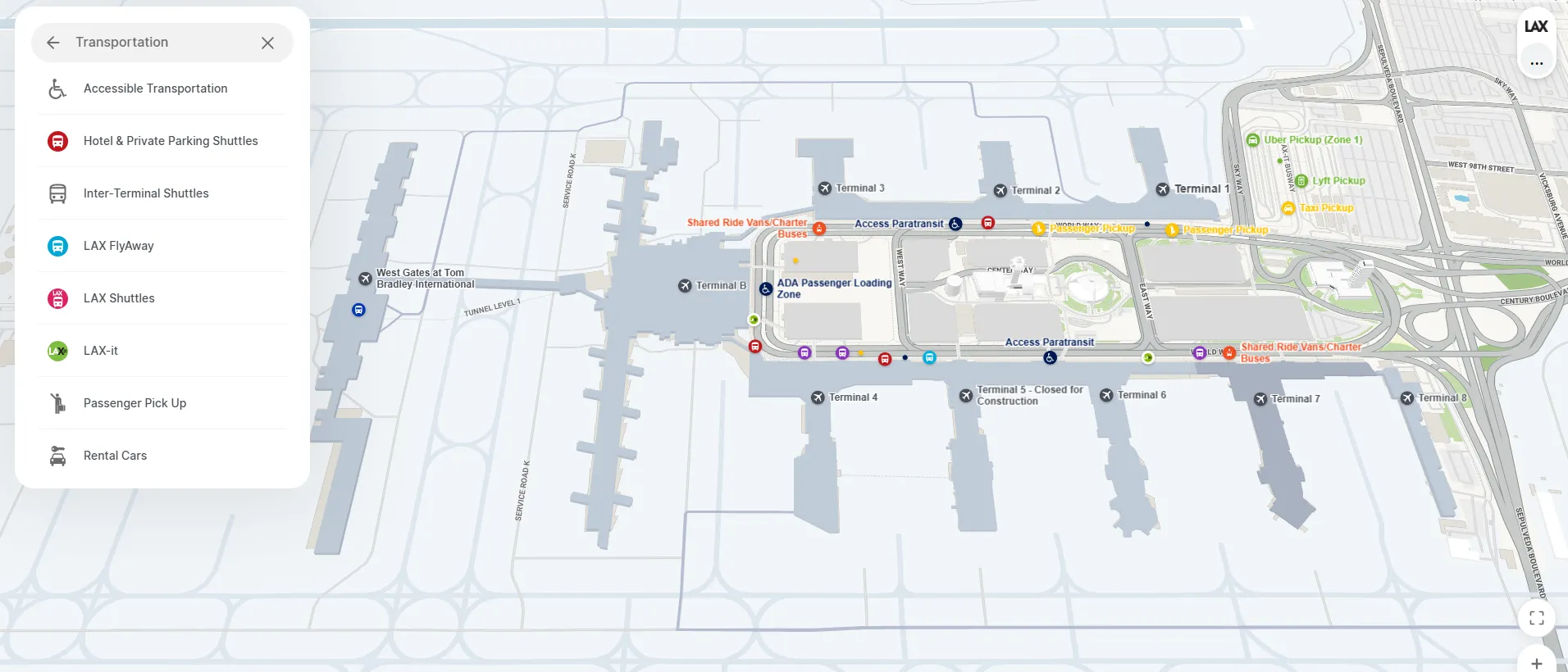
Image from Flylax, Copyright by original author
1.1 LAX Terminal Overview (The "Horseshoe" Loop)
LAX is notoriously designed around a single, one-way traffic loop known as "World Way." Shaped like a giant horseshoe or "U," this roadway forces all vehicles—cars, buses, and shuttles—to enter at Terminal 1 and exit past Terminal 8. As you enter from Century Boulevard, the terminals are arranged counter-clockwise:
-
The North Side (Terminals 1, 2, 3): This is the first section you encounter.
-
Terminal 1: Primarily Southwest Airlines.
-
Terminals 2 & 3: The hub for Delta Air Lines and its SkyTeam partners (like Virgin Atlantic, WestJet).
-
-
The West End (Tom Bradley International Terminal / TBIT / Terminal B): Located at the very back of the horseshoe (the bottom of the U). This is the crown jewel of LAX, hosting the largest international carriers (Lufthansa, British Airways, JAL, Qantas, etc.). Note: A smaller satellite concourse, the West Gates (MSC), is connected to TBIT via an underground tunnel.
-
The South Side (Terminals 4, 5, 6, 7, 8): The return leg of the loop.
-
Terminals 4 & 5: The fortress for American Airlines and JetBlue.
-
Terminal 6: A mix of carriers including Alaska Airlines (main check-in), Air Canada, and smaller international airlines.
-
Terminals 7 & 8: The dedicated hub for United Airlines and United Express.
-
Traffic Tip: The congestion typically peaks at the "bottom" of the U (TBIT and Terminal 4) because traffic from the north side merges here. If you are flying out of Terminal 7 or 8, you are at the end of the loop, so allow extra time just to sit in traffic past the other terminals. All airport internal shuttle buses (such as the LAX-it shuttle and rental car company shuttles) travel counter-clockwise in the order of T1 → T2 → T3 → TBIT → T4... This means that if you are at T1, you will be the first to board; if you are at TBIT, the bus may already be half full.
1.2 Navigating Levels: Departures vs. Arrivals
Unlike many smaller airports, LAX strictly separates passenger flow by vertical levels. Understanding this split is crucial for both drop-offs and pickups.
-
Upper Level (Departures): This is where check-in counters and TSA security checkpoints are located. The curbside here is officially for dropping off passengers. It is open to the sky.
-
Lower Level (Arrivals): This is where Baggage Claim is located. It is covered by the roadway above, making it darker and often noisier. The curbside here is officially for picking up passengers (FlyAway buses and shuttles).
The "Upper Level Hack": If you are arriving at LAX with no checked bags (carry-on only), or if you have already retrieved your luggage and the Lower Level traffic is at a standstill (a common "black line" on traffic maps), you can take the escalator or elevator UP to the Departures level. You can ask your friend or family member to pick you up on the Upper Level curb. It is often less congested because drivers drop off passengers quickly, whereas Lower Level drivers idle while waiting for luggage.
Note: Ride-share drivers (Uber/Lyft) typically cannot do this unless you are using Black/SUV services that have specific curbside privileges.
1.3 How to Move Between Terminals (Walk vs. Shuttle)
Moving between terminals has historically been a nightmare, but renovations have improved connectivity significantly.
-
Airside (Past Security): This is the best way to move if you have a connecting flight.
-
The "Big Connect": You can now walk entirely airside from Terminal 1 all the way to Terminal 8 (effectively the entire loop) without exiting security, although the walk is extremely long (approx. 2 miles).
-
Key Connectors:
-
T2/T3 to TBIT: A secure walkway connects the Delta hub to the International Terminal.
-
T4 to TBIT: The "T4 Connector" allows easy access between American Airlines and international flights.
-
TBIT West Gates: Accessible via an underground pedestrian tunnel from the main TBIT building.
-
-
Strategy: If you land in Terminal 5 and need to get to TBIT for a connection, do not exit the building. Follow signs for "Terminal Connector" or "Gates B."
-
-
Landside (Before Security/Sidewalk): If you exit the terminal to smoke or get fresh air, you are on the public sidewalk.
-
Walking: You can walk between any terminals on the sidewalk.
-
T1 to T7: ~20-25 minutes walking across the central parking structures (shortcuts exist through the parking garages P1 and P7 to cut across the "U").
-
T4 to T5: ~3-5 minutes.
-
-
Terminal Shuttle (LAX Shuttle): An "Airline Connection" (Route A) shuttle bus runs in a loop on the Lower Level, but it is stuck in the same traffic as everyone else. Walking is almost always faster unless you have mobility issues.
-
-
Impact of the APM (Automated People Mover): Once fully active, the APM train will have 3 stations inside the terminal loop:
-
West Station: Between T3, T4, and TBIT.
-
Center Station: Between T1, T2, T5, and T6.
-
East Station: Between T1, T7, and T8.
-
Future Travel: You will be able to take pedestrian bridges from your terminal to these stations to traverse the loop quickly above the traffic.
-
2. Transportation Options Leaving LAX (Quick Comparison)
2.1 LAX Transportation Options at a Glance
In 2026, choosing the right way out depends on your budget, patience, and final destination. Use the table below for a quick side-by-side comparison:
|
Transportation Method |
Best For |
Pickup Location |
Estimated Cost |
Pros & Cons |
|---|---|---|---|---|
|
Ride-Hailing (Uber/Lyft) |
Solo travelers & tech-savvy users |
LAX-it Lot (Shuttle required) |
$40 - $80 |
Pros: Door-to-door. Cons: High wait times; shuttle hassle. |
|
Taxis |
Business travelers & groups |
LAX-it Lot (or T7/T8 for specific ops) |
$40 - $80 |
Pros: Immediate departure; no app needed. Cons: Older vehicles. |
|
Luxury (Uber Black/SUV) |
VIPs & those seeking maximum ease |
Upper Level (Departure level) |
$80 - $150 |
Pros: No shuttles; high comfort. Cons: Most expensive option. |
|
FlyAway Bus |
Budget travelers & DTLA bound |
Terminal Islands Blue Signs (Lower Level) |
$9.75 |
Pros: Very cheap; luggage storage. Cons: Limited destinations. |
|
Scheduled Bus |
Long-distance travelers (e.g., Santa Barbara, Anaheim) |
Terminal Islands (Orange signs) (Lower Level) |
$20 - $50 |
Pros: Reliable for long trips. Cons: Strict schedules; less frequent.
|
|
Rental Cars |
Road trippers & Valley visitors |
Rental Lots (via APM or Shuttle) |
$$$ |
Pros: Total freedom. Cons: Slowest process; traffic heavy. |
|
Private Shuttles/Vans |
Large families & heavy luggage |
Terminal Curbside (Pre-booked) |
$$$ |
Pros: Fixed price; group friendly. Cons: May have multiple stops. |
|
Public Transit (Metro) |
Ultra-low budget travelers |
Aviation/LAX Station (via LAX Shuttle Pink Signs) |
$1.75 |
Pros: Cheapest. Cons: Multiple transfers; not luggage f |
2.2 Best Way to Leave LAX by Traveler Type
-
First-time visitors: If you can afford it, Uber Black removes the confusion. If not, Taxis at LAX-it are often simpler than finding your specific Uber in a sea of cars.
-
International arrivals with luggage: FlyAway Bus (if going Downtown) is fantastic because the bus comes to you on the curb—no dragging bags to a secondary lot.
-
Budget travelers: FlyAway Bus to Union Station, then connect via Metro or a cheaper Uber from there.
-
Late-night arrivals: Traffic inside the loop clears up after 11:00 PM. Uber/Lyft becomes much easier as surge pricing often drops and the shuttle ride is faster.
-
Families or groups: A pre-booked private shuttle or van is often superior to trying to fit car seats and four suitcases into a standard Lyft.
3. Detailed Breakdown of Every Transportation Option From LAX
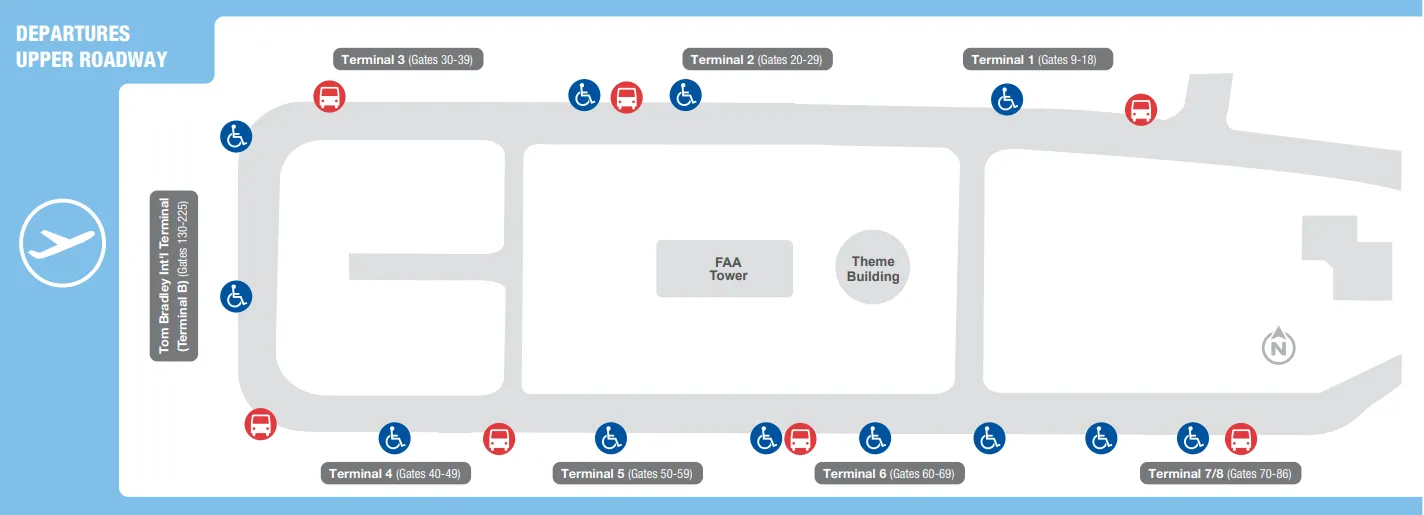
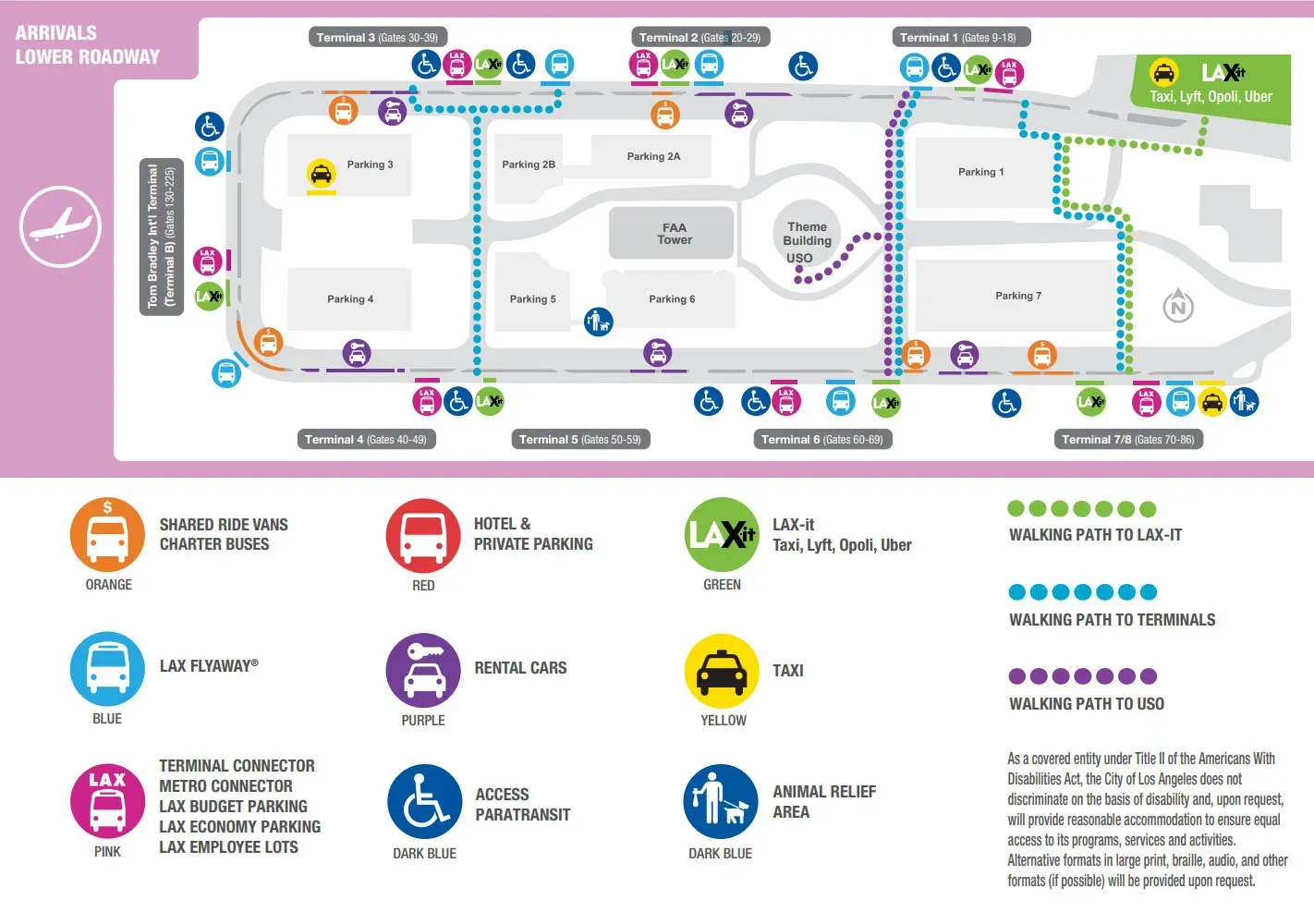
LAX Ground Transportation Waiting Areas👇
3.1 Uber, Lyft, Opoli and Taxis at LAX (Standard Ride-Hailing) - LAX-it
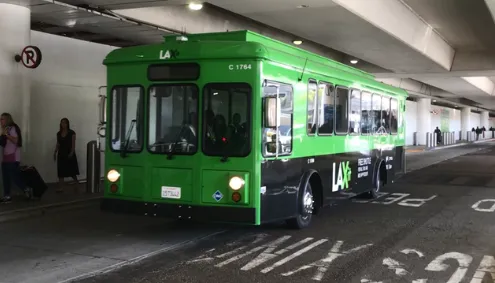
Green Signs
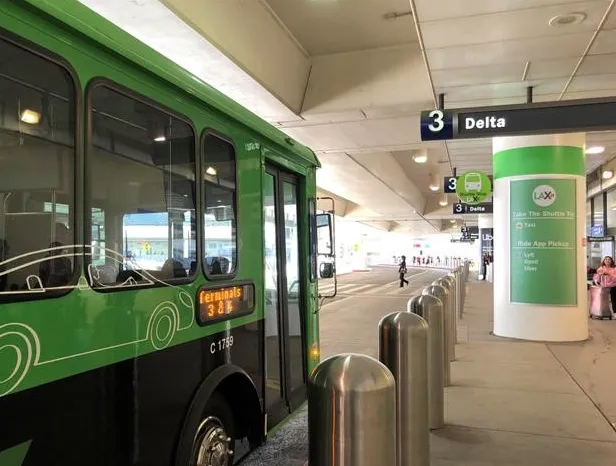
In 2026, standard ride-hailing remains the most common way to leave LAX, but it requires navigating the LAX-it lot.
The Pickup Process: Most taxis and standard services like UberX, UberXL, Uber Comfort, Uber Pet. Lyft, Lyft XL and Opoli are prohibited from picking up at the terminal curbside. After retrieving your luggage, follow the 🟢green signs🟢to the "LAX-it" shuttle stop on the Arrivals level. Shuttles arrive every 3–7 minutes. Alternatively, you can walk to the lot (located next to Terminal 1).
Walking vs. Shuttle Recommendations:
-
-
Terminal 1 (Southwest): A 3-5 minute walk. Walking is highly recommended; do not waste time waiting for the shuttle.
-
Terminals 2 / 7 / 8: A 10-15 minute walk. If you have heavy luggage, it is recommended to take the free shuttle at the green pillars.
-
TBIT (International) / T4 / T5 / T6: These are very far from the lot. You must take the shuttle.
-
Real-world Timing: In off-peak hours, the process takes 15-20 minutes. Note that the walk from the furthest points (Terminals 4 and 5) is approximately 19 minutes.
-
Peak Warning: During late-night "Red-eye" peaks (after 11:00 PM), the shuttle lines can be massive, and total transit time to the lot may soar to over 45 minutes.
-
Requesting Your Ride: Do not request your ride until you are on the shuttle or physically inside the LAX-it lot. Uber and Lyft use a PIN system at LAX during peak hours: you request the ride, receive a 6-digit PIN, join the queue at the designated zone, and provide the PIN to the first available driver.
Pros: Generally cheaper than private cars; highly available.
Cons: The "shuttle-to-lot" process adds 15–30 minutes to your trip; surge pricing can make costs unpredictable.
Notes: LAX authorized taxi companies (each vehicle displays an official decal issued by the Los Angeles Department of Transportation) can also pick up passengers on the first floor of the terminal. The pick-up locations are: ① between the Tom Bradley International Terminal (TBIT) and Terminal 3; ② outside the baggage claim area of Terminal 7.
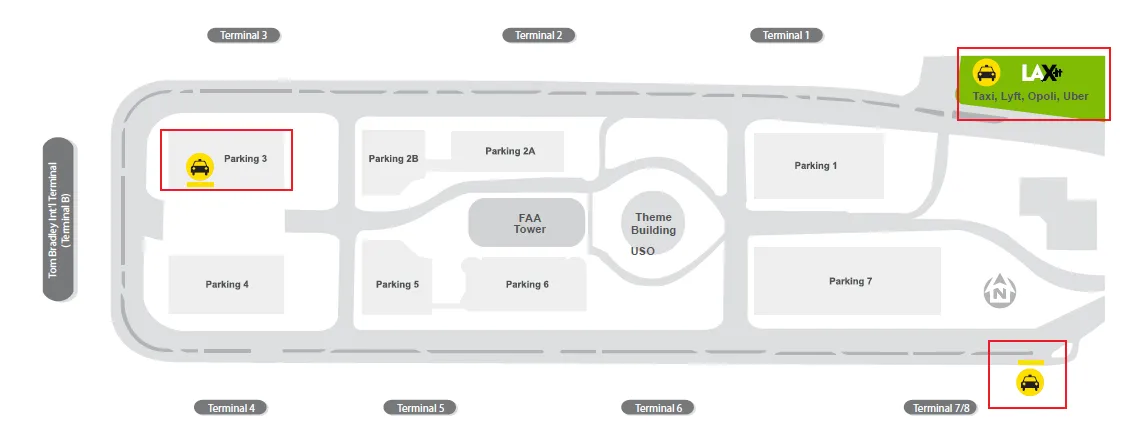
3.2 The FlyAway Bus: Best for Downtown & Valley
The FlyAway is the most efficient public transit option for specific hubs.
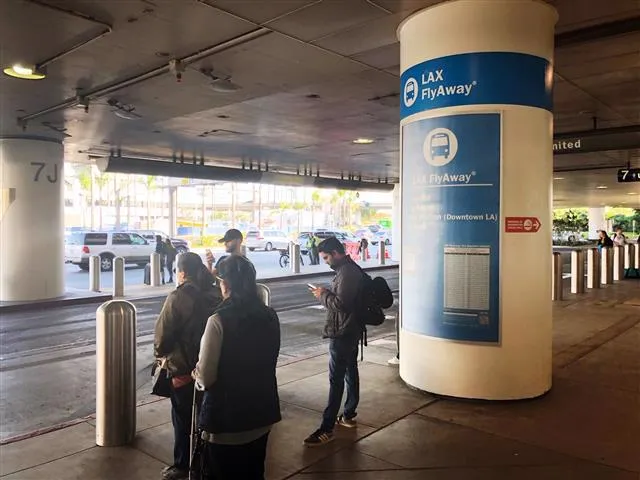
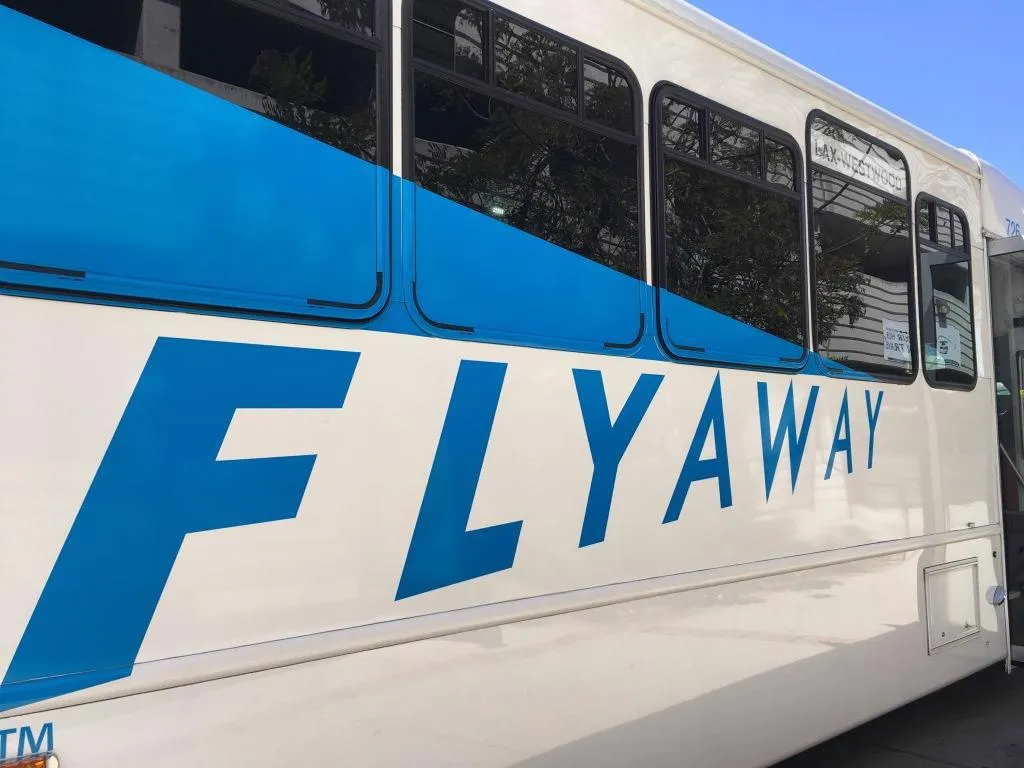
The Pickup Process: No shuttles needed. The FlyAway bus stops directly at every terminal on the Arrivals Level (Lower Level). Look for the 🔵bright blue "FlyAway" signs🔵 on the islands (the middle sidewalk).
Line-Specific Information:
- Ticketing Strategy: * Mobile App: Download the "LAX FlyAway" app while waiting for bags. It is the fastest way to pay.
-
No Cash: Drivers do not accept cash. You can also pay by credit card at kiosks at the Union Station or Van Nuys stops.
-
Union Station Line (Downtown): This is the most popular route. It runs every 30 minutes (24/7). It terminates at the Union Station East Portal in Downtown LA, providing direct connections to the Metro B/D (Red/Purple) lines, Amtrak, and Metrolink. [LAX FlyAway® - Union Station Timetable]
-
Van Nuys Line (San Fernando Valley): This route is ideal for travelers heading to the north part of Los Angeles. It typically runs every 20-30 minutes. It terminates at the Van Nuys FlyAway terminal, which offers long-term parking and easy pickup access for residents in the Valley. [LAX FlyAway® - Van Nuys Timetable]
-
Stop at: T1 (Gates 9-18), T2 (Gates 20-29), T3 (Gates 30-29), TBIT & T4 (Gates 130-225), T6 (Gates 60-69), T7/8 (Gates 70-86)
Ticketing Strategy: ① Purchase tickets through the FlyAway app and scan the QR code on your ticket to board; ② Purchase tickets online, but you will need to print your ticket by yourself; ③ Use contactless payment on board the bus with a Visa/Mastercard contactless credit or debit card, or Apple Pay and Google Pay to purchase single-way tickets.
-
-
No Cash: Drivers do not accept cash. You can also pay by credit card at kiosks at the Union Station or Van Nuys stops.
-
Pros: Single-way $12.75; dedicated luggage storage underneath; high-back comfortable seats.
Cons: Only two destination hubs; schedules can be irregular during heavy traffic.
3.3 The Pink LAX Shuttle: Connectivity for Metro & Remote Lots
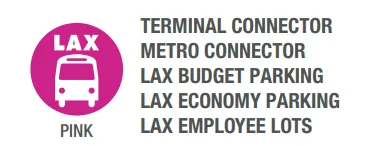
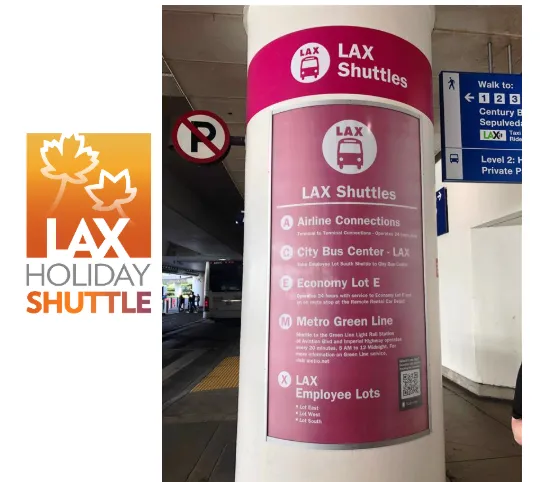
The Pink LAX Shuttle (formally known as Route C, X, or M depending on the current year's branding) provides essential connections to regional transit hubs and remote parking.
The Pickup Process: Like the FlyAway, the Pink Shuttle stops at every terminal on the Arrivals Level (Lower Level). Look for the Pink signs on the terminal islands.
Stop at: T1 (Gates 9-18), T2 (Gates 20-29), T3 (Gates 30-29), TBIT & T4 (Gates 130-225), T6 (Gates 60-69), T7/8 (Gates 70-86)
Line-Specific Information:
-
-
LAX/Metro Transit Center (C/K Line): $1.75 one-way. The shuttle runs frequently between the terminals and the Aviation/LAX Metro Station. This is the primary way for budget travelers to access the C Line (Green) and the K Line (Crenshaw/LAX).
-
City Bus Center Connection: It also connects to the LAX City Bus Center, where regional buses like the Big Blue Bus (Santa Monica) and Culver CityBus depart.
-
Economy Parking: A specific branch of the Pink Shuttle serves the massive Economy Parking structures located off-site.
-
Pros: Completely free; reliable frequency (usually every 10–15 minutes); essential for reaching the cheapest public transit options.
Cons: Can be very crowded; the ride to the Metro station can be slow during peak loop traffic; not ideal for travelers with an excessive amount of luggage.
3.4 Scheduled Buses: Long-Distance Regional Connections (Orange Signs)
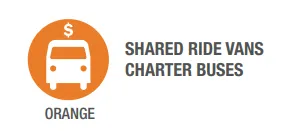
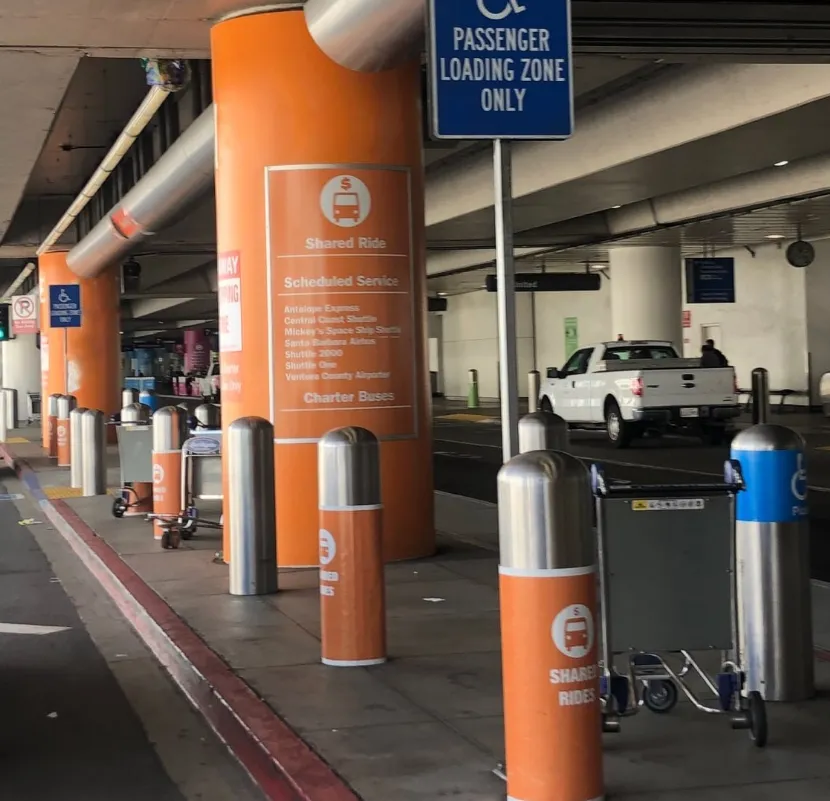
Scheduled Buses provide long-distance transportation to areas far outside the Los Angeles city limits.
The Pickup Process: These buses pick up at the terminal islands on the Arrivals Level (Lower Level). Look for the 🟠Orange signs🟠 labeled "Scheduled Buses."
Stop at: T2 (gates 20-29), T3 (gates 30-39), TITB/T4 (gaets 40-49), Between T6 & T7
Line-Specific Information:
-
-
Central Coast Shuttle: Services Ventura, Santa Barbara, and Goleta.
-
Antelope Valley Airport Express: Services Palmdale and Lancaster.
-
Disneyland Resort Express (SNA/Anaheim): While services fluctuate, these buses typically provide a direct link to the major hotels in the Anaheim Resort District.
-
Santa Barbara Airbus: A highly reliable frequent service specifically for the Santa Barbara area.
-
Ticketing Strategy: Unlike the FlyAway, these are private commercial carriers. Advanced reservations are highly recommended. You usually book tickets through the specific carrier's website. Some allow walk-ons if space is available, but you will pay a premium.
Pros: The only direct way to reach regional cities without multiple train transfers; professional drivers; usually much cheaper than a $200+ long-distance Uber.
Cons: Infrequent schedules (some lines only run 4-6 times a day); strictly fixed routes; expensive if not booked in advance.
3.5 Rental Car Shuttles: Off-Site Rental Access (Purple Signs)
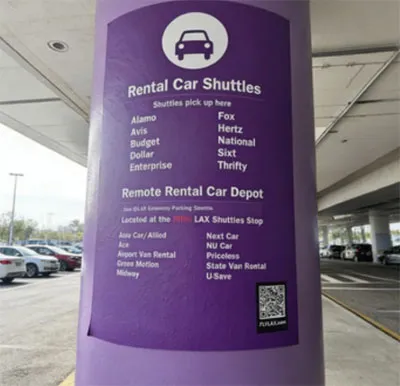
Rental Car Shuttles are dedicated buses provided by rental companies to transport passengers to their off-site lots. [Authorized car companies to pick-up and drop-off their customers at the airline terminals using courtesy shuttles list]
The Pickup Process: These shuttles pick up on the Arrivals Level (Lower Level) islands. Look for the 🟣Purple signs🟣 labeled "Rental Car Shuttles."
Stop at: T2, T3, T5, T6, T7
Line-Specific Information:
-
-
Major Carriers: Dedicated branded buses for Hertz, Avis, Enterprise, Budget, and Sixt run frequently.
-
Shared Shuttles: Smaller companies (like Fox, Midway, or Payless) often share a "Remote Rental Car" shuttle. Check your confirmation email for the specific logo to look for.
-
Frequency: During peak hours, major brand shuttles arrive every 5–10 minutes.
-
Some smaller or budget car rental companies (such as MEX and Midway) are not located inside the off-site rental center; requiring a ride on the Pink Shuttles to LAX Economy Parking.
Pros: Direct transport to your vehicle; no cost; drivers usually help with luggage.
Cons: Shuttles can get extremely crowded; the ride to the off-site lot can take 15–20 minutes due to airport and local street traffic.
Note: when construction is completed , the rental car process is moving toward the Automated People Mover (APM) system. You will take the APM train from the terminal to the ConRAC (Consolidated Rent-A-Car) station.
3.6 Picked-up or Dropped-off by Family/Friends
Dropping Off: For the health and safety of everyone, the airport itself is currently closed to everyone except those with valid tickets, people assisting ticketed passengers and airport personnel. Passengers can be dropped off at in the terminals on the upper level/departures area.
Picking Up: Passengers may be picked up on the outer curb on the lower level/arrivals level outside of baggage claim.
3.7 Hotel & Shared Shuttles

Many major airport-area hotels provide courtesy transportation from LAX terminals. Stops for shuttles to hotels are located on the Upper/Departures Level identified by RED curbside pylons.
4. The Complete Guide to LAX-it (Uber, Lyft, and Taxi Pickup Area)

4.1 What Is LAX-it and Why It Exists
In late 2019, LAX launched LAX-it (pronounced "LA-Exit"), a dedicated pickup lot for ride-hailing and taxis located just east of Terminal 1. This central hub was created to combat the extreme gridlock caused by thousands of private cars entering the "Horseshoe." In 2026, even with the Automated People Mover (APM) coming online, LAX-it remains the primary gateway for travelers using standard Uber/Lyft or Taxis.
4.2 Who Needs to Go to LAX-it — and Who Doesn’t
It is vital to know your "car category" before leaving the terminal:
-
YOU MUST GO TO LAX-it IF YOU ARE USING:
-
Uber: UberX, UberXL, Uber Comfort, Uber Pet.
-
Lyft: Standard Lyft, Lyft XL, Lyft Wait & Save.
-
Opoli
-
Taxis: Partial standard city-authorized yellow/branded taxis.
-
-
YOU DO NOT GO TO LAX-it IF YOU ARE USING:
-
Luxury/Premium: Uber Black, Uber Black SUV, Lyft Black, or Lyft Black SUV (these pick you up curbside).
-
FlyAway Bus: Picks up at terminal islands.
-
Personal Pickup: Friends/family pick you up at the terminal curb.
-
4.3 Getting to LAX-it: Shuttle vs. Walking
Once you have your bags, you have two choices to reach the lot:
A. The LAX-it Shuttle (The Green Bus)
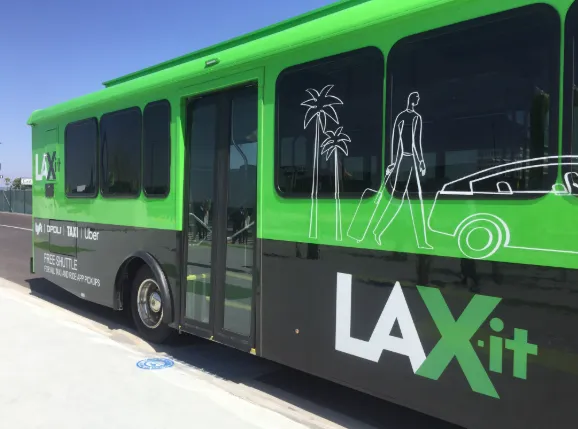
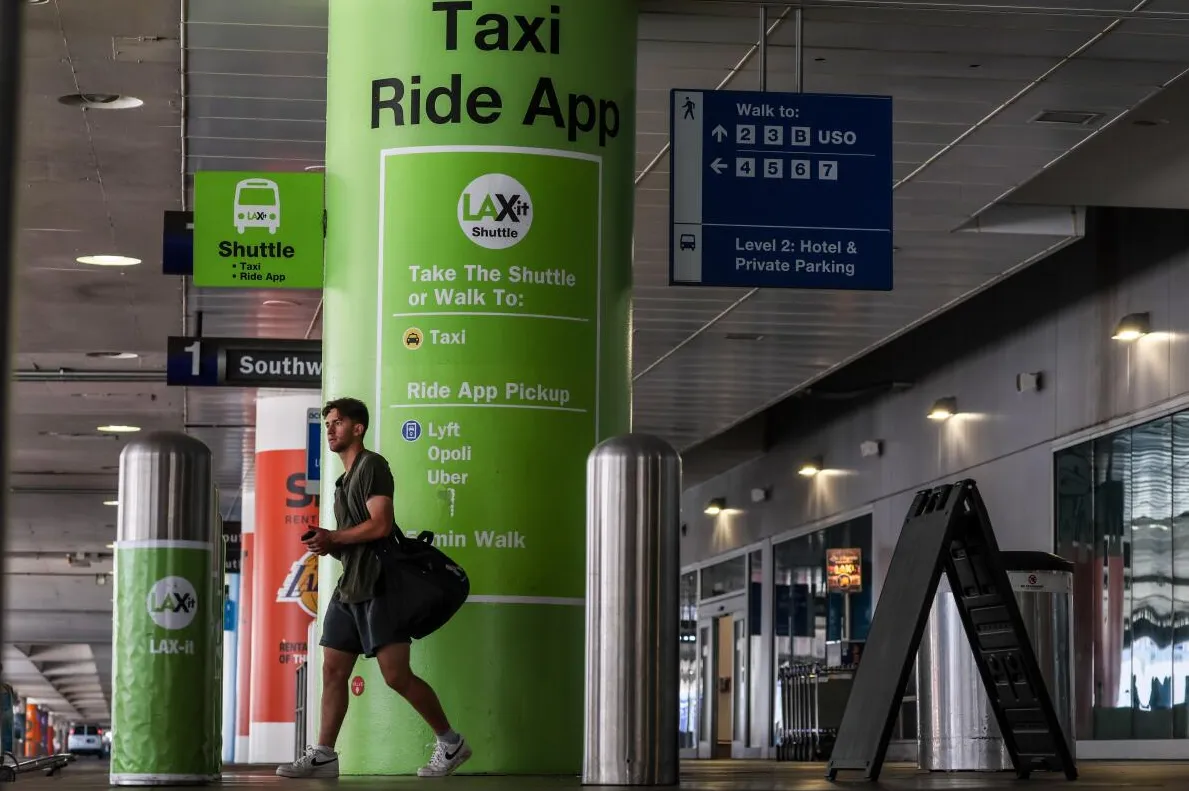
-
How to find it: Look for the 🟢bright green🟢 "LAX-it" signs on the Lower Level (Arrivals) curb.
-
Frequency: Buses run in a continuous loop every 3–5 minutes.
-
The Experience: These are low-floor buses with dedicated luggage racks. While free, they can get very crowded during peak arrival windows (e.g., Sunday nights).
-
Wait Times: Expect a 5-10 minute ride once onboard. During extreme traffic, the shuttle can take up to 20 minutes to complete the loop.
B. Walking (The "Pro" Move)
-
Best from: Terminals 1, 2, 7, and 8.
-
Distance:
-
Terminal 1: 3–5 minutes. Just exit and walk left (east).
-
Terminal 2/7/8: 10–15 minutes.
-
-
The Path: Follow the green "LAX-it" stencils painted on the sidewalk. It is a paved, accessible path.
C. Essential Strategy for TBIT (International Terminal) Passengers
-
Why it matters: Tom Bradley International Terminal (TBIT) is at the "bottom" of the horseshoe, the furthest point from the LAX-it lot.
-
The "No-Walk" Rule: Walking from TBIT to LAX-it takes approximately 20–25 minutes through heavy crowds and fumes. Do not attempt this if you have checked luggage or are arriving after a long-haul flight.
-
Priority Shuttle: Exit the TBIT arrivals hall and head to the green columns. Board the first available LAX-it shuttle. Even if there is a line, it is physically more efficient than the long trek across the terminal loop.
-
The "T1 Transition" Hack: If the TBIT shuttle stop is overwhelmed, walk airside (if possible) or take the intra-terminal shuttle to Terminal 1, then walk the short remaining distance to the lot.
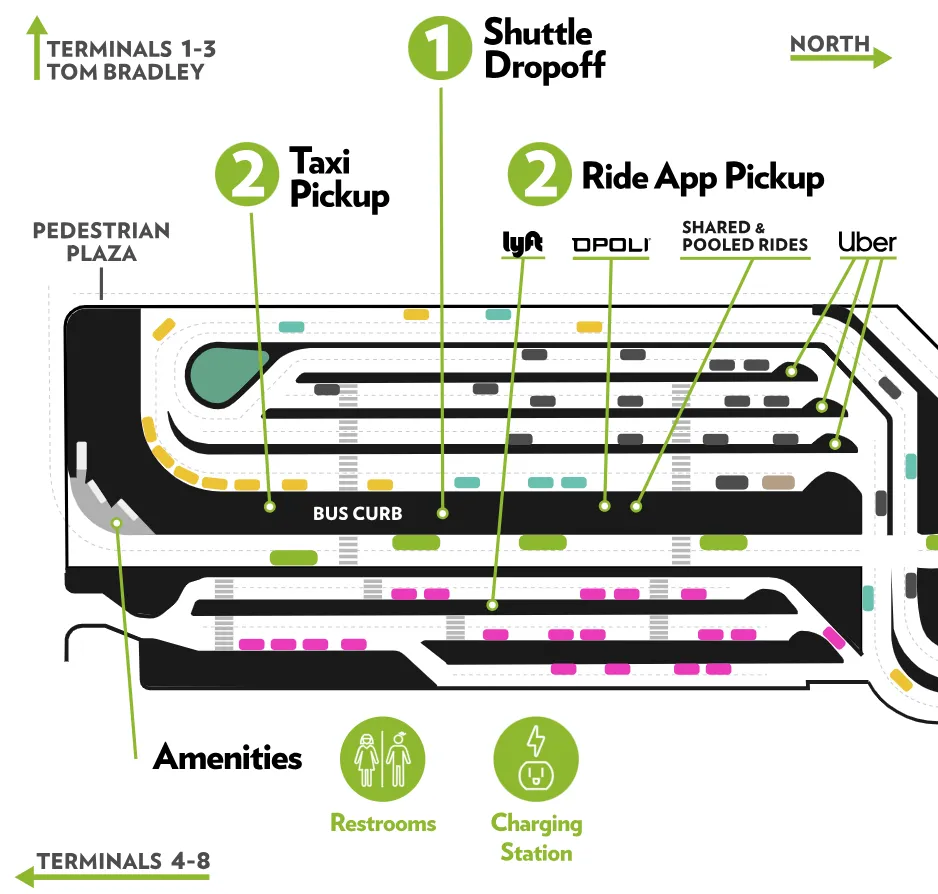
4.4 The PIN System: How to Actually Get Your Ride
Unlike a standard Uber where you find a specific license plate, LAX uses a PIN/Fast Track system during busy hours.
-
Request in the App: Only request the ride once you are at the LAX-it lot or on the shuttle.
-
Get your PIN: The app will give you a 6-digit code instead of a driver’s name.
-
Enter the Queue: Follow signs for "Uber" or "Lyft." You will see a line of cars and passengers.
-
Pair with a Driver: Walk up to the first car in the designated loading zone. Show the driver your PIN. They will enter it into their device, and your trip begins immediately.
-
Exceptions: For UberXL or Comfort, you may still be assigned a specific driver and car. Check your app carefully for instructions.
4.5 2026 Survival Tips for LAX-it
-
Avoid the "Shuttle Shuffle": If the shuttle line is massive (it can stretch down the sidewalk at TBIT), consider walking to Terminal 1 and catching the shuttle from there—or simply walking the rest of the way to the lot.
-
The "Upper Level Hack" for Taxis: Occasionally, Taxis are allowed to drop off and pick up on the Upper Level (Departures) if the lower lot is overflowing. Look for signage or ask an airport staff member in a neon vest.
-
Connectivity: LAX-it has dedicated Wi-Fi, which is helpful if your mobile data is spotty after an international flight.
-
Amenities: The lot features several popular Food Trucks, restrooms, and seating areas with umbrellas. If your wait time is long, grab a taco while you wait.
4.6 Smart Alternatives to LAX-it
If you hate the idea of a shuttle and a crowded lot, try these strategies:
-
The "Black Car" Upgrade: If the UberX price is surging to $70 and Uber Black is $100, the $30 difference might be worth skipping the 30-minute shuttle process and getting picked up right at your door.
-
The Hotel Shuttle Hack: Take a free shuttle to a major hotel on Century Blvd (like the Hyatt Regency or Sheraton). Once you arrive at the hotel lobby, order your Uber from there. It is often $10–$15 cheaper, and you avoid the "airport surcharge" and the LAX-it chaos.
5. Estimated Costs to Popular Destinations (2026)
The following table provides estimated pricing for standard transportation options from LAX.
|
Destination |
UberX / Lyft (Est.) |
Taxi (Flat/Meter) |
Alternative (Other) |
|---|---|---|---|
|
Downtown LA (DTLA) |
💰$45 – $70 |
💲$50 – $65 (Flat) |
$9.75 (FlyAway Bus) |
|
Hollywood |
💰$50 – $80 |
💲$60 – $85 |
$1.75 (Metro B Line) |
|
Santa Monica |
💰$40 – $60 |
💲$45 – $65 |
$1.25 (Big Blue Bus #3) |
|
Beverly Hills |
💰$45 – $65 |
💲$50 – $75 |
$1.75 (Metro D Line) |
|
Pasadena |
💰$75 – $100 |
💲$85 – $110 |
$1.75 (Metro A Line) |
|
Anaheim (Disneyland) |
💰$90 – $130 |
💲$110 – $150 |
$35 (Shared Shuttle) |
|
Van Nuys |
💰$55 – $75 |
💲$65 – $90 |
$9.75 (FlyAway Bus) |
6. Getting to LAX for Departures (Don't Miss Your Flight)
6.1 Best Way to Get to LAX by Time of Day
The key to a stress-free departure at LAX in 2026 is mastering the "Horseshoe" traffic.
-
Early Morning (5 AM - 7 AM): Traffic into the airport is usually light, but this is the "bank" of early departures. TSA lines can be massive.
-
The Afternoon Grind (2 PM - 8 PM): This is the most dangerous time. Congestion on the 405 and Century Blvd can add 60 minutes to your trip before you even reach the terminal loop.
-
Late Night (After 10 PM): Ideal for red-eye flights. You can often zip through the loop in under 10 minutes.
6.2 The "Drop-off Level" Strategy
When heading to LAX, you are typically dropped off at the Departures (Upper) Level. However, if the Upper Level is gridlocked (a common occurrence on Friday afternoons), ask your driver to drop you off on the Arrivals (Lower) Level. From there, you can take an elevator or escalator up to your check-in counter. This "Lower Level Drop-off" often saves 15 minutes of sitting in idle traffic.
6.3 How Early You Should Arrive at LAX in 2026
Wait times vary wildly by terminal. Use these 2026 guidelines for boarding times (not departure times):
-
Domestic Flights: Arrive 2.5 hours before boarding.
-
International Flights (TBIT): Arrive 3.5 hours before boarding. The Tom Bradley International Terminal often has the most rigorous security and documentation checks.
-
The "Digital Buffer": Check the LAX official website or app for real-time TSA wait times. Terminal 1 (Southwest) and Terminals 7/8 (United) often move faster than the central terminals.
6.4 TSA Survival Guide: Clear, PreCheck, and Reservation
To avoid missing your flight, utilize these programs:
-
TSA PreCheck & CLEAR: Available at almost every terminal. If you have both, you can usually clear security in under 10 minutes.
-
LAX Fast Lane: A free program for certain terminals (like T7/T8) that allows you to reserve a 15-minute window for security screening. Pre-booking is essential.
6.5 How the LAX Automated People Mover (APM) Has Changed Everything
By 2026, the Automated People Mover (APM) is the preferred way for savvy travelers to enter the airport.
-
Intermodal Transportation Facility (ITF): Instead of driving into the crowded terminal loop, have your Uber/Lyft drop you off at the ITF East or ITF West stations outside the airport.
-
The Train Experience: The APM train is free and runs every 2 minutes. It stops at dedicated stations serving all terminal groups.
-
Why use it? It bypasses the "World Way" gridlock entirely. You can get from the off-site station to your terminal's pedestrian bridge in about 4-6 minutes, guaranteed.
7. 2026 LAX Transportation Tips and Common Mistakes
7.1 What Locals and Pros Do
-
The "Reverse APM" Drop-off: If the terminal loop is red on Google Maps, tell your driver to drop you at the Economy Parking / APM Station. Hop on the train and glide over the traffic. It’s often 20 minutes faster than driving to Terminal 4.
-
The "Terminal 1" Pickup Trick: If you are at TBIT or T4 and the LAX-it shuttle line looks like a Disney queue, walk across the horseshoe to Terminal 1. It’s a 5-minute walk, and you can catch a much emptier shuttle to the lot from there.
-
The Big Blue Bus Shortcut: Going to Santa Monica or Venice? Don't pay $50 for a Lyft. Take the free "City Bus Center" shuttle to the bus hub and hop on the Big Blue Bus (Route 3 or Rapid 3) for under $2. It’s clean, fast, and uses dedicated lanes.
7.2 Common Mistakes That Will Ruin Your Day
-
Mistake #1: Relying on the Horseshoe Loop for Connections. Never assume you can "just hop out and walk" between terminals if they are on opposite sides (e.g., T1 to T7). Use the Airside Connectors (past security) to avoid re-screening.
-
Mistake #2: Forgetting the 2028 Olympic Preparations. LAX is in a constant state of "pre-Olympic" construction. Road closures can happen overnight. Always check the @FlyLAXStats Twitter/X account or the official app before you leave for the airport.
-
Mistake #3: Waiting for Uber/Lyft at the Curb. Standard UberX and Lyft drivers cannot pick you up at the terminal. If you wait there, you will just get a cancellation fee and a headache. Go to LAX-it.
7.3 Safety and Legality: Beware the "Gipsy Cabs"
-
The "Whisper" Scam: If a person in the terminal whispers "Taxi?" or "Need a ride?"—walk away. These are unlicensed drivers who often lack proper insurance and may overcharge you by hundreds of dollars.
-
Official Zones Only: Only board vehicles in zones marked with official airport signage. Real Uber/Lyft drivers will never ask you to "pay cash" to bypass the app.
7.4 Nighttime Arrival Considerations
-
Midnight Traffic Peaks: Surprisingly, LAX can be busier at midnight than at noon due to the massive wave of international arrivals and red-eyes.
-
Shuttle Frequency: Shuttles run 24/7, but after 2 AM, the frequency drops. If you’re arriving in the dead of night, an Uber Black might be worth the premium just to get home safely and quickly without waiting in the cold.
8. The Future of LAX Transportation After 2026
8.1 2028 Olympic Preparations (LA28)
In preparation for the 2028 Olympic Games, LAX will implement a "Public Transit First" policy. This may include congestion pricing for private vehicles entering the terminal loop, encouraging a massive shift toward the APM (Automated People Mover).
8.2 Deep Integration with Rail Transit
Starting in 2027, the K Line (Crenshaw/LAX) and C Line (Green) will seamlessly connect with the APM via the LAX/Aviation Transit Center. Travelers from Downtown or Santa Monica will be able to take the Metro directly to the APM station for a smooth transfer to their terminal.
8.3 The Disappearance of Individual Shuttles
With the full operation of the ConRAC (Consolidated Rent-A-Car) and ITF (Intermodal Transportation Facility), individual shuttles for rentals, hotels, and remote parking will be phased out. Travelers will use the APM to reach these centralized hubs, significantly reducing horseshoe congestion.
8.4 Relocation of Ride-Hailing Zones
The LAX-it lot is expected to move to ITF West or ITF East. Passengers will take a 3-minute APM ride to reach a more efficient, multi-level ride-hailing center that offers better weather protection and streamlined vehicle dispatching.
9. Frequently Asked Questions (FAQ)
Q: Does the Metro go to LAX?
A: Not directly into the terminal (yet). You must take a shuttle to the Aviation/LAX station (Green Line) or wait for the new APM to connect to the Metro Crenshaw line.
Q: Do I have to go to LAX-it to get an Uber or Lyft at LAX?
A: Yes, in most cases you must go to LAX-it to pick up Uber or Lyft at LAX. Ride-hailing pickups are not allowed directly at most terminal curbs. After exiting the terminal, you’ll either walk or take a free shuttle to the LAX-it lot, where Uber and Lyft pickups are centralized.
Q: Can you walk out of LAX Airport to catch a ride?
A: In most cases, you cannot simply walk out of LAX to catch an Uber or Lyft at the curb. Ride-hailing pickups are restricted, and most travelers must go to LAX-it. However, walking is allowed to nearby terminals, parking structures, or designated pickup areas for other transportation options.
Q: What is the safest way to leave LAX at night?
A: The safest ways to leave LAX at night include official taxis, Uber/Lyft via LAX-it, FlyAway buses, and hotel shuttles. Avoid accepting rides from unofficial drivers inside or outside the terminals.
Q: Where is LAX-it located and how long does it take to get there?
A: LAX-it is located east of Terminal 1, near World Way. From most terminals, it takes 10–15 minutes to reach LAX-it, either by walking or by using the free LAX-it shuttle. Travel time can be longer during peak hours or heavy traffic.