1. Moving Trends 2026: Why Your 2024 Moving Strategy is Outdated
Moving across state lines in 2026 is a vastly different beast than it was just a few years ago. If you are relying on outdated blog posts or "pre-pandemic" price quotes, you’re in for a sticker shock.
Post-Inflation Moving Costs: What to Expect
In the 2026-2027 fiscal year, the moving industry has seen a 15-20% hike in service fees. This surge is driven by two main factors:
-
Labor Shortage: Professional movers (drivers and loaders) are in high demand, leading to higher base wages which are passed on to the consumer.
-
Diesel Volatility: While fuel prices fluctuate, most carriers now implement a more aggressive Fuel Surcharge, often ranging from 10% to 15% of your total bill.
Interstate vs. Local Moves: Understanding the FMCSA Regulations
It’s crucial to understand that an interstate move (crossing state lines) is governed by federal law, specifically the Federal Motor Carrier Safety Administration (FMCSA). Unlike a local move where you might pay a flat hourly rate, interstate movers must:
-
Provide you with a USDOT Number.
-
Give you the official federal booklet: "Your Rights and Responsibilities When You Move."
-
Charge you based on the weight of your goods or the volume (cubic feet), rather than just hours worked.
Editor’s Pro-Tip: If a company tells you they don't need to follow these rules because "it's a short trip across the border," walk away. They are likely unlicensed or operating illegally.
2. The Cost of Moving Out of State: Pillars, Methods, and 2026 Price Comparison
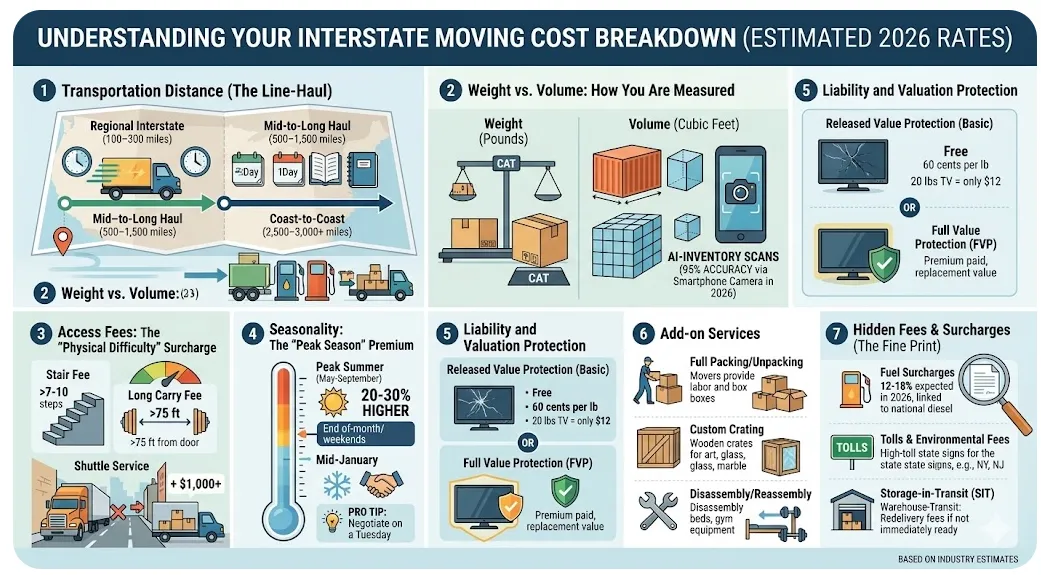
In 2026, an interstate moving quote is no longer just a flat fee. It is a complex calculation based on logistics, labor, and risk. To avoid "sticker shock," you must understand the seven core components that dictate your final bill.
The 7 DNA Components of a Moving Quote
-
Transportation Distance (The Line-Haul): Regional (100-300 miles) vs. Mid-to-Long Haul (500-1,500 miles) vs. Coast-to-Coast (3,000 miles).
-
Weight vs. Volume: Full-service movers charge by Weight (Pounds); container and broker companies usually charge by Volume (Cubic Feet).
-
Access Fees (Physical Difficulty):
- Stair Fee: Charged per flight of stairs
-
Long Carry Fee: Applied if the truck parks >75 feet from your door.
-
Shuttle Service: Required if a 53-foot semi-truck cannot enter your narrow street ($1,000+ extra).
-
Seasonality: Moving in Summer (May-Sept) costs 20-30% more than a winter move. Mid-month moves are cheaper than month-end.
-
Liability and Protection: * Released Value: Free, but only covers 60¢ per pound.
-
Full Value Protection (FVP): Comprehensive coverage for replacement value.
-
-
Add-on Services: Professional packing, custom crating for art, and furniture disassembly.
-
Surcharges (The Fine Print): Fuel surcharges (12-18% in 2026), tolls, and environmental fees.
The 3 Main Moving Methods & 2026 Cost Comparison
Before you choose a mover, you must decide which "Service Level" fits your budget and physical capability.
-
1. Full-Service Movers (The Luxury Option): They handle everything—packing, loading, driving, and unloading. Best for families and those with high-value items.
-
Top Brands: International Van Lines (IVL), American Van Lines.
-
-
2. Moving Containers (The Hybrid Option): They drop a container (like a PODS box) at your door; you pack it; they drive it to the new state.
-
3. Truck Rental (The DIY Option): You rent the truck, you pack it, and you drive it across the country.
2026 Average Pricing Comparison (1,000+ Mile Move)
Estimated for a move between major hubs (e.g., Chicago to Austin or Boston to Atlanta).
| Home Size | Truck Rental (DIY) | Moving Containers (Hybrid) | Full-Service Movers |
| Studio / 1-BR | $900 – $1,600 | $1,750 – $3,200 | $2,900 – $5,200 |
| 2-BR / 3-BR | $2,200 – $4,200 | $3,900 – $6,200 | $5,800 – $12,500 |
| 4+ Bedroom | $4,800+ | $6,800 – $10,500 | $14,000 – $25,000+ |
3. Full-Service vs. DIY vs. Hybrid: Which Moving Method Fits You?
Choosing a moving method is a trade-off between time, physical effort, and money. In 2026, the gap between these services has widened due to technological shifts and labor costs. Here is the deep dive into your three primary options.
Option 1: Full-Service Movers (The "Hands-Off" Luxury)
This is the "white-glove" experience where a crew packs your boxes, loads the truck, and drives it across the country.
-
Operational Process: Estimate & Survey → Packing Day → Loading & Inventory → Transit → Delivery & Unpacking.
-
Price Structure: Line-haul Fee + Packing Labor & Materials + Valuation (Insurance) + Accessorial Charges (Stairs/Long Carry).
-
Pros: Zero heavy lifting; professional packing reduces damage risk; comprehensive insurance options.
-
Cons: Most expensive; "Delivery Windows" can be unpredictable (7–21 days for consolidated shipments).
-
The Hidden Reality: Most interstate moves are "consolidated," meaning your items share a 53-foot trailer with other families.
-
Top 2026 Brands:
-
International Van Lines (IVL): Consistently ranked #1 for customer service and global reach.
-
American Van Lines: Best for high-value items like pianos or antiques, thanks to their highly trained, non-contract labor.
-
-
Best For:
- Busy Professionals: Those who cannot afford to take a week off work to pack and drive.
-
Families with Children: When managing kids and a career makes DIY labor impossible.
-
Corporate Relocations: If your company is providing a "Relocation Package," this is the standard choice.
-
High-Value Households: If you own pianos, fine art, or expensive furniture that requires professional crating.
Option 2: Moving Containers (The Hybrid Flexibility)
A company drops a weather-resistant container (e.g., a PODS box) in your driveway. You load it at your own pace, and they handle the cross-country drive.
-
Operational Process: Container Drop-off → Loading Window → Transit & Storage → Destination Delivery → Final Pickup.
-
Price Structure: Monthly Rental + Transportation Fee + Delivery/Pickup Fees + Storage Fees (if applicable).
-
Pros: No driving a massive truck; perfect for "staggered" moves where you need temporary storage; significantly cheaper than full-service.
-
Cons: You still have to do the heavy lifting; you need a legal parking spot for the container.
-
The Hidden Reality: Container availability is a major issue in 2026. You must book at least 8–10 weeks in advance for peak summer dates.
-
Top 2026 Brands:
-
Best For:
- The "In-Between" Mover: Those whose new home isn't ready yet and need 30–60 days of storage.
-
Staggered Schedules: Perfect if you want to pack slowly over a week rather than all in one day.
-
Urban-to-Suburban: People moving from a house with a driveway (where a container can sit safely) to another house.
-
Small-to-Midsize Homes: Ideal for 1-2 bedroom apartments or small townhomes.
Option 3: Truck Rental (The 100% DIY Grind)
The classic U-Haul route. You rent the truck, recruit friends with pizza, and drive the beast yourself.
-
Operational Process: Reservation → Truck Pickup → DIY Loading → Cross-Country Drive → Unload & Return.
-
Price Structure: Base Rental Rate + Fuel & Tolls + Rental Insurance + Equipment Rental (Dollies/Pads).
-
Pros: Total control over the schedule; the absolute cheapest way to move.
-
Cons: Driving a 26-foot truck through mountain passes or city traffic is exhausting and stressful; hidden costs like gas (4–8 MPG) and hotels.
-
The Hidden Reality: In 2026, rental trucks are often the target of theft at hotels. You must invest in high-end locks and plan "safe" stops.
-
Top 2026 Brands:
-
Best For:
- Extreme Budgeters: Students, recent grads, or anyone looking to keep costs under $2,000 for a long-distance move.
-
The "Minimalist": Those with very few items who can load and unload the truck in a few hours.
-
Adventurous Drivers: People comfortable handling a 26-foot vehicle through mountain passes and heavy city traffic.
-
Last-Minute Movers: Truck rentals are often easier to secure on short notice compared to containers or full-service crews.
Comparison Matrix: At-A-Glance Decision Tool
| Feature | Full-Service | Moving Containers | Truck Rental |
| Physical Effort | Low (None) | High (Loading only) | Extreme (All labor) |
| Stress Level | Low | Medium | High |
| Control of Schedule | Low | High | Extreme |
| Typical Cost |
|
$$ | $ |
| Best For... | Families / Busy Pros | Flexible Timelines | Budget-focused DIYers |
4. How to Spot a Rogue Mover: A Pro Editor’s Audit Checklist
Every year, the FMCSA receives thousands of complaints regarding moving fraud. Most of these could have been avoided with 15 minutes of "detective work." Before you sign anything, put every company through this four-step audit.
4.1. Carrier vs. Broker: Who Actually Owns the Truck?
This is the single most important distinction in the industry.
-
The Carrier: Owns the trucks, employs the movers, and is directly responsible for your cargo. (e.g., International Van Lines).
-
The Broker: Owns zero trucks. They are a sales office that "auctions" your move to the lowest bidder.
-
The Danger: If a broker sells your move to a low-quality carrier, and your items are damaged, the broker will simply say, "Not our problem, call the carrier."
Audit Tip: Always ask: "Are you the Household Goods Motor Carrier or a Broker?" Legally, they must disclose this.
4.2. The FMCSA/SAFER System Background Check
Every interstate mover must be registered with the Federal Motor Carrier Safety Administration (FMCSA).
-
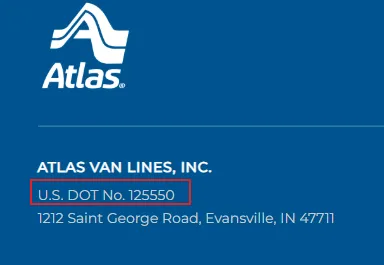
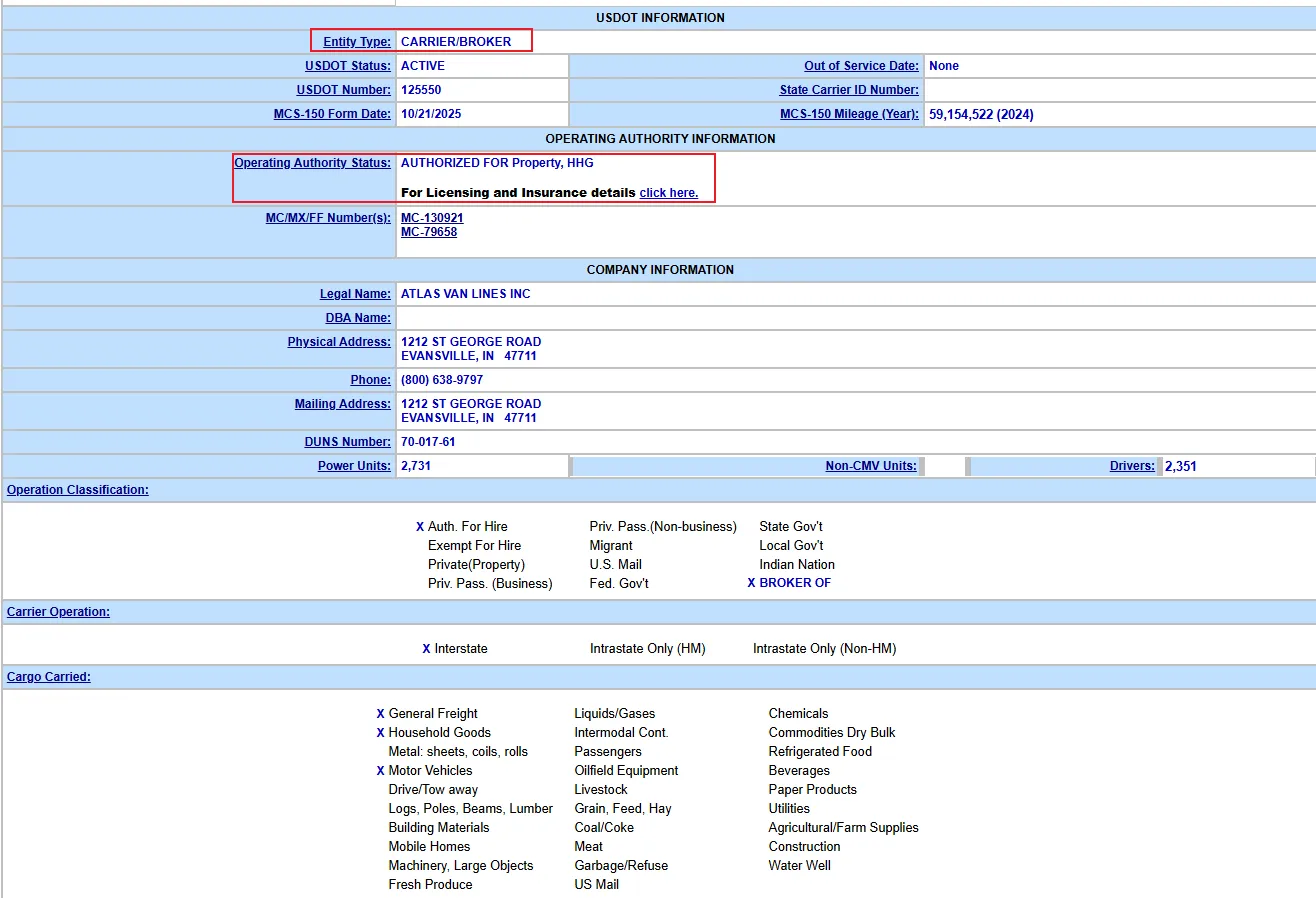
Get the Numbers: Ask for their USDOT Number (usually on the bottom section of its official website) and MC Number.
-
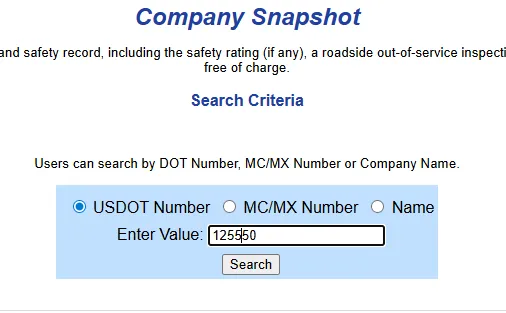
Run the Audit: Go to the SAFER System Website. Enter the information for the company you are inquiring about in the "Search by Name" or "USDOT Number" field.
-
What to Look For:
-
Entity Type: Should be "CARRIER."
-
Operating Status: Must be "AUTHORIZED FOR Property."
-
Insurance: Click on "Licensing & Insurance" to ensure they have Active Cargo and BIPD Insurance. If it says "Pending" or "Dismissed," hang up.
-
4.3. Binding vs. Non-Binding Estimates: The Legal Trap
How a company quotes you determines your legal protection.
-
Non-Binding Estimate: A "rough guess." The final price can skyrocket on moving day based on the weight. Rogue movers love these.
-
Binding Estimate: A guaranteed price based on a specific inventory.
-
Binding Not-to-Exceed (The Gold Standard): You won’t pay more than the quote, but if your shipment weighs less than estimated, your price actually goes down. Always insist on this.
4.4. The "Red Flags" Quick-Scan Checklist
If you see more than two of these, walk away immediately:
-
The "Vague" Company Name: They answer the phone with "Moving Services" instead of a specific brand name.
-
No In-Home/Video Survey: They give you a "guaranteed" price over the phone without seeing your items. (In 2026, a high-quality video survey is the industry standard).
-
Cash-Only Deposits: Legitimate companies accept credit cards or checks. Large cash-only deposits are a sign of a "fly-by-night" operation.
-
The "Too Good to Be True" Quote: If three companies quote $5,000 and one quotes $2,500, the $2,500 quote is a "hook" to get your goods on the truck before they demand more money.
-
No Physical Address: Their "office" is a UPS Store, a virtual PO Box, or a residential house on Google Maps.
5. Professional Packing Pro-Tips: Minimize Damage on Long Hauls
Standard packing for a local move will fail on an interstate trip. To ensure your heirloom china and 4K TV survive the "vibration test" of the I-80 or I-95, follow these professional standards.
5.1. Box Selection: Heavy-Duty vs. Standard
For long-distance moves, the "free boxes from the grocery store" strategy is a recipe for disaster.
-
The "Double-Walled" Rule: High-weight items (books, small appliances) must go in Double-Walled boxes to prevent the bottom from dropping out.
-
Uniformity is Key: Professional movers prefer standard sizes (Small, Medium, Large, Extra Large). Uniform boxes stack tighter in the truck, preventing "tip-overs" during transit.
-
Wardrobe Boxes: Don’t take clothes off hangers. Use wardrobe boxes—they act as a mobile closet and provide a structural "buffer" for other light boxes.
5.2. The "Vertical Loading" Rule for Fragiles
Most people stack plates like pancakes. Professionals stack them like records.
-
Plates & Saucers: Always pack these on their edges (vertically). Plates are structurally strongest on their rims; a vertical hit will rarely break a plate, whereas a vertical hit on a horizontal stack will crack the bottom one instantly.
-
The 3-Inch Buffer: Use "Packing Paper" (not newspaper, which stains) to create a 3-inch cushion of crumpled paper at the top and bottom of every fragile box. If you don't hear "crunching" when you close the lid, there isn't enough padding.
5.3. Inventory Management: The Numbered Labeling System
In 2026, "Kitchen" written in Sharpie isn't enough. If Box #42 goes missing, you need to know exactly what was inside for the insurance claim.
-
The Master List: Use a Google Sheet or an app like Sortly.
-
Labeling Logic: Label the top and two sides of each box with a number (e.g., #001, #002). In your spreadsheet, list the contents: #042 — Air Fryer, Toaster, Spice Rack.
-
The "Open First" Box: Clearly mark 2–3 boxes with Neon Tape. These contain coffee makers, basic tools, bed sheets, and chargers—the things you need the moment you arrive.
5.4. Handling Specialty Items & Electronics
-
The TV Kit: If you don't have the original box, buy a heavy-duty telescoping TV box. Never lay a flat-screen TV flat; the internal crystals can crack under their own weight. Always transport them upright.
-
Hardware Baggy Strategy: When disassembling furniture, put all screws and Allen wrenches into a Ziploc bag. Tape that bag directly to a large piece of the furniture (e.g., the underside of the tabletop). Never put hardware in a random "junk box."
-
Mattress Protection: Use plastic mattress bags to prevent dust, moisture, and bedbugs. For high-end mattresses, consider "Mattress Cartons" (cardboard boxes) for structural support.
6. The 8-Week Master Moving Checklist: Your Action Plan
Use this countdown to transform a monumental task into bite-sized, manageable steps. Treat this as your "Moving Bible."
Phase 1: Weeks 8–6 — The Foundation
-
[ ] The Great Purge: Every pound you don't move is money in your pocket. Sell on Facebook Marketplace, donate to Goodwill, or use services like 1-800-GOT-JUNK.
-
[ ] Secure Your Method: If you’re hiring full-service or a container (PODS), book now. In 2026, top-tier carriers often have zero availability within a 4-week window.
-
[ ] Request "Binding" Quotes: Schedule at least three video surveys to get written, binding estimates.
-
[ ] Gather Documents: Create a "Moving Folder" (physical or digital) for birth certificates, social security cards, and your new lease/mortgage papers.
Phase 2: Weeks 4–2 — The Logistics Shift
-
[ ] USPS Address Forwarding: Do this online at USPS.com. It costs about $1.10 for identity verification, but it ensures your mail follows you.
-
[ ] Utilities Transfer: Schedule your "Stop/Start" dates for Electricity, Water, Gas, and Trash. Pro Tip: Set your internet to install the day after you arrive.
-
[ ] Records Transfer: Contact schools and doctors to have records sent to your new destination.
-
[ ] Inventory Photos: Take photos of the back of your electronics (to remember where cables go) and the condition of high-value furniture for insurance.
Phase 3: The Final Week — The Home Stretch
-
[ ] The "Survival Box" (First-Night Essentials): Pack a separate suitcase with 3 days of clothes, toiletries, chargers, basic tools, a shower curtain, and coffee. This stays with you in your car, not on the truck.
-
[ ] Defrost & Clean: Empty your fridge and freezer at least 24 hours before moving. Clean the stove and wipe down cabinets.
-
[ ] Confirm the Details: Call your mover to re-confirm the arrival window and ensure they have your correct cell phone number.
Phase 4: Moving Day — The Handoff
-
[ ] The Walkthrough: Once the truck is loaded, do a final sweep of every closet, attic, and crawlspace.
-
[ ] Read Before You Sign: Carefully review the Bill of Lading (the contract between you and the mover). Ensure the "Inventory High-Value" list matches your records.
-
[ ] Tip the Crew: Have cash ready. In 2026, the standard tip is $40–$80 per person for a full day of interstate loading.
Editor’s Pro-Tip: When you arrive at your new state, the first thing you should do is change the locks. You never know who—contractors, old tenants, or neighbors—still has a key to your new sanctuary.
7. Smart Ways to Save Money on Your Interstate Move
In 2026, moving costs are at an all-time high. Use these 5 "insider hacks" to trim your budget by $500–$2,000 without compromising the safety of your belongings.
7.1. Master the "Mid-Month" Timing
-
The Hack: Move on a Tuesday or Wednesday between the 10th and 20th.
-
The Payoff: Negotiate 10–15% off the line-haul fee. Avoid month-ends and weekends when demand (and prices) peak.
7.2. The "Media Mail" Book Trick
-
The Hack: Ship all books via USPS Media Mail (up to 70 lbs per box).
-
The Payoff: Books are the #1 "weight-killer" in professional quotes. Shipping them separately can shave hundreds off a weight-based estimate.
7.3. Source "Second-Hand" Packing Supplies
-
The Hack: Use Facebook Marketplace, Nextdoor, or Buy Nothing groups.
-
The Payoff: A 3-bedroom house requires $400+ in new boxes. Get them for free from neighbors who just moved in. Tip: Skip grocery store boxes (pest risk).
7.4. The "Sell-to-Ship" Strategy
-
The Hack: If you haven't used it in a year, sell it.
-
The Payoff: Aim to cut your inventory by 30%. Selling heavy IKEA-style furniture and rebuying at your destination is often cheaper than paying the "per-pound" transport fee.
7.5. Leverage Tax & Employer Perks
-
The Hack: Ask for a "Lump Sum" Relocation Stipend from your new employer.
-
The Payoff: If you are Active Duty Military, your moving expenses remain tax-deductible. For others, a relocation bonus can offset the entire cost of a full-service move.
Editor’s Pro-Tip: Always ask for "Consolidated Shipping." By giving the mover a wider 14-day delivery window, they can "rideshare" your items with another customer, significantly lowering your rate.
8. Protecting Your Assets: Valuation vs. Insurance Explained
Your belongings face 1,000+ miles of road vibration and multiple handlings. Understanding your protection options is the difference between a total loss and a stress-free replacement.
8.1. The Two Legal Standards
-
Released Value Protection (Basic): * Cost: Free (Federal Requirement).
-
The Reality: Covers only 60¢ per pound. If your $2,000 OLED TV (40 lbs) is smashed, you get only $24. Only choose this for low-value moves.
-
-
Full Value Protection (FVP): * Cost: A premium (varies by total value).
-
The Reality: The gold standard. The mover must repair, replace, or pay the current market value for any lost or damaged item. Highly recommended for 2026 moves.
-
8.2. Filing a Claim: The "9-Month" Rule
- Documentation: You have 9 months to file a claim, but do it within 7 days for the best results.
-
The "Before" Proof: Take timestamped photos of all high-value items before they are loaded.
-
The "Inventory" Check: At delivery, don't sign the paperwork until you’ve verified that all numbered boxes (from Chapter 5) have arrived. Mark any exterior box damage on the Bill of Lading immediately.
Conclusion: Start Your New Chapter with Peace of Mind
Moving across state lines is more than a logistics challenge—it’s the beginning of a new life. In 2026, the key to a successful interstate move is early preparation and rigorous verification.
Whether you choose the white-glove luxury of a full-service mover, the flexibility of a container, or the grit of a DIY truck rental, your priority remains the same: Protect your budget, protect your belongings, and protect your peace of mind.
Final Editor's Checklist:
Verify the USDOT Number on SAFER.
Get a Binding Not-to-Exceed estimate.
Pack your Survival Box for night one.
Welcome home!