Whether you’re a fitness enthusiast carrying protein supplements, a foodie bringing home local delicacies, or a parent packing snacks for a long-haul flight, understanding airport security protocols is essential for a stress-free journey. Navigating the intersection of safety regulations and dietary needs can be complex, but with the right preparation, you can ensure your favorite treats make it through the gate.
1. Introduction
“Ever wondered why TSA sometimes confiscates your yogurt, milkshake, or protein shake?”
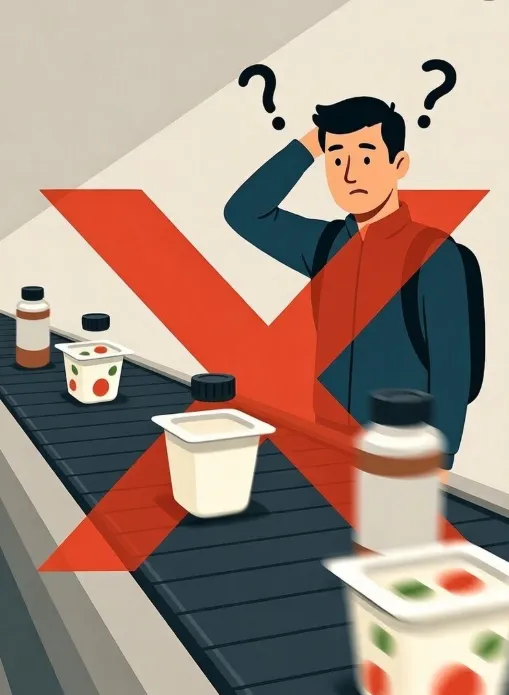
It’s a frustrating scene: you’ve carefully selected your healthy travel snacks, only to watch them being tossed into a bin at the security checkpoint. As we move into 2026, airport security technology has advanced, but the fundamental rules surrounding what constitutes a "liquid" versus a "solid" remain a major point of confusion for travelers.
This guide is designed to help U.S.-bound travelers from Europe, North America, and beyond navigate the updated TSA food rules of 2026. Following the stabilization of travel post-COVID and the implementation of new CT scanning technology in many airports, policies regarding liquids, gels, and "dangerous" food items like self-heating packs have been further clarified. Our goal is to ensure you pack safely, avoid unnecessary delays, and keep your snacks where they belong—with you.
2. TSA vs. CBP: Who Handles Your Food and Snacks?
One of the biggest mistakes travelers make is confusing the two agencies that govern international arrivals in the U.S. Understanding the difference is crucial for a smooth journey.
-
TSA (Transportation Security Administration): Their primary focus is Security. They screen your carry-on luggage for threats. If an item is confiscated by TSA, it’s usually because it violates safety rules (like the liquid limit or fire hazards).
-
CBP (Customs and Border Protection): Their primary focus is Agriculture and Trade. They screen your bags upon arrival in the U.S. If an item is seized by CBP, it’s usually because it poses a biological risk (like pests in fruit or diseases in meat).
Quick Comparison Table: TSA vs. CBP Responsibilities
|
Agency |
Responsibility |
Examples of Items Screened |
|---|---|---|
|
TSA |
Security & Carry-on Screening |
Yogurt, milkshakes, snacks, jelly, self-heating packs, gels |
|
CBP |
Customs & Import Restrictions |
Fresh fruits, meats, seeds, soil, packaged foods from abroad |
3. TSA Food Screening Rules 2026
To avoid the disappointment of losing your snacks at the checkpoint, it is vital to understand the specific criteria TSA uses to evaluate food items. While the general goal is to prevent prohibited substances from entering the cabin, the nuances between a permissible snack and a restricted one often come down to consistency and volume.
3.1 Liquids, Gels, and Solid Foods: 3-1-1 Rule Explained
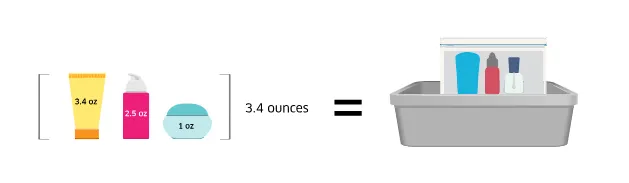
The 3-1-1 Rule remains the gold standard for carry-on luggage. In 2026, while some airports with advanced scanners may allow you to leave liquids in your bag, the volume rules still apply:
-
3.4 ounces (100ml): Each container of liquid or gel must be 100ml or less.
-
1 quart-sized bag: All 100ml containers must fit into one clear, plastic, quart-sized bag.
-
1 bag per passenger: Only one such bag is allowed per person.
The "Spreadability" Test: If you can spill it, spray it, spread it, pump it, or pour it, TSA considers it a liquid or gel. This includes items like Greek yogurt, protein shakes, peanut butter, and hummus.
3.2 Foods You Can Bring in Carry-On Luggage
Solid foods are generally allowed without quantity limits, though they may require additional screening if they appear dense on the X-ray.
-
Dry snacks: Nuts, granola bars, chocolate, crackers, and pretzels.
-
Solid protein: Beef jerky and hard protein bars.
-
Small packaged produce: Whole fruits (apples, oranges) and dry vegetables.
3.3 Foods That Must Be Checked in Luggage
If your food items exceed the 100ml limit, they must go into your checked bag:
-
Large liquids/gels: Full-sized smoothies, jars of salsa, or maple syrup.
-
Alcohol: Any alcohol over 3.4 oz (and note that alcohol over 70% ABV / 140 proof is completely prohibited).
-
Bulk self-heating meals: These are specifically flagged due to their chemical components (see below).
3.4 Why Self-Heating Meals Are Restricted by TSA
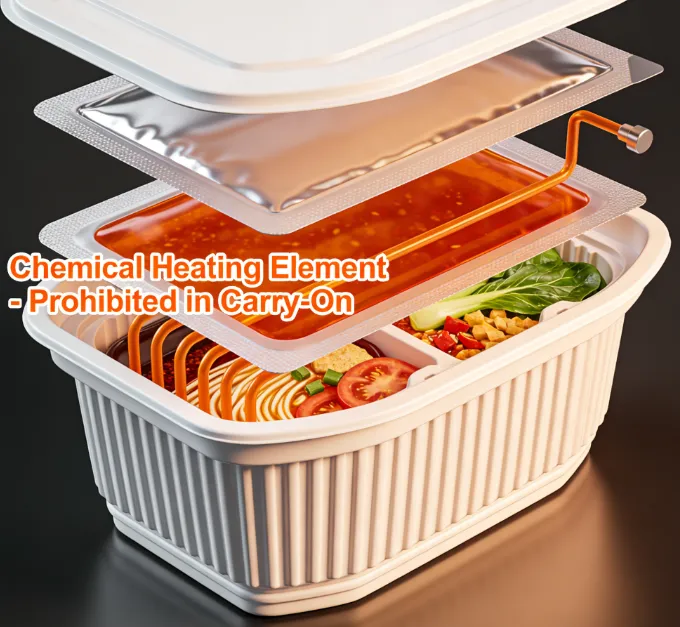
Self-heating meals (MREs or "Instant Hot Pots") are a growing trend. However, they contain magnesium or iron-based heating packs that generate heat through a chemical reaction. TSA views these as potential fire hazards.
-
Carry-on Rule: You generally cannot bring the heating pack itself in the cabin.
-
Pro Tip: “Remove the heating pack to carry the food ingredients safely in your carry-on; pack the heating element in your checked luggage if permitted by your airline.”
4. Commonly Misunderstood Snacks on US Flights
Even for seasoned travelers, certain food items fall into a "gray area" where their classification isn't immediately obvious. A snack that feels like a solid to you might be classified as a liquid or gel by an officer's "spreadability" standards. In this section, we'll clarify these common misconceptions to help you choose your travel fuel more wisely.
4.1 TSA-Friendly vs. TSA-Restricted Snacks
Knowing the difference can save you 20 minutes in the security line.
|
TSA-Friendly (Go ahead!) |
TSA-Restricted (Be careful!) |
|---|---|
|
Dry nuts, protein bars, chocolate |
Yogurt, milkshakes, self-heating meals |
|
Granola, fruit bars |
Bulk sauces, peanut butter over 100ml |
|
Pre-packaged cheese sticks |
Alcohol > 100ml |
4.2 Frozen Foods, Ice Packs, and Cold Snacks: TSA Guidelines
You can bring frozen items (like a frozen steak or a frozen smoothie), but there is a catch: they must be frozen solid at the time of screening. * If there is any liquid at the bottom of the container or if the ice pack is slushy/melting, TSA will treat it as a liquid, and it will likely be confiscated if it's over 100ml.
Tip: Use high-quality gel packs and keep them in a cooler bag until the very last second before security. Medically necessary liquids (e.g., baby formula, liquid medications) are exempt from 3-1-1 but must be declared separately.
4.3 Quick-Reference: The "Solid vs. Liquid" Cheat Sheet
To simplify your packing process, use this quick-reference table for the most common "gray area" food items.
|
Food Item |
TSA Classification |
Can I Bring It in Carry-On? |
|---|---|---|
|
Peanut Butter / Nutella |
Gel |
Only if ≤ 100ml (3.4 oz) |
|
Hummus / Guacamole |
Gel |
Only if ≤ 100ml (3.4 oz) |
|
Hard Cheese (Cheddar/Parmesan) |
Solid |
Yes (Unlimited) |
|
Soft Cheese (Brie/Camembert) |
Gel |
Only if ≤ 100ml (3.4 oz) |
|
Fresh Salsa / Gravy |
Liquid |
Only if ≤ 100ml (3.4 oz) |
|
Frozen Steak / Meat |
Solid |
Yes (Must be frozen rock-solid) |
|
Honey / Maple Syrup |
Liquid |
Only if ≤ 100ml (3.4 oz) |
|
Protein Powder |
Powder |
Yes (Quantities > 12oz may need extra screening) |
5. TSA Snack Blacklist 2026
While many foods are allowed with some common sense, there is a clear "Blacklist" of items that are either strictly prohibited in the cabin or highly likely to be confiscated. Knowing what items are non-negotiable for TSA officers will help you decide what to toss, what to check, and what to leave at home entirely.
5.1 Carry-On Prohibited Foods: What TSA Won’t Allow
Avoid bringing these in your hand luggage:
-
Any liquid or gel container larger than 100ml (even if half-empty).
-
Active chemical heating packs for self-heating meals.
-
Flammable liquids or high-proof alcohol.
5.2 Foods Allowed Only in Checked Luggage
If you really want to bring these home, put them in the hold:
-
Bulk jams, honey, or sauces.
-
Canned goods (these often contain liquid and are difficult for X-rays to see through).
-
Frozen meats or large quantities of liquid-based food.
5.3 Snacks Allowed but Often Flagged by TSA
Expect these to be pulled aside for "secondary screening":
-
Yogurt and Protein Shakes: Their density often triggers an alarm.
-
Nut Butters: Jars of peanut butter are the #1 confiscated "solid" that is actually a "gel."
-
Homemade Spreads: If it looks like a paste, it will be tested.
6. How to Pack Snacks for TSA Clearance
Efficiency is key to avoiding the "bag search" delay. In 2026, many airports have transitioned to advanced Computed Tomography (CT) scanners that provide 3D images, allowing you to keep food inside your bag in some cases. However, until these systems are universal, following a "best-practice" packing method is the only way to guarantee a swift passage.
-
The Layering Strategy: Organize your bag in layers. Place heavy items (like laptops or shoes) at the bottom and your food containers in the middle or top. When food is cluttered or buried under electronics, it becomes difficult for the X-ray to penetrate, often resulting in a manual bag search.
-
The "Easy-Access" Rule: Even if you aren't asked to remove food, pack it in a way that is easy to remove. Transparent silicone or plastic organizer bags are superior to opaque ones, as they allow TSA agents to visually verify contents without opening every pouch.
-
Powder Awareness: Since 2024, TSA has become more stringent with powders (protein powder, pre-workout, etc.). If you are carrying more than 12oz (350ml) of powder, place it in a separate bin for X-ray screening. This prevents "dense spots" on the X-ray that might look like explosives.
-
Standardized Containers: Use clear, travel-sized 100ml containers for gel-like snacks. For liquids, sticking to the original store packaging is often better as it clearly lists the volume, reducing disputes with agents.
-
Labeling: Keep original labels on food whenever possible so agents can quickly identify the ingredients. If you are using reusable containers, a simple label like "Almond Butter" or "Protein Powder" can prevent unnecessary chemical testing.
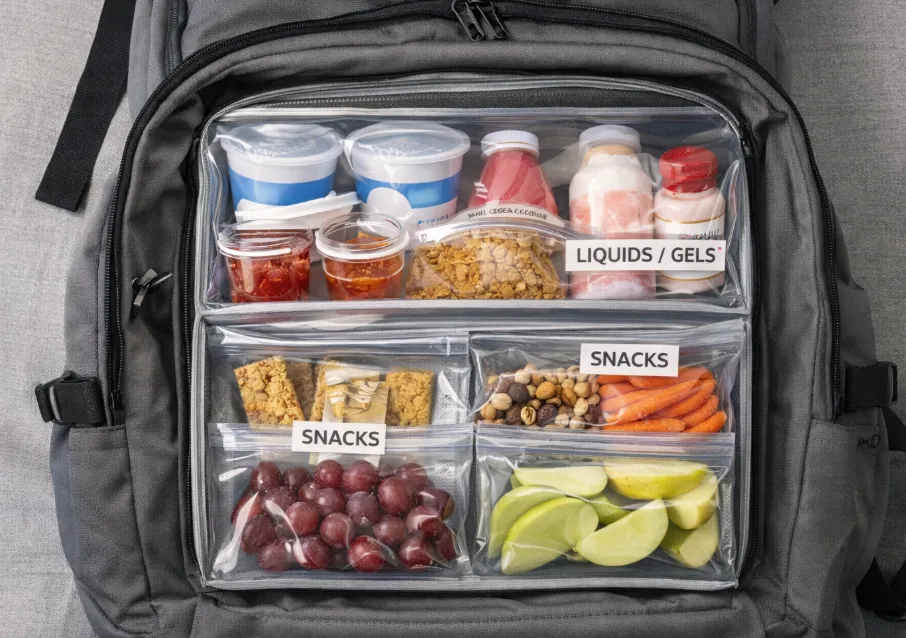
Example Packing List for a US Flight:
-
1 small cup of Greek Yogurt (under 100ml) in your clear 3-1-1 bag.
-
2 Protein bars (Solid).
-
1 Bag of trail mix/nuts.
-
1 Apple or Banana (Eat this before landing to avoid CBP issues!).
7. Quick Travel Checklist & Tips
To ensure a seamless experience from the security gate to your final destination, use this final checklist before you head to the airport. Proper preparation saves time and prevents the awkwardness of having your favorite snacks discarded in front of a crowd.
-
The "Shake & Spread" Audit: Perform a final check of your carry-on. If you shake a container and the contents move (liquid) or if you can spread the contents like butter (gel), ensure it's under 100ml and inside your clear 3-1-1 bag.
-
Consult "AskTSA" Directly: For highly specific or unusual items (e.g., specialized keto supplements or local artisanal pastes), take a photo and message @AskTSA on X (Twitter) or via Apple Business Chat. They provide real-time responses during business hours.
-
The 2026 Tech Check: Check if your departure airport uses modern CT scanners. If they do, you might be able to leave all food in your bag; if not, have your snack pouches ready to pull out into a bin.
-
The "Double Agency" Declaration:
-
TSA Step: Pass security with your snacks (ensure no prohibited liquids/heaters).
-
CBP Step: Upon landing in the U.S., always declare any food on your Customs Declaration form. Even if an item is permitted, failing to declare it can lead to hefty fines ($300+).
-
-
Plan for Disposal: If you realize at the gate that your yogurt is 150ml, don't wait for the agent to find it. Eat it before the line, share it, or dispose of it yourself to keep the line moving.
-
Hydration Hack: Carry an empty, reusable water bottle. Fill it up after you clear security to avoid paying $8 for airport water while keeping your "dry" snacks company.
Safe travels and happy snacking in 2026!