The FIFA World Cup 2026 is not just a football tournament; it is a continental-scale logistical marathon. For the first time in history, 48 teams and millions of fans will navigate across three nations, four time zones, and 16 host cities.
If you are planning to attend, you must unlearn everything you know about previous World Cups. In Qatar, you could see two matches a day by taking a short metro ride. In 2026, traveling between matchday venues like Vancouver and Mexico City is a 5.5-hour flight across international borders.
This guide is your "Survival Manual" for navigating the vast distances of North America, securing the best transit deals, and avoiding the "Match Day Gridlock" that could cost you the opening whistle.
Why Transport is Your Biggest Rival in 2026?
In North America, distance is measured in hours, not miles. To succeed in 2026, you need to master the "Continental Mindset."
The Continental Scale: More Than Just a Commute
To put the scale into perspective, the distance between the Westernmost host city (Vancouver) and the Easternmost (Boston) is approximately 5,000 kilometers (3,100 miles).
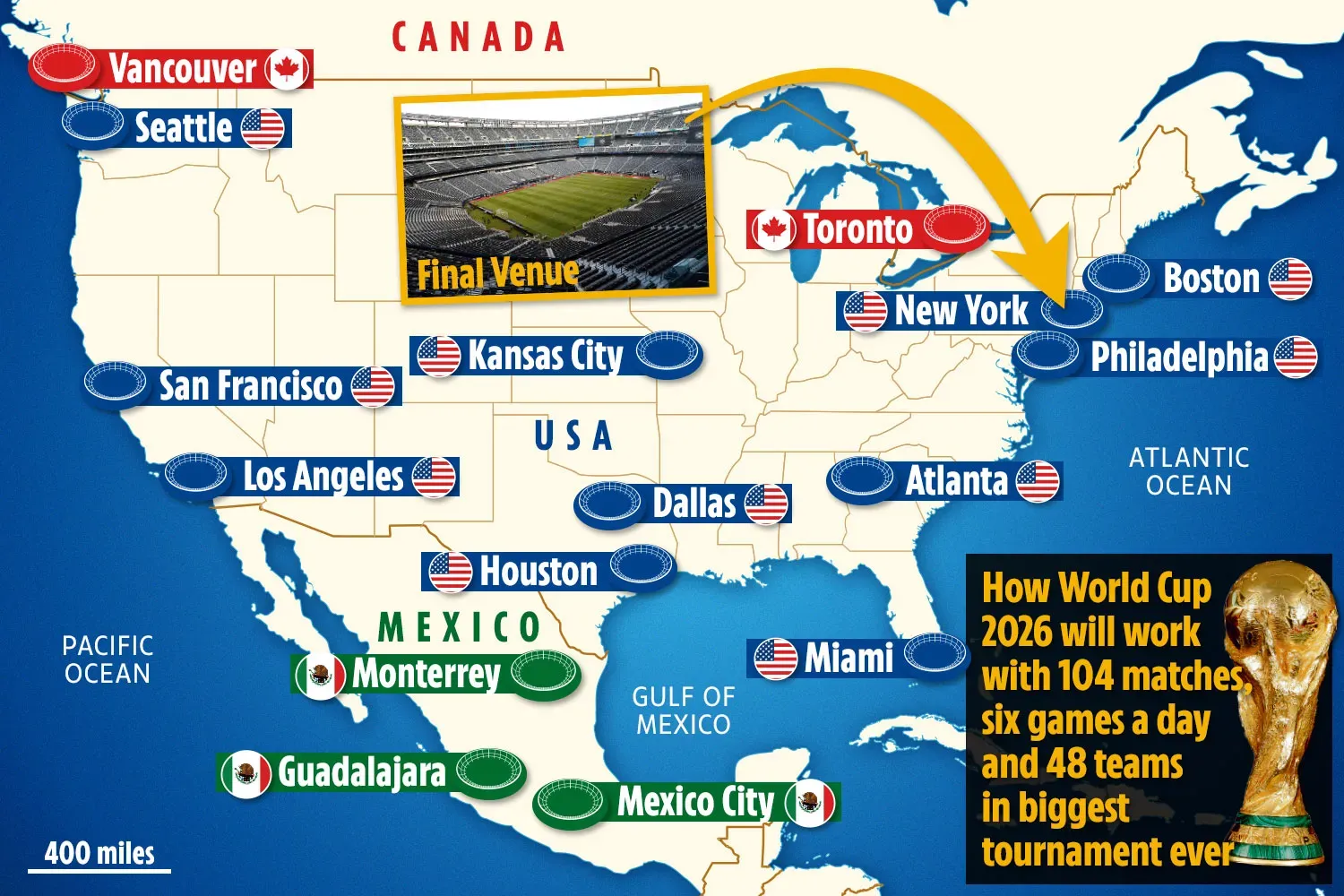
If you are following a specific team through the group stages, your "commute" might involve crossing the Rocky Mountains, the Great Plains, and the US-Mexico border within 72 hours. Relying on last-minute planning is a recipe for exhaustion—and missing the game.
The "Dynamic Surge" Warning: Why Your Budget is at Risk
Unlike Europe or Asia, North American air travel and car rentals operate on highly aggressive dynamic pricing algorithms.
-
The Reality: During the 2026 World Cup, a standard $150 domestic flight could easily spike to $600+.
-
The Strategy: This guide recommends a "Lock-In" strategy. We will show you how to identify "secondary airports" and off-peak transit windows to protect your wallet from the 3x-5x price surges expected in June 2026.
The "No-Car" Pivot: Breaking the North American Stereotype
While the US is famously a "car culture," driving to the stadium on match day is a strategic mistake. Stadiums like SoFi (Los Angeles) and AT&T (Dallas) are surrounded by some of the most congested highways in the world. On a World Cup match day, the "last 3 miles" could take over 90 minutes.
We advocate for the "Park & Ride" and "Stadium Express" models—official transit solutions that use dedicated "Green Lanes" to bypass traffic. If you insist on driving to the stadium gates, be prepared to pay $250+ for parking and sit in gridlock for hours after the final whistle.
The Airline Alliance Hack: Maximize Miles & Hub Efficiency
With host cities spread across 3,000 miles, flying is inevitable. To avoid exorbitant domestic fares, the "Airline Alliance Hack" is your secret weapon. By choosing the best airline for 2026 World Cup travel based on their primary hubs, you can secure better connections and use your miles more effectively.
1. United Airlines (Star Alliance) – The North & Central Corridor
If your matches are in the Northeast or you’re moving between the US and Mexico, United is your strongest bet.
- Primary Hubs: New York/Newark (EWR), Houston (IAH), San Francisco (SFO), and Chicago (ORD).
-
Strategy: Use IAH (Houston) as your gateway to Mexico City and Monterrey. Star Alliance fans should book "Multi-City" tickets to keep their baggage fees unified across partner airlines like Air Canada.
2. American Airlines (oneworld) – The Southern & Sun-Belt Strategy
For fans following teams through Texas, Florida, and the West Coast, American offers the most frequent "Stadium-to-Stadium" connections.
-
Primary Hubs: Dallas/Fort Worth (DFW), Miami (MIA), Philadelphia (PHL), and Los Angeles (LAX).
-
Strategy: DFW is the single most important hub for the 2026 tournament. If you are using miles for World Cup flights, oneworld partners like British Airways or Qatar Airways often have high availability into DFW and MIA.
3. Delta Air Lines (SkyTeam) – The East Coast & PNW Connection
-
Primary Hubs: Atlanta (ATL), Seattle (SEA), and New York (JFK).
-
Strategy: Use Atlanta as your "East Coast Base." It offers direct flights to almost every other host city, making it the perfect spot for last-minute travel if your team advances to an unexpected venue.
Pro Tip: The "Open-Jaw" Booking Advantage Don't book a simple round-trip (e.g., London to New York and back). Instead, book an Open-Jaw ticket: Fly into Vancouver and out of Mexico City. Alliances allow you to do this on a single ticket, often for the same price as a standard round-trip, saving you a 5-hour "backtrack" flight.
Full List of 2026 World Cup Host Cities (Grouped by Country)
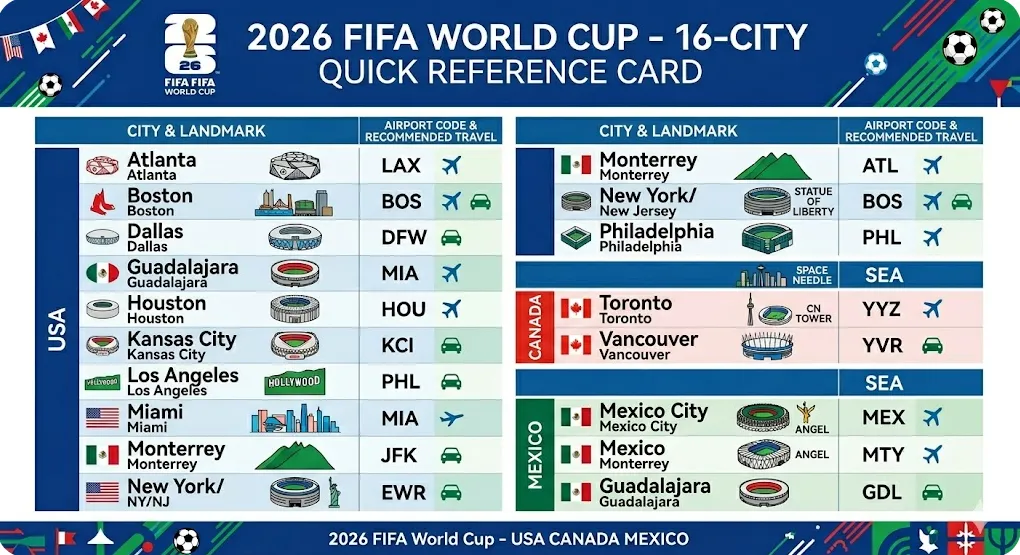
Before diving into the logistics, here is the essential overview of the 16 battlegrounds. This table helps you identify the primary airports and the feasibility of driving in each city.
United States (11 Host Cities)
|
Host City |
Primary Airport |
Driving Suitability |
Key Transit Characteristic |
|---|---|---|---|
|
New York/NJ |
JFK / EWR |
⭐ |
Heavy Rail Focus: Use Meadowlands Rail; avoid driving at all costs. |
|
Los Angeles |
LAX |
⭐⭐⭐⭐ |
Shuttle Dominant: Car is good for the city, but use "Stadium Express" for the match. |
|
San Francisco |
SFO / SJC |
⭐⭐⭐ |
Inter-city Rail: Complex connection between Caltrain and VTA light rail. |
|
Seattle |
SEA |
⭐⭐⭐ |
Walkable Hub: Downtown is connected by a high-efficiency Light Rail system. |
|
Dallas |
DFW |
⭐⭐⭐⭐⭐ |
Car-Dependent: Vast distances; heavy reliance on highways and P+R shuttles. |
|
Houston |
IAH |
⭐⭐⭐⭐⭐ |
Sprawling Hub: Dedicated stadium shuttle lanes are the only way to beat traffic. |
|
Atlanta |
ATL |
⭐⭐⭐ |
Subway Access: MARTA rail provides direct access to the stadium gates. |
|
Boston |
BOS |
⭐⭐ |
Commuter Rail: Historic city with narrow roads; stadium is served by special rail. |
|
Philadelphia |
PHL |
⭐⭐⭐ |
Sports Complex Hub: All major venues are at one terminus of the Subway. |
|
Kansas City |
MCI |
⭐⭐⭐⭐ |
Bus Priority: Heavily reliant on the "Fan Express" shuttle network. |
|
Miami |
MIA |
⭐⭐⭐⭐ |
High-Speed Link: Utilize the "Brightline" train to bridge city and stadium. |
Canada (2 Host Cities)
|
Host City |
Primary Airport |
Driving Suitability |
Key Transit Characteristic |
|---|---|---|---|
|
Toronto |
YYZ |
⭐⭐ |
GO Transit: Highly efficient commuter rail drops you at the stadium doorstep. |
|
Vancouver |
YVR |
⭐⭐⭐ |
SkyTrain Access: World-class automated rail with a station steps from the pitch. |
Mexico (3 Host Cities)
|
Host City |
Primary Airport |
Driving Suitability |
Key Transit Characteristic |
|---|---|---|---|
|
Mexico City |
MEX |
⭐ |
High Density: Use verified ride-hailing (Uber Black); avoid driving yourself. |
|
Guadalajara |
GDL |
⭐⭐ |
Shuttle Focus: Connect from the city center via official tournament shuttles. |
|
Monterrey |
MTY |
⭐⭐⭐ |
App-Based: Uber/Lyft is the standard for safe and reliable stadium access. |
🏆 Top 5 Most Worth Visiting Cities for the 2026 World Cup
| Rank | City | Tag | Match Highlights | Best For |
|---|---|---|---|---|
| 🥇 | Los Angeles | 🎉 Atmosphere King + All-Rounder | Latin fans gather heavily; High chance to see Argentina / Mexico; Possible to watch Lionel Messi in his first World Cup | Fans who want the best atmosphere and vibrant energy |
| 🥈 | New York City | 🌍 International Hub + Best Connectivity | Strong European teams concentrated; Likely to see France / England; High chance to watch Kylian Mbappé | Fans who want to watch many big matches without complicated travel |
|
🥉 |
Mexico City | 🔥 World-Class Football Passion | Extremely intense local atmosphere; Explosive when Mexico plays at home; Possible Argentina/Brazil clashes | Fans who want to experience the purest and most passionate World Cup vibe |
| 🏅 | Dallas | ✈️ Transportation Hub + Match-Heavy | Many group stage matches; Strong teams often rotate squads; Easy to watch multiple games | Fans who want to watch as many matches as possible on a budget |
| 🎉 | Miami | 🌴 Holiday Vibes + Latin Carnival | Strong Latin American fans (especially Argentina/Brazil); Great party and beach atmosphere | Fans who want to combine football with vacation and entertainment |
2026 World Cup Cross-Border Travel & Visa Guide
Crossing borders between the USA, Canada, and Mexico during the World Cup involves strict legal requirements. Failure to have the correct documents will result in denied boarding.
Cross-Border Transportation Modes: How to Move Between Countries
1. USA ⇄ Canada (The Northern Link)
-
Air (Flights):
-
Best Cities: Seattle ⇄ Vancouver (50 mins); NYC ⇄ Toronto (1.5 hours).
-
Pricing: Expect $200-$500 during match weeks.
-
-
Rail (Train):
-
Best Cities: Seattle ⇄ Vancouver (via Amtrak Cascades).
-
Highlight: Incredible Pacific Northwest scenery. It is often more relaxed than airport security.
-
Caution: Expect delays at the border for customs inspection while the train is stationary.
-
-
Bus / Self-Drive:
-
Recommended Route: The I-5 corridor between Seattle and Vancouver.
-
TIPS: Check "One-Way Rental" fees, as dropping a US car in Canada can be extremely expensive ($500+ surcharge).
-
2. USA ⇄ Mexico (The Southern Link)
-
Air (Flights) - STRONGLY RECOMMENDED:
-
Best Cities: Houston/Dallas ⇄ Monterrey/Mexico City (1.5 - 2 hours).
-
Recommended Airlines: Aeroméxico (Full service), Volaris (LCC), Viva Aerobus (LCC), United Airlines, and American Airlines.
-
Pricing: $250-$600. These are the busiest cross-border routes.
-
-
Bus / Self-Drive - NOT RECOMMENDED:
-
Warning: Considering border security and extremely long queues during the tournament (starting from 4 hours+), we strongly advise average fans to avoid land entry into Mexico.
-
Safety Note: Do NOT drive a US rental car deep into Mexico unless you have specific Mexican auto insurance (standard US insurance is invalid).
-
-
The "CBX" Exception:
-
Recommended Route: San Diego ⇄ Tijuana (using the Cross Border Xpress/CBX bridge). This is the only safe/fast land option to catch domestic Mexican flights from Tijuana airport while staying on the US side.
-
3. Canada ⇄ Mexico (The Long Leap)
-
Air (Flights) - ONLY PRACTICAL OPTION:
-
Direct Routes: Toronto ⇄ Mexico City (5.5 hours); Vancouver ⇄ Mexico City (5.5 hours).
-
Recommended Layover Hubs: If direct flights are sold out or too expensive, look for connections in Dallas (DFW), Houston (IAH), or Los Angeles (LAX). These hubs offer the highest frequency of flights into Mexico's host cities.
-
Recommended Airlines: Aeroméxico, Air Canada, United, and American Airlines.
-
Pricing: $400-$800. These are long-haul international flights; book early.
-
-
Logistics: There is no direct land or rail connection between Canada and Mexico that does not transit through the USA.
-
TIPS: If your flight has a layover in the USA, you must meet US entry/transit requirements (Visa or ESTA), even if you never leave the airport for a connecting flight.
2026 World Cup Canada Mexico US Visa Guide
1. The "Hard" Threshold: Mandatory Documents for All
Regardless of your nationality, you must meet these three requirements to enter any host country:
-
Valid Passport: Must be valid for at least 6 months beyond your planned stay.
-
Match Ticket / FIFA ID: While not a visa itself, having your digital match ticket ready is essential for secondary security screenings.
-
Proof of Onward Travel: Border officers will likely ask for your flight/bus ticket out of the country to ensure you aren't overstaying.
2. Visa Requirements by Country
-
United States: Requires a B1/B2 Visitor Visa or an ESTA (for Visa Waiver Program countries). Note: Processing times for US visas can exceed 12 months in some regions—apply now.
-
Canada: Requires a Temporary Resident Visa (TRV) or an eTA (Electronic Travel Authorization).
-
Mexico: Requires a Mexican Visitor Visa. Pro Tip: Travelers with a valid, multiple-entry US Visa can usually enter Mexico for tourism without an additional Mexican visa.
| Nationality Category | United States 🇺🇸 | Canada 🇨🇦 | Mexico 🇲🇽 |
|---|---|---|---|
| Visa Waiver / Exempt Countries (e.g. EU, UK, Japan, Australia, South Korea, etc.) | Visa-Free (up to 90 days) + ESTA required | Visa-Free + eTA required (for air travel) | Visa-Free (up to 180 days) |
| Most Other Countries | B1/B2 Tourist Visa required | Visitor Visa required (or eTA in limited cases) | Visa Required for most nationalities |
| Holders of Valid US / Canada / Schengen Visa | Not applicable (already covered above) | May qualify for eTA in some cases | Often Visa-Free (if the visa is multiple-entry and valid) |
| U.S. & Canadian Citizens | N/A (home country) | Visa-Free | Visa-Free |
|
Nationality |
to US | to CA | to Mexico |
|---|---|---|---|
| US | — | visa-free | visa-free |
| CA | 免签 | — | visa-free |
| Mexico | ❗visa | ⚠️most people visa required | — |
What is the FIFA PASS?
The FIFA PASS is the official digital Fan ID and tournament pass for the 2026 World Cup. It serves as a unified digital identity that bridges your match tickets, personal identification, and host country logistics. It is essentially an evolved version of the "Hayya Card" used in Qatar 2022.
⚠️ CRITICAL WARNING: Ticket ≠ Visa The FIFA PASS is a logistics and fan-experience tool; it is NOT a substitute for a legal visa. Holding a match ticket or a FIFA PASS does not guarantee entry into the host countries. Standard background checks remain extremely strict, and your visa application can still be denied regardless of your ticket status. Always secure your legal travel documents before booking non-refundable transport.
How to Obtain and Operate Your FIFA PASS
The process is entirely digital and managed through the FIFA+ official app:
-
Ticket Linkage: After purchasing tickets through the official FIFA portal, log in to the FIFA+ app using the same credentials. Your tickets will automatically sync.
-
Identity Verification: Upload a high-resolution scan of your passport and a "live" selfie for biometric matching.
-
Cross-Border Integration: Input your visa/ESTA/eTA details. The app will generate a unique encrypted QR code.
-
Digital Wallet: Add the FIFA PASS to your Apple Wallet or Google Pay for offline access at stadium turnstiles and transit readers.
What is Inside the FIFA PASS?
The FIFA PASS is more than just a ticket; it is your "All-Access" key for the summer of 2026:
-
Transit Module: This is the most valuable feature. On match days, your PASS typically grants free or discounted access to the Stadium Express shuttles and local metro systems (e.g., LA Metro, NJ Transit).
-
Customs Acceleration: Integration with MPC (Mobile Passport Control) for faster entry into the US and dedicated "Fan Lanes" at major airports like LAX, JFK, and MEX.
-
Fan Zone Entry: Access to official FIFA Fan Festivals™ and exclusive sponsor activations.
-
Emergency Contact & Alerts: Real-time push notifications for stadium evacuations, transport delays, or match schedule shifts.
Inter-City Travel: How to Hop Between Host Cities
North America is vast. Choosing the right mode of transport between cities can save you thousands of dollars and dozens of hours.
1. ✈️Air Travel: The Backbone of the Tournament
For most fans, flying is the only way to move between distant "clusters" (e.g., moving from Vancouver to Miami).
-
Major Hubs: Use Atlanta (ATL), Dallas (DFW), and Chicago (ORD) as your primary connecting points.
-
Booking Strategy: Airfares will spike. Use Multi-City bookings (Open-jaw) rather than multiple one-way tickets to secure better rates.
-
Regional Carriers: Look into low-cost carriers like Southwest (free checked bags) or JetBlue for regional leaps.
2. Rail Travel: The "Northeast Corridor" Advantage
Train travel is only highly efficient in the Northeast United States and parts of Eastern Canada.
-
The Route: Perfect for hopping between Boston, New York, Philadelphia, and Toronto/Montreal.
-
Amtrak Acela: The closest thing to high-speed rail in the US. It connects downtown hubs directly, avoiding airport security lines.
-
VIA Rail: Use this for the Toronto-Vancouver transcontinental experience (if you have 4 days to spare) or short hops in Ontario/Quebec.
3. Road & Bus: The Regional Clusters
Best for short-distance "Groups of Death" (e.g., Seattle/Vancouver or Texas Triangle).
-
FlixBus & Greyhound: Affordable for budget travelers between cities like NYC and Philadelphia or Seattle and Vancouver.
-
Rental Car Road Trips: Only recommended for regional clusters. Beware of One-Way Drop-off Fees, which can be astronomical during peak events.
2026 World Cup Transportation Comparison helps you to make decision
| Scenario | Flight | Train (Amtrak / VIA) | Bus | Car Rental (Self-Drive) |
|---|---|---|---|---|
| Long-distance (> 500 km) | ⭐⭐⭐⭐⭐ The only sensible choice | ⭐ Way too time-consuming | ⭐ Extremely exhausting | ⭐⭐⭐ Suitable for road trip lovers |
| Short-distance (Same region) | ⭐⭐⭐ Security checks take time | ⭐⭐⭐⭐ City center to city center | ⭐⭐⭐ Best budget option | ⭐⭐⭐⭐⭐ Most flexible |
| Cost-Saving Index | 💰💰💰💰 | 💰💰💰 | 💰 | 💰💰💰 (incl. insurance & fuel) |
| Comfort Level | ⭐⭐⭐⭐ | ⭐⭐⭐⭐⭐ | ⭐⭐ | ⭐⭐⭐ |
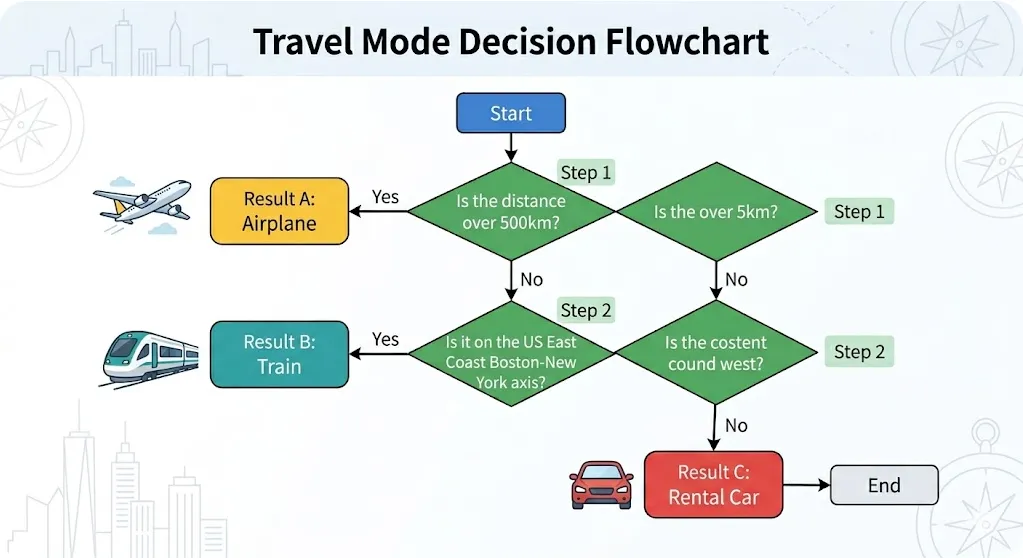
Next Chapter Preview: We will dive into the 16 Host Cities Master Table, categorizing each city into "Transit-Friendly" vs "Car-Centric" and revealing the secret "Stadium Express Hubs."
Recommended Multi-City Travel Routes
[Check FIFA 2026 World Cup standings & schedule]
Planning by "Geographical Clusters" is the most cost-effective way to see multiple matches. Here are three expert-recommended circuits:
1. East Coast Football Circuit (Rail & Short Flights)
Route: Boston → New York/New Jersey → Philadelphia → Miami
-
Logistics: Use Amtrak trains (Northeast Regional or Acela) to move between Boston, NYC, and Philly. These cities are only 1.5 to 4 hours apart by rail. To reach Miami, a quick 3-hour flight from PHL or EWR is necessary.
-
Vibe: High-density historic cities, diverse global fan bases, and the Grand Final venue (NJ).
-
Pro Tip: Buy an Amtrak Multi-Ride Pass early to lock in lower rates for the Northeast corridor.
2. Central USA & Mexico Route (The "Heartland" Leap)
Route: Kansas City → Dallas → Houston → Mexico City
-
Logistics: This is a flight-heavy route. While Dallas and Houston are driveable (4 hours), you should fly between Kansas City and Dallas, and definitely fly to Mexico City. Use United or American Airlines hubs for frequent connections.
-
Vibe: Massive NFL-style stadiums, legendary BBQ culture, and the unmatched passion of Mexico’s Azteca Stadium.
-
Pro Tip: Use a US Visa to enter Mexico to avoid double-visiting embassies.
3. West Coast & Pacific Route (Scenic & Cross-Border)
Route: Seattle → Vancouver → San Francisco Bay Area → Los Angeles
-
Logistics: The Seattle-Vancouver leg is a beautiful 3-hour drive or Amtrak Cascades train ride across the border. To head south to California, fly from Seattle/Vancouver to SFO or LAX (approx. 2.5 hours).
-
Vibe: Stunning Pacific scenery, tech-driven host cities, and the primary base for Team USA.
-
Pro Tip: Rent a car for the Seattle-Vancouver leg to enjoy the scenery, but check the "One-Way Cross-Border" rental policy first.
Best Ways to Travel Between Host Cities & Stadium Access
The 2026 FIFA World Cup is a continental-scale marathon. Navigating between and within the 16 host cities is the ultimate logistical challenge. We have categorized these cities into three distinct "Transit Personas" to help you decide whether to rent a car, hop on a train, or rely on ride-hailing apps.
Category 1: "Car is King" (Driving for Dignity & Sprawling Hubs)
These cities are built for wheels. While public transit exists, the car is the primary mode of survival. However, do not drive to the stadium gates on match day. Use the official Stadium Express hubs listed below.
What is the "Stadium Express"? > In these car-centric cities, the "Stadium Express" is the official tournament shuttle service. These buses operate on dedicated, congestion-free lanes (Green Lanes) to bypass massive highway gridlock. For fans not using a rental car, these shuttles are the only reliable way to reach the stadium gates on time.
|
Host City |
Airport |
Match-Day Secret |
Stadium Express Hub |
Transit Notes |
Match Highlights (Stars/Teams) |
|---|---|---|---|---|---|
|
Los Angeles (US) |
LAX |
Park far; use bike-share or shuttles. |
Hawthorne/Lennox Station |
Metro will deploy 330+ extra shuttle buses to SoFi. |
Team USA HQ; Hollywood star power. |
|
Dallas (US) |
DFW |
Allow 3+ hours for travel; heavy traffic. |
CentrePort Station |
Transfer from TRE rail to the official stadium shuttle. |
Heavyweights: England vs. Croatia type fixtures. |
|
Houston (US) |
IAH |
Rent cars at the airport; inventory is high. |
Fannin South Station |
Use METRORail to reach the official shuttle staging area. |
Mexico / Germany / Portugal likely hubs. |
|
Miami (US) |
MIA |
Rideshare surge is extreme; use private car service. |
Aventura Station |
Best via Brightline high-speed rail then official shuttle. |
Lionel Messi's potential home turf. |
|
Kansas City (US) |
MCI |
Parking is ample but exit takes 2+ hours. |
Downtown P+R Points |
Official "Fan Express" from Power & Light District. |
Argentina / Messi focus matches. |
|
Atlanta (US) |
ATL |
Use the MARTA rail to bypass airport traffic. |
GWCC/CNN Center |
MARTA Blue/Green lines drop you steps from the gates. |
Spain and Southern European seeds. |
Car Rental & Rideshare Survival Tips
-
Avoid the Queue: Airport car rental lines can exceed 2 hours. Register for Hertz Gold or Avis Preferred (usually free) to bypass the counter and go straight to your car.
-
The "1-Hour Rule" for Uber/Lyft: After the match, expect 3x-5x surge pricing. Pro Tip: Grab a meal or hit a nearby bar for 60-90 minutes post-game before calling your ride.
Category 2: "Rail & Metro" (The Traffic-Free Magic)
In these high-density cities, parking is a nightmare ($80-$250). The Subway, Light Rail, and Amtrak are your best friends.
|
Host City |
Airport |
Transit Strategy |
Stadium Express Hub |
Transit Notes |
Match Highlights (Stars/Teams) |
|---|---|---|---|---|---|
|
New York/NJ (US) |
JFK/EWR |
Never Drive. Use NJ Transit. |
Secaucus Junction |
Transfer here for the dedicated Meadowlands Line. |
The World Cup Final; France/Senegal. |
|
Toronto (CA) |
YYZ |
Use TTC Day Pass for best value. |
Exhibition GO Station |
A 5-minute walk to BMO Field. Very efficient. |
Team Canada Opener; Erling Haaland (if qual.). |
|
Vancouver (CA) |
YVR |
SkyTrain is world-class; no car needed. |
Stadium-Chinatown |
Direct SkyTrain access; no additional shuttle required. |
West Coast Hub; Australia / Mexico fans. |
|
Boston (US) |
BOS |
Commuter Rail is the only way. |
South Station / Back Bay |
Dedicated "Stadium Special" trains run on match days. |
Netherlands / England European giants. |
|
Philadelphia (US) |
PHL |
SEPTA is direct and fast. |
NRG Station |
Broad Street Line terminus right at the sports complex. |
Brazil vs. Haiti and other historic draws. |
|
Seattle (US) |
SEA |
Walkable city center; use Light Rail. |
Stadium / Int'l Dist |
Located in the city core; 5-min walk to Lumen Field. |
Belgium / Egypt; Mohamed Salah watch. |
|
San Francisco (US) |
SFO/SJC |
Caltrain is your lifeline to Santa Clara. |
Mountain View / Milpitas |
Caltrain from SF or BART from East Bay + VTA Light Rail. |
Brazil / Japan fan favorites. |
Category 3: The Mexico Trio (The Uber-First Strategy)
Safety and reliability are the priorities here. Avoid unofficial taxis and stick to verified apps.
|
Host City |
Airport |
Strategy |
Safety Warning |
Match Highlights (Stars/Teams) |
|---|---|---|---|---|
|
Mexico City |
MEX |
Uber Only. |
Avoid unofficial cabs; traffic is brutal near Zócalo. |
Opening Match; Massive Mexico home support. |
|
Guadalajara |
GDL |
Uber Comfort. |
Significant road closures; allow extra time for roadblocks. |
Traditional football heartland; high passion. |
|
Monterrey |
MTY |
Hotel Shuttle/Uber. |
High industrial wealth; safe for cross-border road trips. |
Sweden / Tunisia; Northern European seeds. |
Why We Recommend Uber in Mexico
-
Security: Verified drivers and GPS tracking are essential for international visitors.
-
Comfort Level: Always select Uber Comfort or Uber Black. The price difference is minimal compared to the safety and vehicle quality upgrade.
Where to Find Real-Time Stadium Express Updates
Transit policies will shift dynamically based on match schedules and security levels. Stay connected via these three essential channels:
1. The Official FIFA+ App (Primary Source)
FIFA will launch a dedicated "Travel & Logistics" module within the FIFA+ app closer to the tournament. This is the only place where your match ticket will be digitally linked to your transit passes (similar to the "Hayya Card" in Qatar).
-
What to check: Real-time shuttle frequency, "Stadium Express" terminal maps, and emergency transit alerts.
2. Host City Official "Fan Guide" Websites
Each city has a dedicated World Cup portal managed by local organizing committees, ex: losangeles2026.com or nycnj2026.com. These sites provide granular details on local rail schedules and road closures:
-
Example (NY/NJ): Search for "Host City NYNJ World Cup Transport."
-
Example (LA): Monitor the "Metro.net" World Cup special bulletin.
3. Real-Time Social Media X (formerly Twitter) Alerts
During match days, local transit authorities use X for minute-by-minute updates. Follow these handles now:
-
@NJTransit (For NYC/NJ matches)
-
@LAmétro (For LA SoFi Stadium matches)
-
@TTChelps (For Toronto matches)
City Personas & "The Last Mile" Alert
Do NOT drive to the stadium on match days. Use the official Stadium Express shuttles. However, be prepared: "getting there" doesn't always mean "getting to the gate."
|
City Category |
Host Cities |
Core Strategy |
Walking Distance Alert |
|---|---|---|---|
|
Car-Centric |
LA, Dallas, Houston, Miami, Atlanta, Kansas City |
P+R Mode: Park at a city hub and take the official shuttle. |
🔴 LONG: 15–25 min walk from the drop-off point. |
|
Transit-Friendly |
NY/NJ, Boston, Philly, Toronto, Vancouver, Seattle, SF |
Rail First: Use dedicated match-day trains/metros. |
🟡 MODERATE: 5–10 min walk from the station. |
|
Mexico Trio |
Mexico City, Guadalajara, Monterrey |
App-First: Use Uber Comfort/Black or official fan shuttles. |
🟢 SHORT: Drop-offs are usually closer to the gate. |
⚠️Critical Warning⚠️
For fans traveling with children, the elderly, or those with mobility issues, the "Last Mile" is often the most exhausting part of the day:
-
Los Angeles (SoFi) & Dallas (AT&T): Due to massive security perimeters, even if you take the Stadium Express, you will be dropped off 1.2 to 2 kilometers (0.7–1.2 miles) away from your gate. This walk often includes steep ramps and stairs.
-
San Francisco (Levi's): The light rail station requires a 15-minute walk through an open, sun-exposed security zone with no shade.
-
Advice: Wear professional walking shoes. If you have mobility needs, check the official app to pre-reserve ADA Assistance (golf cart shuttles) inside the stadium complex.
How to Save Money During 2026 World Cup Travel
The 2026 World Cup will be the most expensive sporting event in history. Use these four strategies to protect your wallet.
1. Early Flight Booking Strategies
-
The "330-Day" Rule: Most major US and Canadian airlines open their booking windows 330 days in advance. Be ready to book the moment the window opens for your match dates.
-
Fly to "Secondary" Cities: If flights to Los Angeles (LAX) are too expensive, look at Burbank (BUR) or Ontario (ONT). For New York, check Philadelphia (PHL) or Baltimore (BWI) and take a train in.
-
Open-Jaw Tickets: Instead of two one-way tickets, book a "Multi-City" itinerary (e.g., Fly into Seattle, out of Los Angeles).
2. City-Pass and Transit Cards
-
Day Passes vs. Pay-per-Ride: In cities like Vancouver or Toronto, a "Day Pass" often pays for itself after just three trips.
-
Regional Rail Passes: If you are following the East Coast Circuit, look for Amtrak Multi-Ride passes or regional bus bundles (FlixBus) which offer significant discounts over individual tickets.
-
Digital Bonus: Some cities offer "Fan Discounts" through the FIFA PASS—always check the app before tapping your credit card.
3. Hotel vs. Airbnb Comparisons
-
The "Commuter Town" Strategy: Don't stay in Manhattan or Downtown LA. Stay in satellite towns connected by rail (e.g., stay in New Brunswick, NJ for NY matches, or Bellevue for Seattle matches).
-
Hotel Loyalty Points: Now is the time to accumulate Marriott, Hilton, or Hyatt points. Standard "Point Redemptions" often stay the same even when cash prices triple during events.
-
Airbnb Caution: Be wary of new hosts with zero reviews appearing just for the World Cup; "Last-minute cancellations" are common when hosts try to re-list for higher prices. Stick to "Superhosts."
4. Group Travel Discounts
-
Ride-Share Pooling: If traveling with 4+ people, always order an Uber XL. It is almost always cheaper than two standard Ubers.
-
Group Train Tickets: Amtrak and VIA Rail often offer "Group Companion" discounts where the 3rd or 4th passenger travels at a 25-50% discount.
-
Split the Drive: For clusters like Seattle-Vancouver, a single SUV rental split between 5 fans is significantly cheaper than 5 bus or train tickets.
Essential Apps & Tools for Fans: Digital Survival Kit
1. Flight Tracking & Comparison
-
Google Flights / Skyscanner: Essential for comparing "Secondary Airport" prices across different dates.
-
FlightAware: Best for real-time tracking. Use the "Where is my plane?" tool to predict delays before they hit the airport monitors.
2. Smart Transit & Navigation
-
Transit (App): The best aggregator for Stadium Express shuttles and metros in LA, Dallas, and Seattle.
-
Citymapper: Superior for subway-heavy cities like NYC, Toronto, and Vancouver.
-
Official Metro Apps: Download NJ Transit (NY), LA Metro, or PRESTO (Toronto) to use contactless mobile tickets.
3. Parking & Driving
-
SpotHero / ParkWhiz: Critical for "Car-Centric" cities. Book stadium-area parking weeks in advance to avoid $200+ match-day drive-up rates.
-
Waze: Often more accurate than Google Maps for real-time match-day road closures and fan-zone traffic.
4. Customs & Border Efficiency
-
MPC (Mobile Passport Control): The secret weapon for international fans. Use it at JFK, LAX, or YYZ to skip 80% of the standard US Customs line.
-
CBP BWT: Real-time wait times for Seattle-Vancouver and San Diego-Tijuana land borders.
5. Travel Commands & Connectivity
-
TripIt: Automatically syncs your 16-city itinerary (flights, hotels, tickets) into one master view.
-
Airalo / Holafly: For eSIMs. Get a "North America" plan to stay connected in USA, Canada, and Mexico without changing SIMs.
Weather-Ready Transit: Preparing for the North American Extremes
The 2026 World Cup will be a tournament of contrasts. Moving between host cities means transitioning from tropical humidity to temperate rain within hours. Your transit comfort depends on knowing what to wear for PNW matches versus surviving the midday sun in Mexico.
1. Surviving the Southern Heat (Monterrey, Guadalajara, Houston, Miami)
-
The Challenge: High temperatures and extreme humidity are standard in June. Waiting for "Stadium Express" shuttles at midday or walking the "last mile" to the gates can be physically draining.
-
The Fix: When traveling in Mexico heat World Cup matches, hydration is non-negotiable. Carry a reusable, collapsible water bottle. While stadium policies vary, most major US and Mexico venues will have hydration stations. Wear breathable, moisture-wicking fabrics and a wide-brimmed hat.
-
Transport Tip: Opt for air-conditioned Metro or light rail lines over open-air walking routes whenever possible.
2. The Cool & Damp Pacific Northwest (Vancouver, Seattle, Toronto)
-
The Challenge: June in the PNW and Canada can be surprisingly chilly and prone to sudden rain showers.
-
The Fix: Layering is essential. When deciding what to wear for PNW matches, think light waterproof shells over a jersey. Remember that umbrellas are often banned inside stadiums, so a high-quality poncho is a much better choice for both the transit commute and the stands.
3. High Altitude & Sun Exposure (Mexico City)
-
The Challenge: Mexico City sits at an altitude of 7,300 ft (2,240m). The sun is much stronger than it feels, and the thin air can lead to quick exhaustion.
-
The Fix: Apply high-SPF sunscreen even on cloudy days and double your hydration levels during your transit commute to avoid altitude sickness.
FAQ: Frequently Asked Questions
Q: Does holding a match ticket grant me a visa for the host country?
A: No. Unlike the 2022 Qatar World Cup, a match ticket or the FIFA PASS is NOT a visa substitute. You must apply for US, Canada, or Mexico visas/entry permits (ESTA/eTA) separately following standard legal procedures.
Q: Can I drive my US rental car across the borders into Canada or Mexico?
A: USA to Canada: Generally yes, but check for "cross-border surcharges" and ensure your insurance covers Canada. USA to Mexico: Strongly discouraged. Most US rental agreements forbid entering Mexico, and standard US insurance is invalid there. Land border queues will also exceed 4 hours.
Q: Will public transit be free for ticket holders?
A: It varies by city. Some host cities will offer free "Stadium Express" shuttles or discounted day passes via the FIFA PASS, but cities like New York and Boston have already discussed "Dynamic Surcharges" where event-day rail tickets could cost significantly more than usual.
Q: What is the best way to move between East Coast cities like New York, Philly, and Boston?
A: Amtrak (Acela or Northeast Regional). This is faster and more reliable than flying for these short distances. It drops you in city centers, avoiding the massive security and commute times of airports like JFK or BOS.
Q: Is it safe to use public transport in the Mexico host cities late at night?
A: While metros in CDMX are efficient, it is highly recommended to use Uber Comfort or Uber Black for post-match travel late at night. These services provide GPS tracking and verified drivers, which is the gold standard for fan safety in the region.
Q: Why should I use "Secondary Airports" for my flights?
A: Major hubs like LAX, JFK, and DFW will experience extreme congestion and price surges. Airports like Burbank (BUR) for LA, Ontario (ONT) for SoCal, or Baltimore (BWI) for the East Coast often have lower demand and better regional rail connections, saving you hours of terminal gridlock.
The 2026 World Cup is more than a tournament; it’s a cross-continental adventure. Across 16 cities and 3 nations, your success depends on one thing: Proactive Planning.
Don't let gridlock or border queues stand between you and the opening whistle. Lock in your "Stadium Express" routes, download your digital transit cards early, and use tools like MPC to breeze through customs.
North America is vast, but with the right strategy, the journey is as epic as the game itself. See you at the kick-off!